
Medicare Part D isn’t just a prescription drug benefit-it’s a massive economic engine built on one simple idea: generics save money. Since its launch in 2006, the program has saved over $1.37 trillion by steering beneficiaries toward lower-cost generic medications. But how does it actually work? And why do some people still pay too much-even when generics are available?
How Part D Uses Tiers to Push Generics
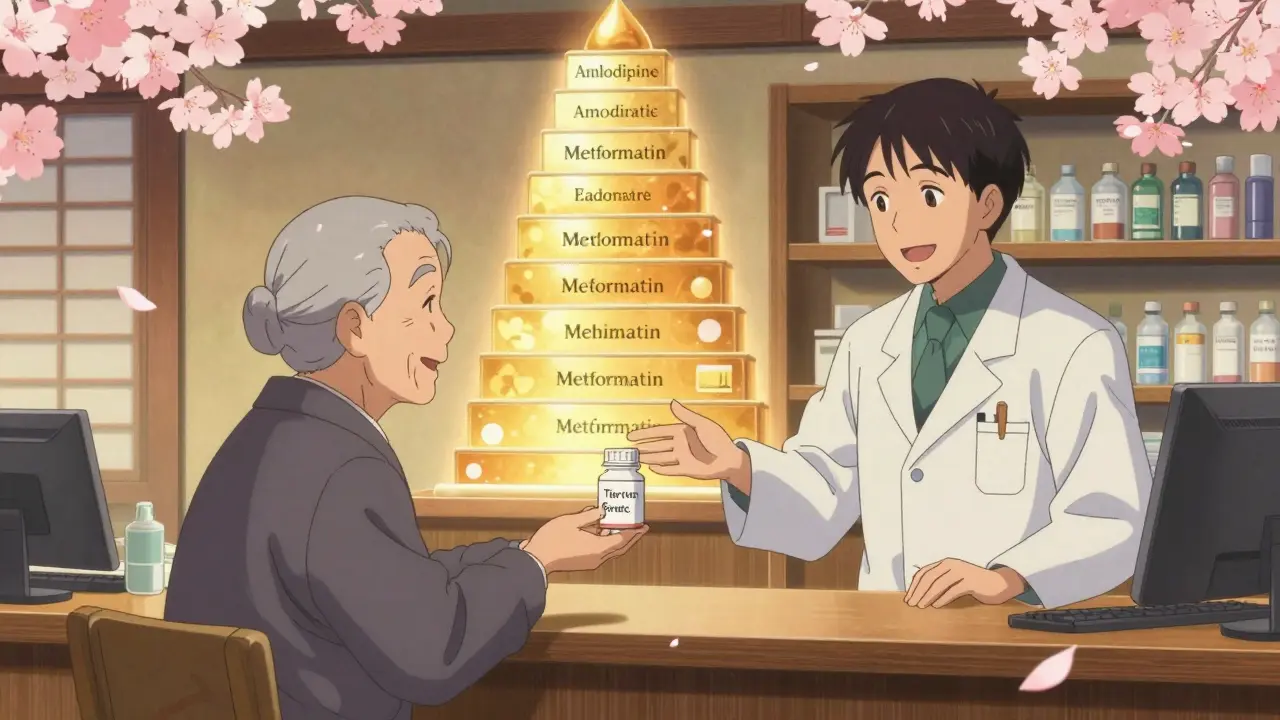
Every Medicare Part D plan uses a tiered formulary to control costs. Think of it like a pricing ladder. At the bottom is Tier 1: Preferred Generics. These are the cheapest drugs, often with $0 to $10 copays for a 30-day supply. Most plans put common medications like amlodipine (for blood pressure), metformin (for diabetes), and lisinopril (for heart conditions) here. The goal? Make it easier and cheaper to choose the generic version. Above Tier 1 is Tier 2: Generics. These still cost less than brand names, but slightly more-around $15 on average. Then come Tier 3 (preferred brand names), Tier 4 (non-preferred brands), and Tier 5 (specialty drugs). The structure is intentional: the lower the tier, the more the plan wants you to use that drug. By 2023, 87.3% of all Part D prescriptions were for generics. That’s up from just over 50% when the program started. Why? Because the financial incentive is strong. If you pick a Tier 1 generic instead of a Tier 3 brand name, you could save $45 to $75 per month. That’s over $1,500 a year on a single medication.Generics vs. Brand Names: The Real Cost Difference
The numbers don’t lie. According to Medicare Payment Advisory Commission (MedPAC), generic drugs cost Part D plans just $18.75 per prescription on average. Brand-name drugs? $156.42. That’s 88% cheaper. But here’s the twist: even though generics make up nearly 9 out of 10 prescriptions, they only account for 24.1% of total drug spending. Brand names, at just 12.7% of prescriptions, make up 75.9% of the bill. Why? Because some brand-name drugs are insanely expensive. A single dose of a specialty drug for multiple sclerosis or cancer can cost hundreds or even thousands of dollars. Generics, even if they’re for complex conditions, stay cheap. For example, the generic version of the immunosuppressant mycophenolate costs under $20 a month. The brand name? Over $1,000. This is why Part D plans push generics so hard. They’re not just helping beneficiaries-they’re keeping the whole program from exploding in cost. The Congressional Budget Office estimates generic use saves the federal government $14.2 billion a year in subsidies and catastrophic coverage payments.How the ‘Donut Hole’ Changed Everything
For years, the biggest problem in Part D was the coverage gap-nicknamed the “donut hole.” Once you spent $4,430 in 2023 (now $2,000 in 2025), you had to pay 100% of drug costs until you hit catastrophic coverage. That hit hard, especially for people on multiple medications. The Bipartisan Budget Act of 2018 and the Inflation Reduction Act of 2022 changed that. Now, in the coverage gap, you pay only 25% of the negotiated price for both brand and generic drugs. But here’s the key: generics are cheaper to begin with, so 25% of $20 is $5. Twenty-five percent of $500 is $125. That’s why generics became even more attractive. And now, with the $2,000 annual out-of-pocket cap starting in 2025, the incentive to use generics is stronger than ever. Once you hit that cap, you pay nothing for the rest of the year. If you’re on a high-cost brand-name drug, you’ll hit that cap faster. But if you’re on generics, you’ll spend less overall-and may never reach the cap at all.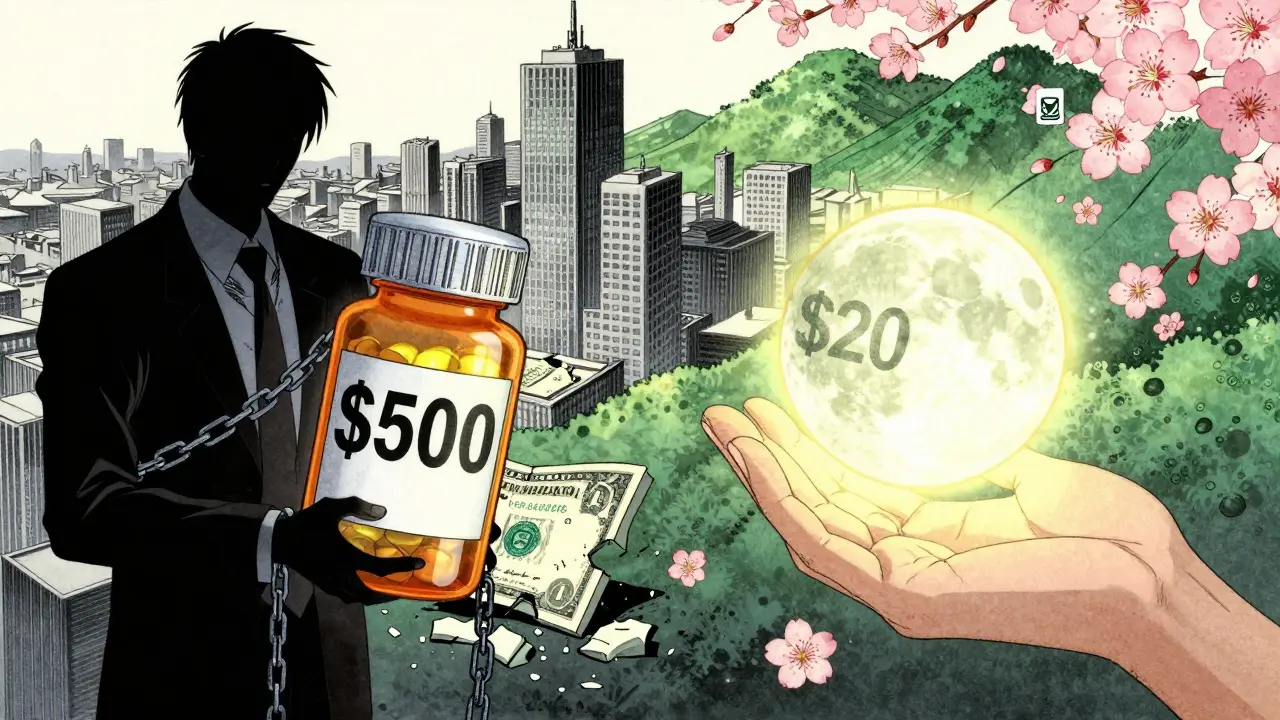
Why Some Generics Still Cost Too Much
It’s not all smooth sailing. Not all generics are treated equally. Some specialty generics-like those for rheumatoid arthritis or HIV-are placed in higher tiers, even though they’re chemically identical to cheaper versions. A 2023 CMS report found that 63.2% of beneficiaries would pay more if they switched plans without checking formularies. Also, some plans don’t accept manufacturer coupons for brand-name drugs. That means if your doctor prescribes a brand-name drug with a $50 coupon, you might still pay full price under Part D. But if you switch to the generic, you pay $0. One Reddit user, u/MedicareUser87, said their blood pressure generic costs $0, while the brand (Norvasc) was $45. That’s not a fluke-it’s standard. Another issue: automatic substitution. Pharmacists are often allowed to swap a brand for a generic unless the doctor writes “dispense as written.” That’s good if the generic works. But if you have a reaction-even a mild one-you’re stuck. About 58.6% of generic fills happen this way, according to CMS.How to Get the Best Generic Coverage
You don’t have to guess. Here’s how to make sure you’re getting the best deal:- Use the Medicare Plan Finder during Annual Enrollment Period (Oct 15-Dec 7).
- Search for your exact medications-both brand and generic.
- Filter for plans with $0 copays on Tier 1 generics at your preferred pharmacy.
- Check if your drugs require prior authorization-even if they’re generic.
- Look at the total annual cost, not just the monthly premium.
The Big Players Behind the Generics
The generic drug market isn’t made up of small companies. It’s dominated by three giants: Teva, Mylan, and Sandoz. Together, they control 63.2% of the Medicare Part D generic market. That means if one of them raises prices, it affects millions. But there’s good news. The Inflation Reduction Act now requires drugmakers to pay rebates if generic prices rise faster than inflation. In 2023, 14.7% of generic drugs actually dropped in price-up from just 8.3% in 2022. That’s the first real check on generic inflation in years.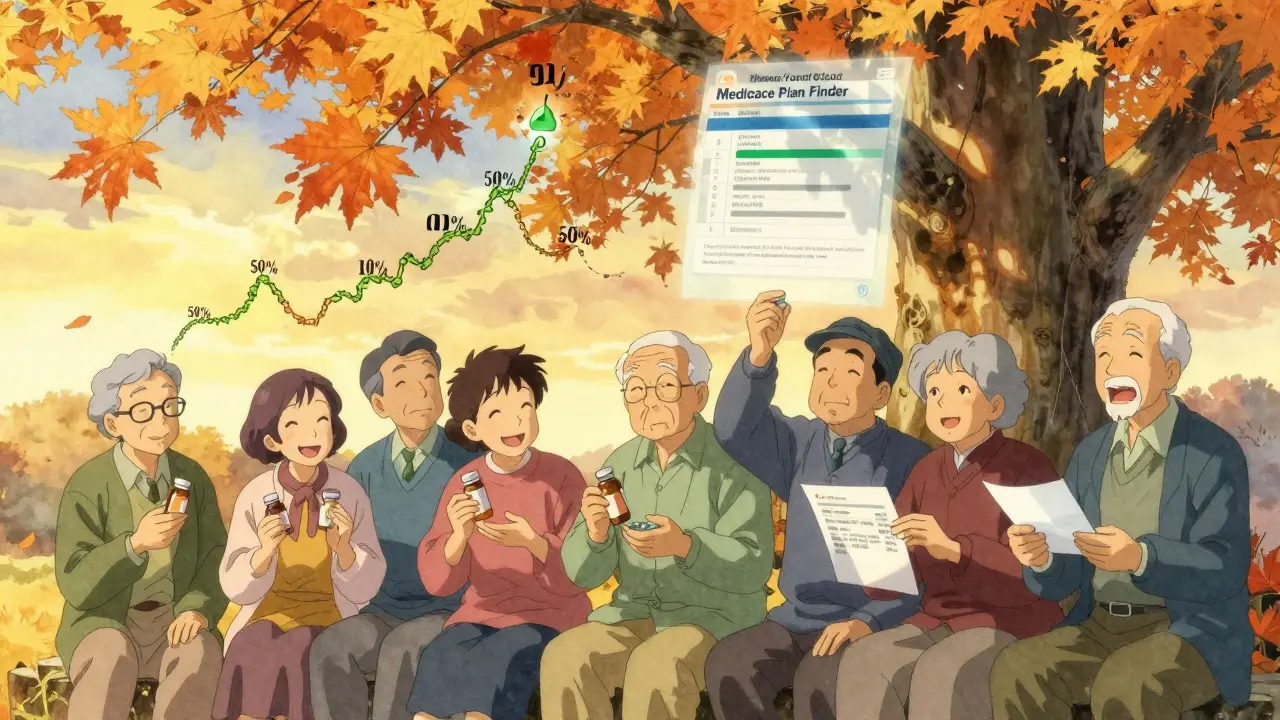
What’s Coming Next
Starting January 1, 2025, a new rule called the Manufacturer Discount Program kicks in. Drugmakers must give extra discounts on certain drugs during both the initial coverage phase and catastrophic phase. The Congressional Budget Office expects this to push generic use up another 3.2 percentage points by 2026. Also, CMS now requires every therapeutic category to have at least one generic drug available without prior authorization. That’s a direct fix for a problem the Medicare Rights Center highlighted in 2023: patients stuck waiting for approval just to get a generic. By 2030, experts predict 91.5% of Part D prescriptions will be generics. That’s the only way the program stays solvent. The Medicare Trustees Report says Part D’s trust fund will last through 2093-if generic use keeps rising at its current pace.Real People, Real Savings
On Medicare.gov, SilverScript scores 4.6 out of 5 stars-mostly because users love its $0 generic copays. One reviewer wrote: “I take five generics. My total monthly cost is $12. I used to pay $180 before switching.” But not everyone wins. A September 2023 KFF analysis found that 32.1% of low-income beneficiaries still skip doses because of cost-even when generics are available. The problem isn’t always the price of the drug. It’s the complexity of the system. Formularies change mid-year. Pharmacies drop coverage. Copays go up. The solution? Stay informed. Check your plan every year. Use the Plan Finder. Ask your pharmacist. If something seems off, file a complaint with CMS. You’re not alone-and you’re not powerless.Are all generic drugs the same under Medicare Part D?
No. While all generics contain the same active ingredient as brand-name drugs, they can differ in fillers, coatings, or release timing. More importantly, Part D plans put generics in different tiers based on cost and negotiation. A generic in Tier 1 might cost $0, while an identical generic in Tier 3 could cost $25. Always check your plan’s formulary to see which tier your drug is in.
Why does my generic cost more than last year?
Your plan may have moved the drug to a higher tier, or the manufacturer raised the price. Part D plans change formularies every year. Sometimes, a generic that was in Tier 1 gets bumped to Tier 2 because the plan negotiated a better deal with a different generic maker. Always review your plan’s annual notice of changes-usually sent in October.
Can I get brand-name drugs covered if the generic doesn’t work for me?
Yes. If a generic causes side effects or doesn’t control your condition, you can request a “coverage determination” from your plan. You’ll need a letter from your doctor explaining why the generic won’t work. CMS approves these requests 78.4% of the time. Don’t assume you’re stuck-ask for an exception.
Do all Medicare Part D plans have the same generic coverage?
No. Standalone Prescription Drug Plans (PDPs) tend to cover slightly more generics than Medicare Advantage plans with drug coverage (MA-PDs). In 2022, PDPs covered 92.4% of generics on their formularies, while MA-PDs covered 89.7%. Always compare plans side-by-side using Medicare.gov’s Plan Finder tool.
Is there a limit to how many generics I can get per month?
No, there’s no monthly limit on the number of generic prescriptions you can fill. But some plans may restrict early refills-for example, you might not be able to refill a 30-day supply until day 25. This isn’t about generics vs. brands; it’s a standard pharmacy rule to prevent waste and misuse.


Ajay Sangani
December 24, 2025 AT 03:04so generics are cheaper but sometimes they make me feel weird like my brain is on slow mo lol idk if its the fillers or just my mind playing tricks but i swear one brand feels smoother even if its the same chem stuff
Diana Alime
December 24, 2025 AT 08:31i just take whatever the pharmacist gives me and hope for the best 🤷♀️ also why do they always run out of the $0 ones???
Chris Buchanan
December 25, 2025 AT 19:42Wow. So you’re telling me the system is designed so that if you’re rich enough to afford brand names, you’re basically subsidizing the rest of us? And we’re supposed to be grateful? 😏
claire davies
December 26, 2025 AT 07:13Oh my dear, this is such a beautifully layered issue - like a Victorian novel written by a pharmacist with a sense of humor. The tiered system? It’s not just economics, it’s a social ballet. You step lightly on Tier 1, tiptoe past Tier 2, and if you dare land on Tier 5? Darling, you’ve entered the opera of pharmaceutical royalty. And yet, the real tragedy isn’t the price - it’s the confusion. One week your generic is $0, next week it’s $25 because someone in a cubicle in Ohio decided to renegotiate with Teva. I once cried over a $12 copay for metformin. Don’t judge me. We’ve all been there.
Bhargav Patel
December 28, 2025 AT 04:59The economic architecture of Medicare Part D is a fascinating case study in incentive alignment. The system leverages behavioral economics by making the optimal choice - the generic - not only cheaper but also structurally effortless. The tiered formulary functions as a nudge, not a mandate. It does not coerce; it entices. And yet, the persistent disparities in access reveal a deeper structural flaw: the assumption that information asymmetry can be remedied solely through digital tools like the Plan Finder. In rural India, where I grew up, elders would walk five miles to a pharmacy, only to be told the generic was 'out of stock' - a euphemism for 'not profitable.' The real innovation isn’t the tier system - it’s the cultural and institutional trust that must precede its success.
Rosemary O'Shea
December 29, 2025 AT 13:11How is it possible that in the 21st century, we’re still debating whether a pill with the same active ingredient should cost 50x more? Honestly, this isn’t healthcare - it’s a performance art piece titled 'The Capitalist Pharmacy.' I’m not surprised. The FDA approves generics as bioequivalent, but the pharmaceutical lobby? They treat bioequivalence like a suggestion. And don’t even get me started on those 'specialty generics' - what a farce. If it’s the same molecule, why is it suddenly 'premium'? It’s not science. It’s sociology dressed in white lab coats.
Bartholomew Henry Allen
December 30, 2025 AT 21:23Generics save billions. That’s facts. America wins. We outsmarted the drug companies. No other country does this. Stop complaining. We built this system. It works. You want cheaper? Move to Canada. We don’t need your whining. The system isn’t perfect - it’s perfect for America.
Pankaj Chaudhary IPS
December 31, 2025 AT 17:08As a public servant who has seen healthcare systems from Delhi to Dublin, I must commend the ingenuity of Medicare Part D’s tiered structure. It is not merely an economic mechanism - it is a moral instrument. By incentivizing generics, we affirm that dignity in healthcare does not require extravagance. Yet, we must also recognize that equity is not achieved by formularies alone. The real challenge lies in ensuring that every citizen, regardless of digital literacy or geographic isolation, can access this knowledge. Let us not mistake efficiency for justice. Let us build bridges - not just tiers.
Wilton Holliday
December 31, 2025 AT 17:52Y’ALL. I just switched to a plan with $0 generics and my monthly bill dropped from $210 to $18. I cried. I called my mom. I posted a TikTok. 😭💖 You guys, it’s not magic - it’s just knowing where to look. Use the Plan Finder. Don’t wait. Your wallet will thank you. And yes, your pharmacist can change your drug without asking - but you can ask them to NOT change it. Just say the words: 'I need this exact one.' You got this!
Raja P
January 1, 2026 AT 10:14my grandma’s on 6 generics and pays $3 a month. she says 'if it don’t kill me, it’s good enough.' i laugh but she’s right. just check your plan every year, man. no one’s gonna do it for you.
Joseph Manuel
January 1, 2026 AT 14:25Let’s be clear: the 87.3% generic utilization rate is a statistical mirage. It ignores the fact that the majority of spending is concentrated in the 12.7% of brand-name prescriptions. The system is not designed to reduce overall cost - it is designed to obscure it. The real problem is not the tier system - it is the lack of price transparency and the systemic collusion between PBMs and manufacturers. Until we break the rebate system and cap wholesale prices, we are merely rearranging deck chairs on the Titanic.
Adarsh Dubey
January 2, 2026 AT 05:55Interesting how the same drug can cost $0 or $25 depending on which box it’s in. Makes you wonder if the 'active ingredient' is really the only thing that matters. Or if the real active ingredient is the insurance company’s contract with the distributor.