

Clopidogrel-PPI Interaction Checker
This tool helps you understand whether your proton pump inhibitor (PPI) is safe to take with clopidogrel. Based on clinical evidence, certain PPIs can significantly reduce clopidogrel's effectiveness, increasing your risk of blood clots.
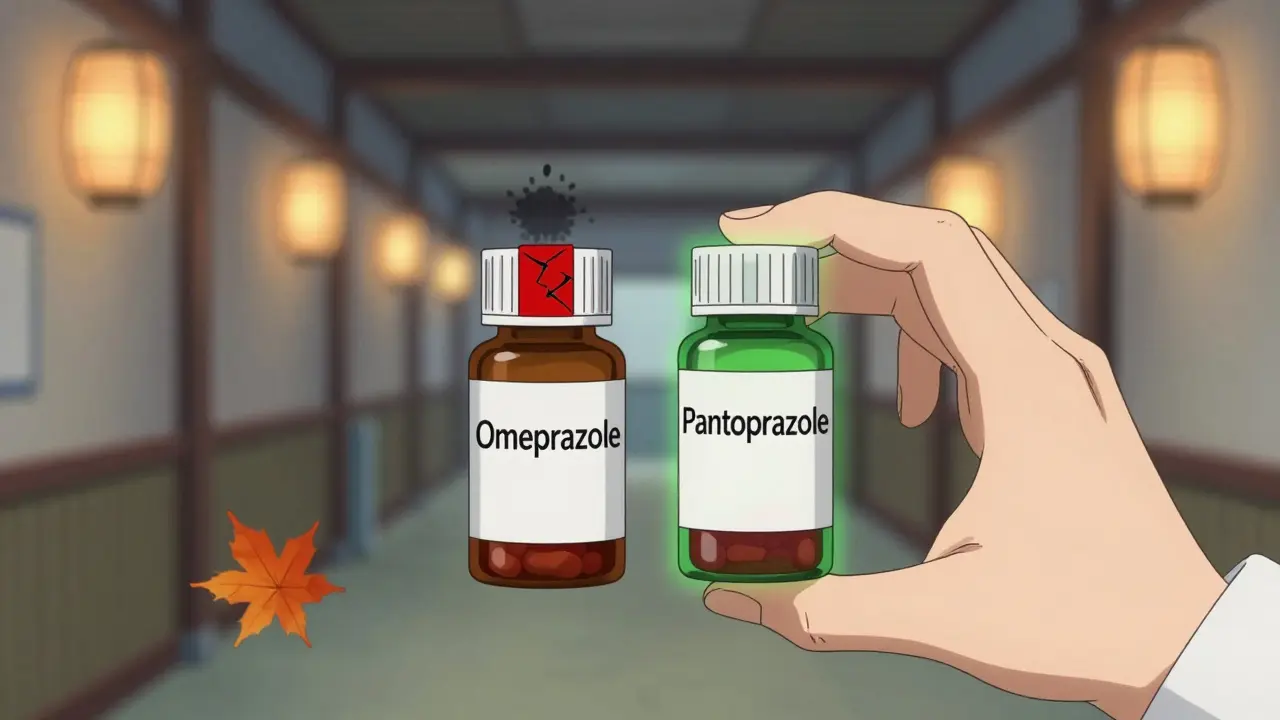
The safest options are pantoprazole and rabeprazole. Omeprazole and esomeprazole should be avoided.
When you're on clopidogrel after a heart attack or stent placement, your doctor prescribes it to stop your blood from clotting too easily. But if you also have stomach issues - which many people do - you might be told to take a proton pump inhibitor (PPI) like omeprazole to protect your gut. Sounds logical, right? Except here's the problem: omeprazole can seriously weaken clopidogrel’s ability to work. And not just a little - we’re talking about cutting its effect by nearly half in some cases.
How Clopidogrel Actually Works
Clopidogrel isn’t active when you swallow it. It’s a prodrug, meaning your liver has to turn it into something else before it does anything. That something is its active metabolite, and it’s made mostly by one enzyme: CYP2C19. Once made, this metabolite sticks to platelets and blocks them from clumping together. That’s how it prevents heart attacks and strokes. If that enzyme doesn’t do its job, clopidogrel might as well be sugar pills.
Now, here’s where PPIs come in. Some of them - especially omeprazole and esomeprazole - are strong inhibitors of that same CYP2C19 enzyme. They don’t just slow it down; they block it. So when you take omeprazole at the same time as clopidogrel, your liver can’t make enough of the active drug. The result? Platelets stay sticky. Blood clots become more likely. And that’s dangerous when you’re on clopidogrel for a reason.
The Evidence Isn’t Just Theoretical
In 2009, researchers published a study that changed how doctors think about this combo. They measured platelet activity in people taking clopidogrel with or without omeprazole. Those on omeprazole had platelet reactivity that was 25% higher - meaning their blood was clotting more easily. That’s not a small difference. It’s the kind of change you’d expect if someone skipped their dose entirely.
One patient in the study had his platelet inhibition drop from 80% down to just 8% after starting omeprazole. Even when the doses were spaced 12 hours apart, the effect didn’t go away. That’s because the interaction isn’t about timing - it’s about the enzyme being blocked. Omeprazole doesn’t just hang around; it latches onto CYP2C19 and keeps it offline for hours.
Other studies confirmed it. One showed omeprazole cut the concentration of clopidogrel’s active form by 47%. Another found that people on this combo had a 50% higher risk of having another heart attack or dying. The FDA issued a safety warning in 2009. The European Medicines Agency followed with a label update. This wasn’t speculation - it was measurable, repeatable, and dangerous.
Not All PPIs Are Created Equal
Here’s the good news: not every PPI does this. The problem isn’t PPIs in general - it’s specific ones. Omeprazole and esomeprazole are the worst offenders. They bind tightly to CYP2C19. Lansoprazole? A bit weaker. Pantoprazole and rabeprazole? Almost no effect.
Studies show that when patients switched from omeprazole to pantoprazole, their platelet inhibition stayed in the therapeutic range - around 35-45%. With rabeprazole? Same thing. Even better, a 2023 review by the NHS Specialist Pharmacy Service concluded that pantoprazole and rabeprazole carry no increased cardiovascular risk. Their hazard ratios were practically 1.0 - meaning no added danger.
Here’s a quick comparison:
| PPI | CYP2C19 Inhibition Strength | Effect on Clopidogrel | Recommended with Clopidogrel? |
|---|---|---|---|
| Omeprazole | Strong (Ki = 2-6 μM) | Reduces active metabolite by up to 47% | No |
| Esomeprazole | Strong (similar to omeprazole) | Significant reduction in antiplatelet effect | No |
| Lansoprazole | Moderate | Mild to moderate reduction | Use with caution |
| Pantoprazole | Weak (Ki > 20 μM) | No clinically significant effect | Yes |
| Rabeprazole | Very weak | No measurable impact | Yes |
So if you’re on clopidogrel and need a PPI, don’t panic. Just make sure it’s not omeprazole or esomeprazole. Pantoprazole or rabeprazole are safe alternatives. In fact, a 2019 survey of U.S. cardiologists found that 72% of them already prefer pantoprazole for this exact reason.
Why This Matters for Your Health
Let’s say you had a stent put in after a heart attack. You’re on clopidogrel and aspirin - dual antiplatelet therapy. You’re also 78 years old, have a history of ulcers, and take ibuprofen for arthritis. Your GI bleeding risk? More than 13 times higher than someone without those factors.
Without a PPI, your chance of a dangerous bleed is real. But with omeprazole? You might be trading one risk for another: a clot instead of a bleed. That’s why guidelines from the American College of Gastroenterology say PPIs reduce GI bleeding risk by 69% in people on dual therapy. The problem isn’t whether to use a PPI - it’s which one.
The data is clear: if you use the wrong PPI, you increase your chance of another heart attack. If you use the right one, you protect your stomach without hurting your heart. It’s not a trade-off - it’s a choice between two safe options.
What Doctors Are Doing About It
Since 2010, inappropriate co-prescribing of omeprazole with clopidogrel has dropped from over 20% to under 9% in the U.S. Why? Because doctors learned. Guidelines updated. Pharmacies started flagging the interaction. Insurance systems now block automatic refills of omeprazole for patients on clopidogrel.
But the change hasn’t been uniform. In Europe, about 65% of high-risk patients get a PPI. In the U.S., it’s 82%. That gap shows how deeply ingrained the old habit was - and how hard it is to change. Even now, some doctors still default to omeprazole because it’s cheap, familiar, or what the patient has always taken.
That’s why the 2022 American Heart Association statement says this clearly: "When PPI co-therapy is necessary, pantoprazole or rabeprazole are preferred." It’s not a suggestion. It’s a standard of care.

What About New Drugs?
There’s good news on the horizon. New antiplatelet drugs like ticagrelor and prasugrel don’t rely on CYP2C19. They work directly - no liver conversion needed. That’s why the European Society of Cardiology now recommends ticagrelor as the first-line choice for most heart attack patients. If you’re starting treatment now, your doctor might skip clopidogrel entirely.
And there’s a new PPI alternative called vonoprazan. It blocks stomach acid just as well, but doesn’t touch CYP2C19. It’s currently in phase III trials. If approved, it could become the go-to for people on clopidogrel who need acid control.
What Should You Do?
If you’re on clopidogrel:
- Check what PPI you’re taking. If it’s omeprazole or esomeprazole, talk to your doctor - don’t stop it yourself.
- Ask if pantoprazole or rabeprazole is an option. They work just as well for your stomach.
- If you’re on lansoprazole, ask whether switching is worth it. The risk is lower, but not zero.
- Don’t assume timing helps. Spacing doses doesn’t fix this interaction.
- If you’re starting a new heart condition treatment, ask if ticagrelor or prasugrel might be better than clopidogrel.
There’s no need to fear PPIs. But you do need to choose wisely. The right one protects your stomach. The wrong one could put you back in the hospital.
Does every PPI reduce clopidogrel’s effect?
No. Only omeprazole and esomeprazole have strong, clinically significant effects. Pantoprazole and rabeprazole do not meaningfully interfere with clopidogrel’s antiplatelet action. Lansoprazole has a mild effect, but it’s not considered high-risk.
Can I just take my PPI at night and clopidogrel in the morning?
No. Studies show that even with 12-hour separation, omeprazole still blocks CYP2C19 long enough to reduce clopidogrel’s effectiveness. The interaction isn’t about timing - it’s about enzyme inhibition. The only reliable solution is switching to a safer PPI like pantoprazole or rabeprazole.
Is it safe to stop my PPI if I’m on clopidogrel?
Only if your doctor says so. If you have a history of ulcers, are over 75, or take NSAIDs, stopping your PPI could lead to serious gastrointestinal bleeding. The risk of a bleed is often higher than the risk of reduced clopidogrel effect - if you’re using the right PPI. Never stop a PPI without medical advice.
Why do some studies say there’s no increased heart attack risk?
Some large studies didn’t find higher heart attack rates because they included patients on safer PPIs like pantoprazole, or because they didn’t measure platelet activity. Pharmacodynamic studies (measuring how well platelets are blocked) consistently show a drop with omeprazole. Clinical outcome studies are harder to interpret because many patients switched PPIs or were on newer drugs like ticagrelor. The disconnect between lab results and real-world outcomes is why guidelines are cautious.
Should I switch from clopidogrel to ticagrelor?
It depends. Ticagrelor is more effective than clopidogrel and doesn’t interact with PPIs. But it’s more expensive, can cause shortness of breath, and isn’t right for everyone. If you’re tolerating clopidogrel and have no GI risks, you might not need to switch. But if you’re on omeprazole and have other risk factors, switching to ticagrelor could be the safest move. Talk to your cardiologist.




Judith Manzano
March 8, 2026 AT 09:32Tom Sanders
March 8, 2026 AT 15:55Jazminn Jones
March 10, 2026 AT 11:26Stephen Rudd
March 10, 2026 AT 16:24Erica Santos
March 11, 2026 AT 05:55George Vou
March 12, 2026 AT 00:28Scott Easterling
March 12, 2026 AT 01:52Mantooth Lehto
March 12, 2026 AT 04:45Melba Miller
March 14, 2026 AT 04:25Katy Shamitz
March 15, 2026 AT 03:47Nicholas Gama
March 15, 2026 AT 15:37Mary Beth Brook
March 16, 2026 AT 05:51Neeti Rustagi
March 17, 2026 AT 18:07