
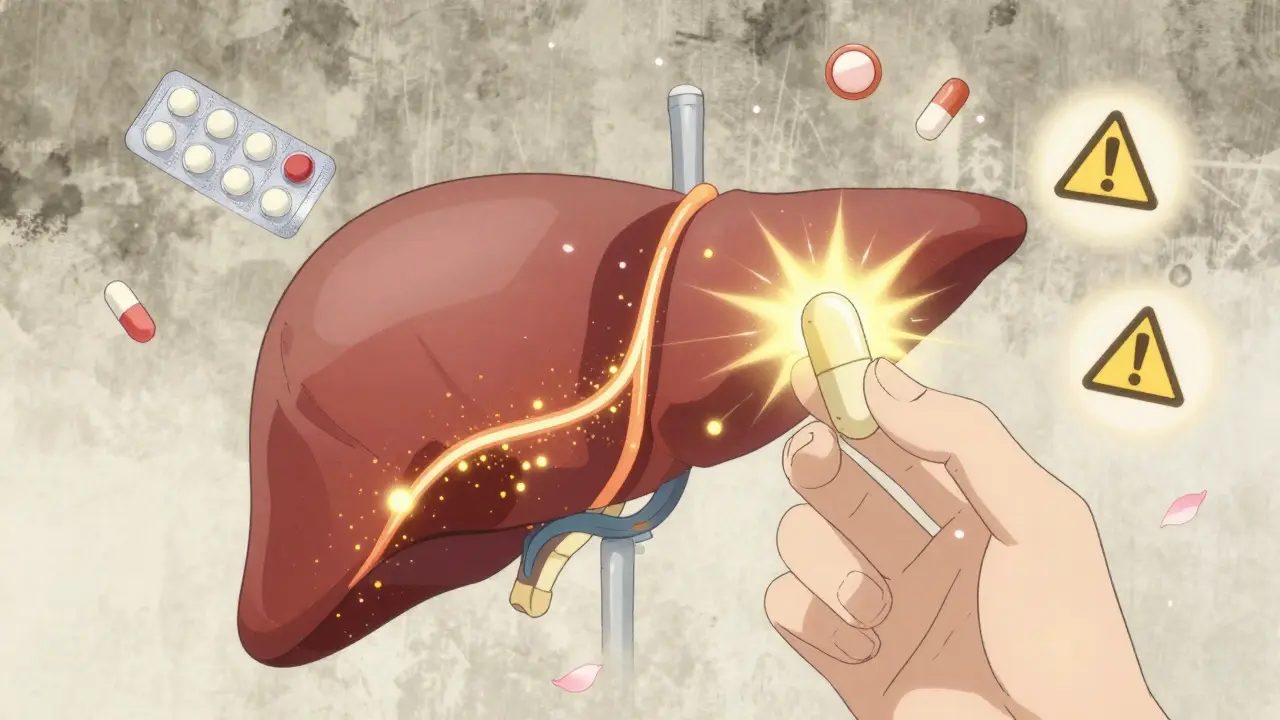
Switching from brand-name carbamazepine to a generic version might seem like a simple cost-saving move-but for many patients, it’s anything but. Carbamazepine isn’t just another seizure medication. It’s a drug with a narrow therapeutic index, meaning the difference between an effective dose and a dangerous one is small. And when you add in its powerful ability to speed up how your body processes other drugs, things get complicated fast.
Why Carbamazepine Is Different
Carbamazepine works by calming overactive nerve cells in the brain, which helps stop seizures. But here’s the twist: it also tricks your liver into making more of certain enzymes-especially CYP3A4-that break down not just carbamazepine itself, but dozens of other medications. This is called enzyme induction. It doesn’t happen right away. It takes 2 to 3 weeks to reach full force. And once it’s going, it doesn’t stop just because you stop taking the drug-it lingers for another week or two.
This means if you’re on carbamazepine and start taking something else-like a blood thinner, birth control pill, or even a common antifungal-it might not work. The carbamazepine is pushing your body to clear that other drug too fast. On the flip side, if you stop carbamazepine suddenly, those other drugs can build up to toxic levels because the enzymes slow down again.
The Generic Problem
There are over 30 FDA-approved generic versions of carbamazepine tablets and nearly 20 extended-release forms. Legally, each one must prove it’s bioequivalent to the brand-meaning it releases the same amount of drug into the bloodstream under lab conditions. But here’s the catch: bioequivalence studies are done on healthy volunteers, not people with epilepsy who are on 3 or 4 other drugs, have liver issues, or are women whose hormone levels change monthly.
A 2018 study of 327 patients found that 12.4% had seizures or bad side effects after switching between different generic brands-even though all met FDA standards. Nearly 8% ended up in the emergency room. One patient reported her blood level of carbamazepine dropped from 7.2 to 4.8 mcg/mL after switching generics, even though her dose stayed the same. That’s below the therapeutic range. She went from having 1-2 seizures a month to 4-5 a week.
Extended-release versions like Tegretol XR, Carbatrol, and Equetro are especially tricky. They’re made with tiny beads that release the drug slowly. Different manufacturers use different bead sizes or coatings. For someone with gastroparesis (slow stomach emptying), a change in bead size can mean the drug doesn’t dissolve properly-leading to sudden drops in blood levels.
Who’s at Highest Risk?
Not everyone has problems. About 60% of patients switch generics without issue. But certain groups are far more vulnerable:
- Women of childbearing age: Hormones affect CYP3A4 enzyme activity. A 2021 study showed women had 22% more breakthrough seizures after switching generics than men.
- People on multiple seizure drugs: When carbamazepine is mixed with valproate, lamotrigine, or phenytoin, the variability in how the body handles it jumps from 25% to 45%. Tiny differences in absorption become big problems.
- Asian patients: The FDA warns that people with the HLA-B*1502 gene variant-common in Han Chinese, Thai, Malaysian, and Filipino populations-have a 10-fold higher risk of life-threatening skin reactions like Stevens-Johnson Syndrome. Screening is recommended before starting carbamazepine at all.
- Patients with unstable seizures: If you’ve had recent breakthrough seizures or frequent hospital visits, switching generics is risky. The American Academy of Neurology advises against it in these cases.

Therapeutic Drug Monitoring Is Non-Negotiable
Carbamazepine’s therapeutic range is 4 to 12 mcg/mL. But what’s “normal” for one person might be too low or too high for another. That’s why doctors who treat epilepsy routinely check blood levels-about 65-75% of patients need it.
If you switch from one generic to another, you need a blood test before the switch to establish a baseline. Then again at 7 to 10 days after the switch, and once more at 4 weeks. If your level drops or rises by more than 15%, your dose needs to be adjusted. Waiting for symptoms to appear-like dizziness, blurred vision, or more seizures-is too late.
Many pharmacies and insurance plans automatically substitute generics. But your doctor can write “dispense as written” (DAW 1) on the prescription. This legally blocks the pharmacist from switching brands without your approval. A 2023 survey found that 68% of U.S. neurologists now do this for carbamazepine patients.
Drug Interactions You Can’t Ignore
Carbamazepine doesn’t just affect itself-it affects everything else you take. Here are key interactions:
- Birth control pills: Carbamazepine can make them 30-50% less effective. Alternative contraception is strongly advised.
- Warfarin: Levels drop, increasing clot risk. INR must be checked weekly after starting or switching carbamazepine.
- Cyclosporine and tacrolimus: Used after organ transplants. Carbamazepine can cause rejection by lowering levels too much.
- HIV meds (protease inhibitors): Both drugs interfere with each other. This combo is often avoided entirely.
- Other seizure drugs: Valproic acid, lamotrigine, and topiramate all interact. Some levels go up (risk of toxicity), others go down (risk of seizures).
Even over-the-counter drugs like St. John’s wort can trigger dangerous drops in carbamazepine levels. Always tell your doctor and pharmacist about every supplement or medication you take-even if you think it’s harmless.

What’s Changing in 2026?
Regulators are catching on. The FDA now calls carbamazepine extended-release products “high-priority” for better testing. They’re developing new methods that look beyond single-dose studies in healthy people. Instead, they’re modeling how the drug behaves over weeks in real patients-with factors like age, weight, genetics, and other drugs built in.
Researchers have found at least 17 gene variations that change how fast carbamazepine is broken down. People with the CYP3A4*22 variant need 25% less drug to reach the same blood level. In the next 5 years, doctors may routinely test for these genes before prescribing.
The American Epilepsy Society is preparing a new Therapeutic Drug Monitoring Toolkit for 2024, designed to help doctors adjust doses based on your specific profile-not just a standard chart.
What Should You Do?
If you’re on carbamazepine:
- Know your brand. Write down the manufacturer name on your prescription or pharmacy label. Don’t assume all generics are the same.
- Ask your doctor if you need a blood test before and after any switch.
- Use DAW 1 on prescriptions if you’ve had problems before.
- Report any new side effects or increased seizures immediately-don’t wait.
- If you’re of Asian descent, confirm you’ve been tested for HLA-B*1502.
- Keep a list of every medication and supplement you take. Review it with your pharmacist every 6 months.
Carbamazepine generics aren’t bad. They’ve helped millions save money. But they’re not interchangeable in the way aspirin or statins are. This drug demands attention. Your life depends on keeping levels steady. And that means staying informed, staying vigilant, and speaking up if something feels off.
Susheel Sharma
February 4, 2026 AT 08:32Carbamazepine generics? More like a Russian roulette with your neurons. 🤯 I’ve seen patients in Mumbai go from stable to seizing like they’re in a Tesla coil-just because the pharmacy swapped the tablet color. FDA bioequivalence? Sure, in a lab with healthy 22-year-olds. But real life? Hormones, liver enzymes, gastroparesis, and 12 other meds? Nope. This isn’t aspirin. It’s a precision instrument. And someone’s paying the price in ER visits.
Janice Williams
February 5, 2026 AT 12:12It is profoundly concerning that regulatory bodies continue to permit the substitution of pharmaceuticals with such a narrow therapeutic index under the guise of "bioequivalence." The very notion that a 25% variability in absorption is acceptable for a drug with documented life-threatening consequences is not merely negligent-it is an affront to the ethical foundations of medical practice. One must question the integrity of a system that prioritizes cost over clinical stability.
Roshan Gudhe
February 7, 2026 AT 11:11There’s a quiet tragedy here: we treat medicine like a commodity, but the human body isn’t a vending machine. You can’t just swap out a generic carbamazepine tablet like you’d swap a soda brand and expect the same result. The real issue isn’t the generics-it’s the assumption that biology is uniform. People aren’t data points. A woman in Delhi with fluctuating estrogen levels? A man in Chennai with slow gastric emptying? Their bodies don’t care about FDA tables. They care about staying alive. Maybe the answer isn’t better generics-it’s better recognition of individuality in pharmacology. 🌱
Rachel Kipps
February 9, 2026 AT 06:01i just rea d this and i’m so glad i’m not on carbamazepine. i had a friend who switched generics and her seizures got worse and no one listened until she was in the er. i think doctors need to be more proactive about testing. i know it’s annoying to do blood work every time but it’s worth it. i’m just saying. 💔
Alex LaVey
February 11, 2026 AT 02:39This is why I love medicine-it’s not just science, it’s storytelling. Every patient’s body tells a unique tale. Carbamazepine generics? They’re not the villain. The villain is the system that treats people like interchangeable parts. We’ve got the tools-therapeutic drug monitoring, genetic screening, DAW 1 prescriptions. What we need is the will to use them. Let’s stop blaming the pill and start fixing the pipeline. We can do better. We owe it to every patient who’s had to fight just to stay stable.
Jhoantan Moreira
February 11, 2026 AT 10:45As someone who’s watched a cousin struggle with epilepsy after a generic switch in London, I’m just grateful someone finally laid this out clearly. 🙏 The fact that 12% of patients had bad outcomes? That’s not a glitch-it’s a failure of systemic empathy. I hope more pharmacists start pushing back on automatic substitutions. And maybe, just maybe, insurance companies will realize that preventing one ER visit saves more than it costs. Small steps, but they matter.
Justin Fauth
February 12, 2026 AT 16:32U.S. generic drug system is a joke. We let some factory in India slap a different label on the same powder and call it "equivalent"? Meanwhile, Americans are getting seizures because some CEO thinks saving 5 cents per pill is worth risking lives. FDA’s asleep at the wheel. This isn’t innovation-it’s negligence with a corporate logo. Time to ban auto-substitution for anything with a narrow therapeutic index. Period.
Meenal Khurana
February 14, 2026 AT 08:20DAW 1 saved my sister. Don’t let them swap it.