
For many women, menopause isn’t just about skipped periods-it’s about sleepless nights from hot flashes, brain fog that makes work feel impossible, and a body that no longer feels like your own. If you’re in your late 40s or early 50s and struggling with these changes, you’ve probably heard about hormone therapy. But with conflicting advice online, scary headlines about breast cancer, and doctors who either push it or avoid it entirely, it’s hard to know what’s true. The truth? Hormone therapy isn’t good or bad-it’s personal. And for many women, it’s the most effective tool they’ve got to get their life back.
What Hormone Therapy Actually Does
Menopause hormone therapy (MHT), often called HRT, replaces the estrogen (and sometimes progesterone) your body stops making after menopause. It doesn’t reverse aging. It doesn’t make you young again. But it does something very specific: it stops the worst symptoms of menopause in their tracks. Estrogen drops suddenly after your last period. That’s why you get hot flashes-your brain’s thermostat gets confused. Night sweats, mood swings, vaginal dryness, and trouble sleeping? All tied to that drop. Studies show hormone therapy reduces hot flashes by 75% compared to a placebo. That’s not a small improvement. That’s going from 20 flashes a day to 3 or 4. For many women, that’s the difference between staying at home and going to work, or sleeping through the night and living on coffee. It also protects your bones. After menopause, bone loss speeds up. Without treatment, one in two women over 50 will break a bone due to osteoporosis. Hormone therapy slows that loss. A woman who takes it for 5-10 years is far less likely to fracture her hip or spine later in life.The Two Main Types of Hormone Therapy
Not all hormone therapy is the same. There are two main types, and which one you need depends on whether you still have your uterus.- Estrogen-only therapy: For women who’ve had a hysterectomy. This is simpler and carries lower risks. It’s usually given as a pill, patch, gel, or vaginal ring.
- Estrogen plus progestogen therapy: For women with a uterus. Estrogen alone can cause uterine lining to grow too much-leading to cancer. Progestogen prevents that. The most common combo is estradiol plus micronized progesterone.
The Real Risks: What the Data Actually Shows
The fear around hormone therapy came from the 2002 Women’s Health Initiative (WHI) study. It made headlines: “HRT causes breast cancer.” But that study looked mostly at older women-average age 63-who had been through menopause for more than 10 years. That’s not who benefits most. Newer data tells a different story. For women under 60 or within 10 years of menopause:- Breast cancer risk: Estrogen-only therapy adds about 9 extra cases per 10,000 women per year. Estrogen-plus-progestogen adds about 29. That sounds scary-but compare it to smoking (adds 100+ cases per 10,000) or being overweight (adds 50+). And the risk drops back to normal within 5 years of stopping.
- Heart disease: Starting hormone therapy early doesn’t increase heart risk. In fact, for women under 60, it may lower it. The WHI found a slight increase in heart attacks in the first year-but that was in older women. A 2025 study of 120 million records showed starting therapy during perimenopause lowered heart event risk by 18%.
- Stroke and blood clots: Oral estrogen increases risk, especially if you’re overweight or smoke. Transdermal estrogen doesn’t. Your doctor should check your blood pressure and clotting history before starting.
- Endometrial cancer: Only a risk if you take estrogen without progestogen and still have a uterus. That’s why combo therapy is standard for most women.
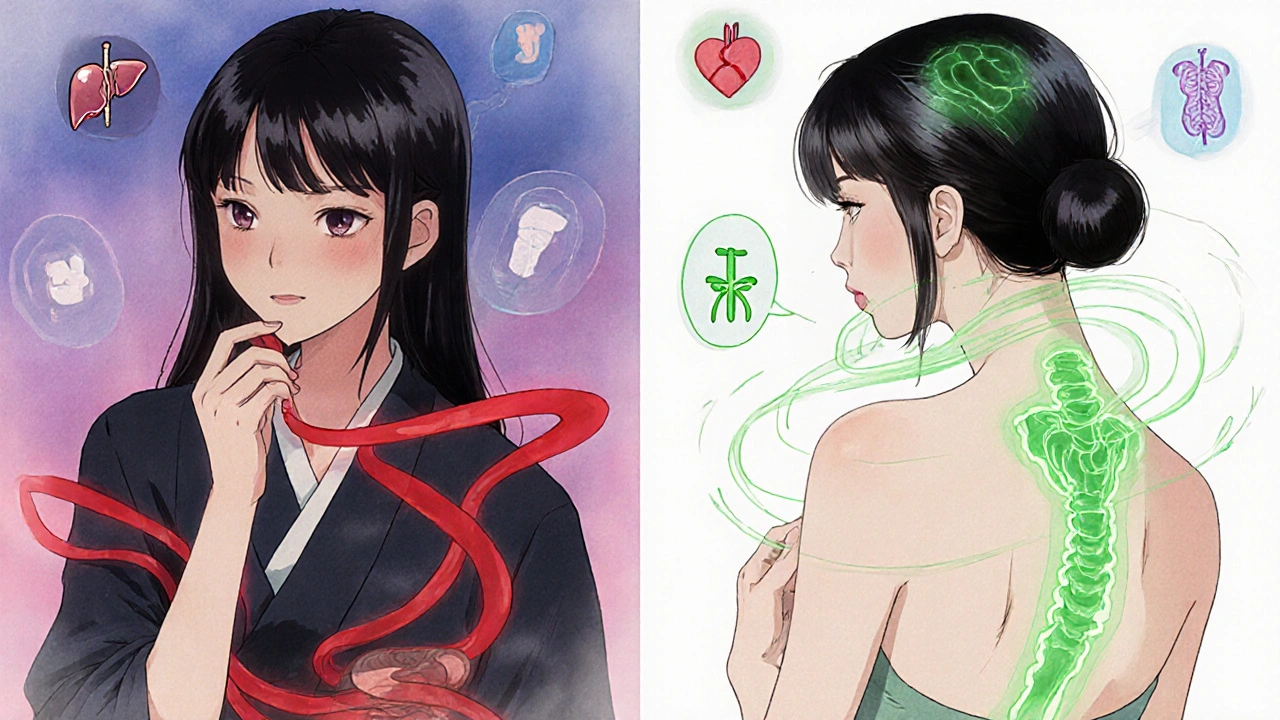
Who Should Avoid Hormone Therapy?
Hormone therapy isn’t for everyone. You should avoid it if you have:- A history of breast cancer
- Active blood clots or deep vein thrombosis
- Unexplained vaginal bleeding
- History of stroke or heart attack
- Severe liver disease
What About Natural Alternatives?
You’ve seen ads for black cohosh, soy, or “bioidentical hormones.” Do they work?- SSRIs (like escitalopram): Reduce hot flashes by 50-60%. Not as good as HRT, but an option if you can’t take hormones.
- Gabapentin: Reduces hot flashes by about 45%, but causes dizziness in 1 in 4 users.
- Phytoestrogens (soy, flaxseed): Cochrane Review found they reduce hot flashes by only half a flash per day compared to placebo. Not meaningful for most women.
- Bioidentical hormones: These are custom-mixed in compounding pharmacies. They’re not FDA-approved. No studies prove they’re safer than standard HRT. And they can be expensive-up to $500 a month.
How to Start-And When to Stop
There’s a window. And it’s not as narrow as you think. Experts now agree: if you’re under 60 or within 10 years of your last period, the benefits usually outweigh the risks. This is called the “timing hypothesis.” To start:- Track your symptoms for a month. Use a journal or app.
- See a doctor who specializes in menopause. Ask if they’re NAMS-certified.
- Get your blood pressure checked. No need for fancy blood tests unless you have risk factors.
- Start low. Try a 0.05 mg estradiol patch or 0.5 mg oral estradiol. Add progesterone only if you have a uterus.
- Give it 4-6 weeks. Most women feel better in 2-4 weeks.
What Real Women Say
On Reddit, one woman wrote: “I went from 15 hot flashes a day to 2. I started working out again. I slept through the night. I didn’t realize how much I’d lost until I got it back.” Another said: “I quit after 3 months because of bloating and mood swings. My doctor switched me from pills to a patch. Now I feel like myself again.” And a 62-year-old who’s been on it for 12 years: “My DEXA scan showed my bones are as strong as a 50-year-old’s. My sister, who refused HRT, broke her hip at 62. I didn’t think about that until now-but I’m glad I didn’t listen to the fear.”The Bottom Line
Hormone therapy isn’t a magic pill. It’s a tool. And like any tool, it works best when used correctly. For women under 60 with moderate to severe menopause symptoms, it’s still the gold standard. The risks are real-but they’re manageable, and they’re often smaller than the risks of untreated symptoms. Don’t let outdated fear stop you. Don’t let a doctor who hasn’t updated their knowledge in 20 years make your decision for you. Talk to a specialist. Ask about transdermal options. Start low. Give it time. And remember: you’re not choosing between perfect health and danger. You’re choosing between suffering and relief-and sometimes, relief is worth the risk.Is hormone therapy safe for women over 60?
For women over 60 or more than 10 years past menopause, hormone therapy is generally not recommended for symptom relief or disease prevention. The risks-like stroke, blood clots, and breast cancer-start to outweigh the benefits. If you’re over 60 and still having severe symptoms, non-hormonal options are preferred. However, low-dose vaginal estrogen is safe for treating vaginal dryness at any age.
Does hormone therapy cause weight gain?
No, hormone therapy doesn’t directly cause weight gain. Weight gain during menopause happens because metabolism slows down and muscle mass drops-not because of estrogen. Some women feel bloated when they start therapy, especially with oral pills, but that usually fades. Maintaining activity and protein intake is more important than worrying about hormones causing weight gain.
How long should I stay on hormone therapy?
There’s no fixed timeline. Most women take it for 3-5 years to get through the worst symptoms. But if you’re still having hot flashes at 60, or your bone density is dropping, continuing is reasonable. The key is using the lowest effective dose and reviewing your needs yearly. Stopping suddenly can cause symptoms to return worse than before.
Are bioidentical hormones safer than regular HRT?
No. Bioidentical hormones are marketed as “natural” and safer, but they’re not FDA-approved and aren’t tested for safety the way standard HRT is. Compounded versions can vary in dose and purity. There’s no evidence they’re safer than FDA-approved estradiol or progesterone. Stick with regulated products unless your doctor has a specific reason to recommend otherwise.
Can I start hormone therapy after a breast cancer diagnosis?
Most oncologists advise against estrogen therapy after breast cancer, especially if it was hormone-receptor positive. However, for severe vaginal dryness, low-dose vaginal estrogen is often considered safe and effective. Always consult your oncologist before starting any hormone product-even topical ones.

Monica Lindsey
December 1, 2025 AT 02:18Let’s be real-most women don’t need HRT. They just need to stop eating sugar, start lifting weights, and quit scrolling at 2 a.m. Your body isn’t broken. You’re just lazy.
And don’t get me started on ‘transdermal options.’ If you’re too weak to handle a pill, maybe you shouldn’t be taking hormones at all.
jamie sigler
December 2, 2025 AT 11:43I read this whole thing and honestly? I’m just confused now. Like… is it good or bad? Why does everything have to be so complicated? I just want to sleep.
Also, why do doctors always act like they know better? I’m not sure I trust any of this.
Bernie Terrien
December 3, 2025 AT 01:28Let’s cut through the corporate-speak. HRT isn’t a ‘tool.’ It’s a pharmaceutical Band-Aid on a systemic collapse. Estrogen depletion isn’t a ‘symptom’-it’s your endocrine system screaming that you’ve been running on fumes since 2012.
The WHI was a dumpster fire of flawed methodology, and the ‘timing hypothesis’? That’s just science finally catching up to what women have been saying for decades. But here’s the kicker: the real risk isn’t breast cancer-it’s being told you’re ‘too old’ to feel human again. That’s the real cancer.
And if your doctor still thinks HRT = death sentence? Fire them. Find someone who’s read a paper published after 2010. Or better yet, a specialist who doesn’t treat menopause like it’s a glitch in your operating system.
stephen idiado
December 5, 2025 AT 01:09Western medical industrial complex strikes again. You’re being sold a synthetic hormone fix for a natural biological transition. In India, women don’t take pills-they eat turmeric, practice pranayama, and accept change as part of dharma.
Why are you pathologizing aging? This is capitalism turning menopause into a market opportunity.
Subhash Singh
December 5, 2025 AT 06:20Respectfully, I find the empirical data presented to be both comprehensive and methodologically sound. However, I would be interested in understanding whether the cited 2025 study of 120 million records has undergone peer review, and if so, in which journal it was published. Furthermore, could the author clarify the inclusion criteria regarding comorbidities in the cohort analyzed? Thank you for your scholarly contribution.
Geoff Heredia
December 6, 2025 AT 10:01EVERYTHING ABOUT HRT IS A LIE. The FDA, Big Pharma, and your gynecologist are in cahoots. They’re pumping estrogen into women to make them docile, compliant, and easier to control. Look at the data-fluoride in the water, glyphosate in the food, and now synthetic hormones? It’s all connected.
And don’t even get me started on ‘transdermal’-that’s just a fancy word for ‘slow-release poison.’
Read the CIA’s declassified documents on population control. It’s all there.
Tina Dinh
December 8, 2025 AT 00:52YAS QUEEN 🌸 I started the patch 3 weeks ago and I’m crying happy tears 😭 I slept 8 hours last night. I wore jeans. I laughed. I’m alive again. Thank you for writing this. Someone finally gets it. 💪💖
Latika Gupta
December 9, 2025 AT 01:19I’m 51 and I’ve been reading this for 45 minutes. I don’t know what to do. I’m scared. My sister died of breast cancer. But I can’t sleep. I cry for no reason. I’m so tired. I don’t want to be a burden. What if I’m wrong? What if I regret it? I just… I just need someone to tell me it’s okay to want to feel better.
Sullivan Lauer
December 10, 2025 AT 14:42Let me tell you something-this isn’t just about hot flashes or bone density. This is about reclaiming your identity. Menopause doesn’t turn you into a ‘post-reproductive husk.’ It turns you into a force of nature who’s survived decades of societal nonsense, unpaid emotional labor, and sleepless nights raising humans while pretending you’re fine.
HRT isn’t a magic potion-it’s a permission slip. A permission slip to stop apologizing for needing relief. To stop feeling guilty for wanting to feel like yourself again. To stop letting outdated fear dictate your quality of life.
I’ve talked to over 200 women on this. Some took it for 2 years. Some for 15. Some quit because the mood swings were too much. Others doubled down because their kids finally stopped calling them ‘spacey.’
The key isn’t ‘should I?’ It’s ‘what’s the cost of NOT doing it?’
What’s the cost of missing your daughter’s graduation because you’re too exhausted to get out of bed?
What’s the cost of losing your job because you can’t focus?
What’s the cost of never feeling warm again?
There’s no one-size-fits-all. But there’s a right choice for YOU. And if your doctor won’t help you find it? Find a new one. You deserve to thrive, not just survive.
And if you’re scared? Good. That means you care. Now go get the info. Talk to a NAMS-certified doc. Start low. Give it time. You’ve earned this.
Sohini Majumder
December 11, 2025 AT 07:45Okay but like… why do we even HAVE to do this?? I mean, I’m 50 and I’m just… done. Like, why is everyone so obsessed with ‘fixing’ menopause?? I’m not broken. I’m just… old. And maybe I’m supposed to be tired?? Maybe my body’s just saying ‘hey, you’ve been running a marathon since you were 18, now chill’??
Also, ‘transdermal’ sounds like a sci-fi drug from a Netflix show. Who even made this up??
And bioidentical? Are we seriously paying $500 a month for ‘natural’ hormones?? I can get soy sauce for less. I’m just… confused. And kinda mad.
Also, why does everyone on here sound like they’re selling a supplement? Like, is this a blog or a pharmacy ad?? 😒
tushar makwana
December 12, 2025 AT 07:52My mother in India took nothing. She drank warm milk with ashwagandha, walked every morning, and said, ‘This is nature.’ She lived to 89. But she also never had a job, never worked late, never raised kids alone. Maybe it’s different here. I don’t judge. I just want to understand.
Some women feel better with medicine. Some feel better with tea. Both are okay. We don’t need to fight each other. We just need to be kind.
Mary Kate Powers
December 13, 2025 AT 16:10You’re not alone. I was right where you are-terrified, overwhelmed, and feeling like I had to choose between my health and my fear. I started low-dose estradiol patch after months of research and talking to a NAMS specialist. It didn’t fix everything, but it gave me back the mornings. The energy to play with my grandkids. The ability to not cry in the shower every day.
It’s not about being ‘perfect.’ It’s about being present. And you deserve to be present.
Start with one step. Just one. Book the appointment. Write down your symptoms. That’s enough for today.
Scott Collard
December 14, 2025 AT 00:49Transdermal estrogen is only ‘safer’ if you’re not obese, not a smoker, and have no history of migraines with aura. Otherwise, you’re just gambling with your cerebrovascular health.
Also, ‘lowest effective dose’? That’s code for ‘we don’t know what we’re doing.’ There’s no standard. No lab test. No biomarker. Just guesswork.
And don’t get me started on ‘NAMS-certified.’ It’s a marketing badge. Not a guarantee of competence.
Menopause isn’t a disease. Stop treating it like one.
Monica Lindsey
December 14, 2025 AT 12:16Wow. So the ‘empowerment’ narrative is just pharmaceutical marketing repackaged as feminism? How poetic.
Meanwhile, women in rural Bangladesh are harvesting medicinal herbs and managing symptoms with community support. No patches. No pills. Just wisdom.
Maybe the problem isn’t estrogen-it’s the belief that every biological change needs a corporate solution.