
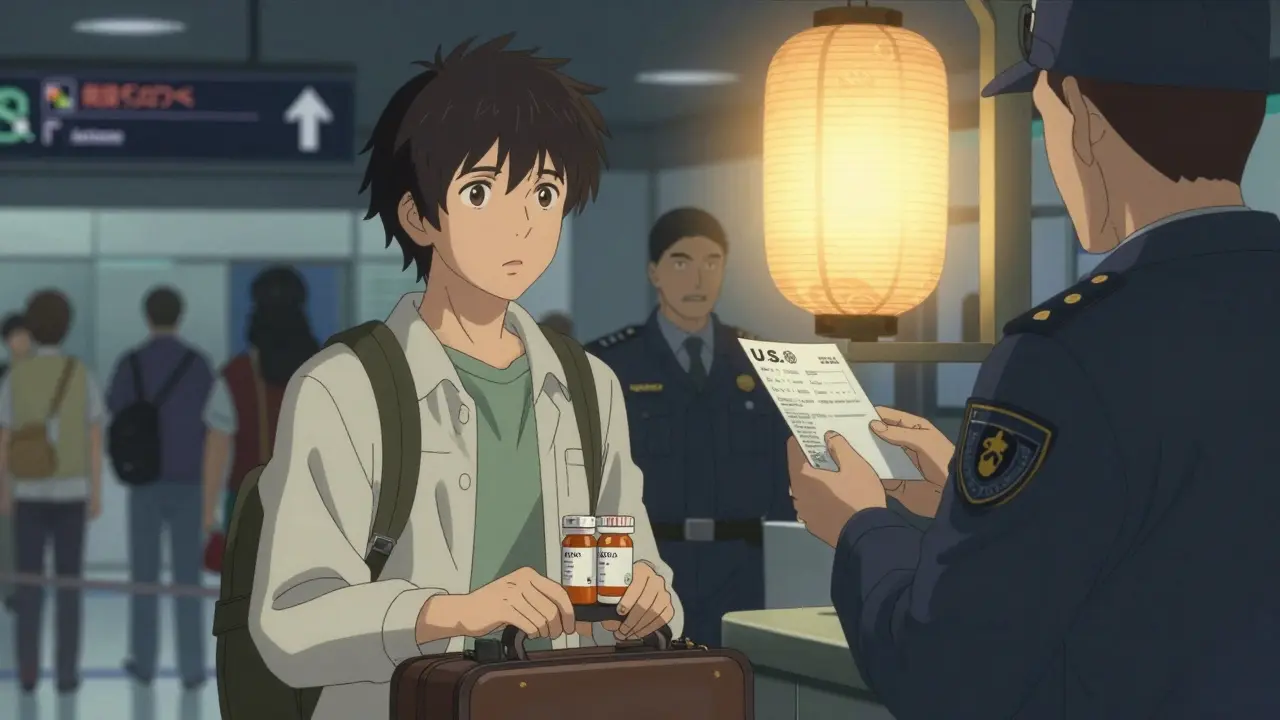
Trying to refill your prescription while traveling abroad isn’t as simple as walking into a local pharmacy. Even if you have the exact same medication, laws, naming conventions, and pharmacy systems vary wildly from country to country. What works in the U.S. might not work in Canada, the EU, or even Thailand. If you’re planning a trip and rely on regular medication, you need a clear plan-because running out mid-trip isn’t an option.
Why Prescription Transfers Between Countries Are So Complicated
There’s no global system for transferring prescriptions. Each country has its own rules, and many don’t recognize foreign prescriptions at all. The U.S. Food and Drug Administration (FDA) generally bans importing prescription drugs for personal use. But here’s the catch: they often don’t stop you if you’re bringing in a 90-day supply for yourself. Enforcement is inconsistent. One border agent might let you through with your pills; another might confiscate them. Meanwhile, the European Union has a much smoother system. If you’re traveling within the EU, your prescription is legally valid in any member country. But even there, problems pop up. Your medication might be sold under a different brand name. Or the dosage might not match what you’re used to. The pharmacy might not stock it at all. Canada is another story. U.S. pharmacies won’t transfer prescriptions directly to Canadian ones. Instead, you need what’s called a “cosigning” process-a Canadian doctor reviews your medical history and writes a new prescription based on your U.S. one. It’s not a transfer. It’s a restart.What You Can and Can’t Do in the U.S.
In 2023, the Drug Enforcement Administration (DEA) updated rules for transferring controlled substances between U.S. pharmacies. Now, one-time electronic transfers are allowed for Schedule II-V drugs. But this only applies within the U.S. No international transfers are permitted. If you’re moving from a U.S. pharmacy to one in another country, you’re on your own. Your U.S. pharmacy won’t send your prescription abroad. They’re not allowed to. And if you ask, many pharmacists will tell you it’s “against policy.” That’s not always true-it’s just that most aren’t trained to handle international requests. The best thing you can do is get a fresh prescription from your doctor before you leave. Make sure it includes:- The generic name of the medication (not just the brand)
- The exact dosage and frequency
- The total quantity you’ll need for your trip
- Your doctor’s signature and contact info
Transferring Prescriptions to Canada
Canada is one of the most common destinations for Americans seeking lower drug prices. But you can’t just walk into a Canadian pharmacy with your U.S. prescription and expect them to fill it. Here’s how it actually works:- Call a Canadian pharmacy that accepts international prescriptions (like those listed on PharmacyChecker.com).
- Send them your original U.S. prescription, your medical history, and your doctor’s contact info.
- The pharmacy forwards your info to a Canadian physician.
- The doctor reviews your case and issues a new Canadian prescription.
- The pharmacy fills it and ships it to you.

Traveling Within the European Union
If you’re traveling between EU countries, you’re in the best position. Your prescription is legally valid anywhere in the bloc. But here’s what you need to do to avoid trouble:- Carry the original prescription, not just a copy.
- Make sure it lists the generic drug name-not the brand name. For example, write “metformin” instead of “Glucophage.”
- Include the dosage, quantity, and prescribing doctor’s details.
- Bring a letter from your doctor explaining why you need the medication.
Challenges in the Middle East, Asia, and Other Regions
Countries like China, Japan, Saudi Arabia, and the UAE have some of the strictest rules. Many don’t allow foreign prescriptions at all. Some require:- A notarized letter from your doctor
- A detailed diagnosis statement
- Proof the medication is for personal use only
- Approval from local health authorities
What to Pack: The Travel Medication Checklist
No matter where you’re going, bring these five things:- Original prescriptions-in English, with generic names and doctor’s signature.
- Doctor’s letter-on letterhead, explaining your condition and why you need the medication.
- Medication in original bottles-with pharmacy labels intact. Never repack pills into daily organizers for international travel.
- 90-day supply maximum-even if you’re staying longer, bring only what you need for 3 months. Excess can raise red flags.
- Digital copies-email yourself PDFs of prescriptions and letters. Save them on your phone and cloud storage.
What to Do If You Run Out
If your medication runs out and you can’t get a refill:- Call your U.S. doctor. They can often fax a new prescription to a local pharmacy if you’re in a country with good medical infrastructure.
- Visit a local clinic or hospital. Bring your original prescription and doctor’s letter. Many doctors will write a new one based on your documentation.
- Use verified international pharmacy services like PharmacyChecker or MedAire. They can help connect you with licensed pharmacies abroad.
- Avoid buying medication on the street or from unverified online sellers. Counterfeit drugs are common in many countries.
Real Stories: What Happens When You Don’t Plan
One woman from Florida lost her prescription while visiting Italy. She couldn’t find a pharmacy that would fill it because the brand name didn’t match local stock. She ended up paying $200 for a local doctor’s visit just to get a new prescription. A man from Chicago tried to refill his blood pressure medication in Canada. His U.S. pharmacy refused to transfer it. He flew back to the U.S. just to get a new script. That trip cost him $800. Another traveler was detained at a Dubai airport because his ADHD medication wasn’t on the approved list. He spent 12 hours in custody before his doctor faxed the necessary paperwork. These aren’t rare cases. They happen every day.Bottom Line: Plan Ahead, Don’t Guess
There’s no easy shortcut for international prescription transfers. The system is broken. But you can still get your medication safely if you plan ahead. Start at least 3-4 weeks before your trip. Contact your doctor. Get your prescriptions in order. Research the rules of your destination. Use trusted resources like the FDA’s personal importation guidelines or the European Commission’s cross-border prescription portal. If you’re going to Canada, use PharmacyChecker. If you’re going to the EU, carry generic names. If you’re going to Asia or the Middle East, contact the embassy. And never, ever assume your U.S. pharmacy will help you with international transfers-they won’t. Your health depends on it. Don’t leave it to chance.Can I transfer my U.S. prescription to a pharmacy in another country?
No, U.S. pharmacies are not allowed to transfer prescriptions internationally. The DEA’s 2023 rule only applies to transfers between U.S. pharmacies. For other countries, you must either get a new prescription from a local doctor or use a service like PharmacyChecker to facilitate a cosigning process.
Is it legal to bring prescription drugs into another country?
It depends on the country. The U.S. FDA allows foreign nationals to bring in a 90-day supply for personal use, but U.S. citizens face stricter limits. Countries like Canada, the UK, and EU members generally allow it if you have proper documentation. But countries like China, Japan, and the UAE have strict bans on many common medications. Always check the destination country’s rules before you travel.
Why can’t I just use my U.S. prescription at a foreign pharmacy?
Because each country has its own drug approval system. A medication sold under one brand name in the U.S. might be sold under a different name-or not available at all-abroad. Pharmacists are legally required to dispense only medications approved in their country. Without a local prescription or cosigning, they can’t legally fill your U.S. script.
What if my medication is a controlled substance like Xanax or Adderall?
Controlled substances are treated much more strictly. Many countries classify common U.S. medications like Xanax, Adderall, or oxycodone as illegal narcotics. Even with a prescription, you may need special permits or be denied entry entirely. Always research your destination’s controlled substance laws. Some countries require pre-approval from health authorities. Never assume your U.S. prescription is enough.
How far in advance should I plan for a prescription transfer?
At least 3-4 weeks. If you’re going to Canada, the cosigning process takes 5-10 business days. For countries like China or the UAE, you may need to apply for import permits weeks in advance. Waiting until the last minute risks running out of medication while you’re away.

Shae Chapman
December 29, 2025 AT 20:59kelly tracy
December 31, 2025 AT 08:05Kunal Karakoti
January 1, 2026 AT 14:53henry mateo
January 2, 2026 AT 06:35Cheyenne Sims
January 3, 2026 AT 03:11Hayley Ash
January 3, 2026 AT 09:23Nadia Spira
January 4, 2026 AT 17:46Glendon Cone
January 6, 2026 AT 16:05Henry Ward
January 6, 2026 AT 19:36srishti Jain
January 8, 2026 AT 11:17Kelly Gerrard
January 10, 2026 AT 00:45Aayush Khandelwal
January 11, 2026 AT 03:58Sandeep Mishra
January 11, 2026 AT 11:28Joseph Corry
January 12, 2026 AT 04:30Colin L
January 12, 2026 AT 15:12