
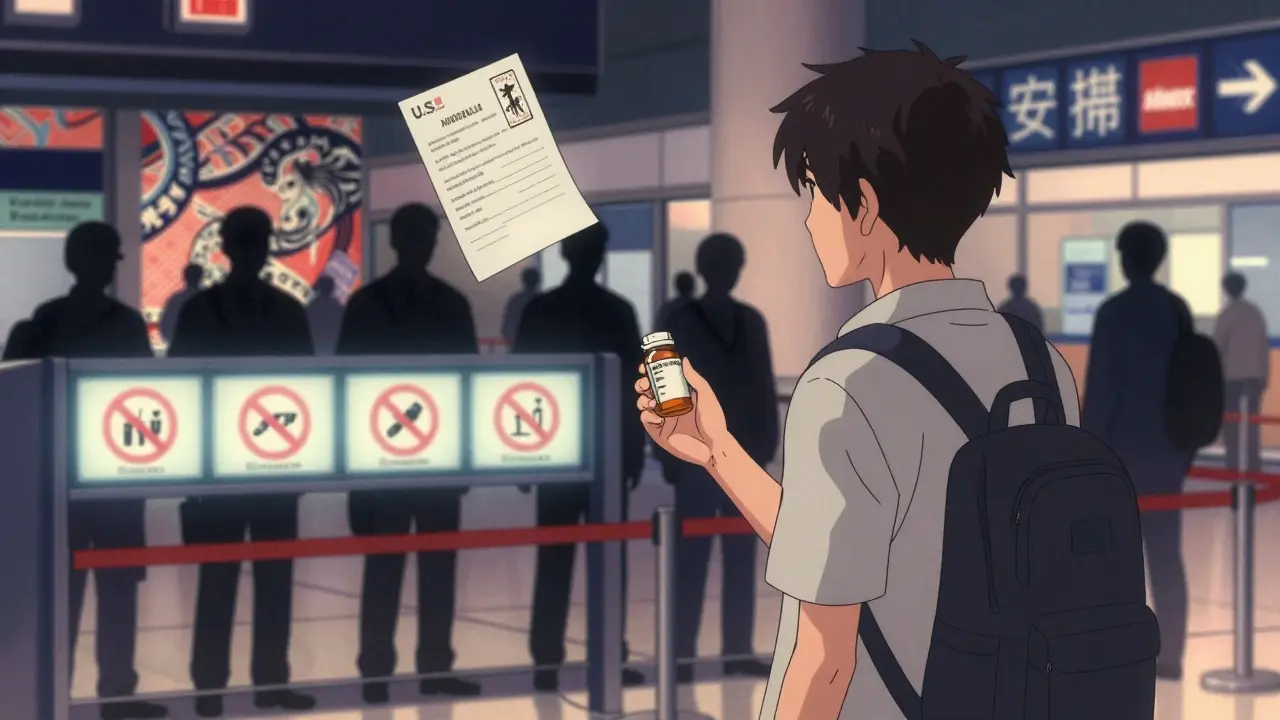
Planning a trip overseas? If you take medication for a chronic condition, you can’t just pack your pill bottle and hope for the best. What’s legal in the U.S. might be completely banned in another country-and carrying it could land you in jail, get your meds confiscated, or even block you from entering the country. This isn’t a rare scenario. In 2024, over 1,400 travelers were detained or denied entry because of their medications, according to U.S. State Department records. The good news? Almost all of these cases were preventable with simple, early planning.
What Medications Are Most Likely to Cause Problems?
Not all prescriptions are equal when crossing borders. Some are treated like controlled substances everywhere. The CDC’s Yellow Book lists the usual suspects:- Narcotics: Hydrocodone, oxycodone, codeine (even in cough syrup)
- Sedatives and anti-anxiety meds: Alprazolam (Xanax), diazepam (Valium)
- Sleep aids: Zolpidem (Ambien)
- ADHD medications: Amphetamine/dextroamphetamine (Adderall), lisdexamfetamine (Vyvanse)
- Decongestants: Pseudoephedrine (found in many cold medicines)
These aren’t just "high-risk"-they’re outright banned in some places. Japan prohibits over 1,400 medications, including common ones like pseudoephedrine and certain antibiotics. The UAE has strict rules on codeine-even in over-the-counter products. Thailand detains travelers for carrying zolpidem without a notarized doctor’s letter. And in Saudi Arabia, you need a government-issued import permit for any prescription, no exceptions.
How Much Can You Bring?
The U.S. Customs and Border Protection (CBP) says you can bring no more than a 90-day supply for personal use. That sounds simple, but it’s not that cut-and-dried. If you’re staying longer, you need documentation proving you need more. A 12-week trip? You can’t just pack 90 days’ worth and assume you’re fine. You need to prove you’re not trying to import meds for resale or long-term use abroad.Some countries have their own limits. Australia allows only a 30-day supply without special permission. Canada requires a letter from your doctor for any controlled substance. And if you’re flying through multiple countries? Transit rules can be stricter than your destination’s. A traveler going from the U.S. to Thailand via Dubai might get flagged in Dubai for carrying Adderall-even if Thailand allows it with paperwork.
How to Pack Your Medications Right
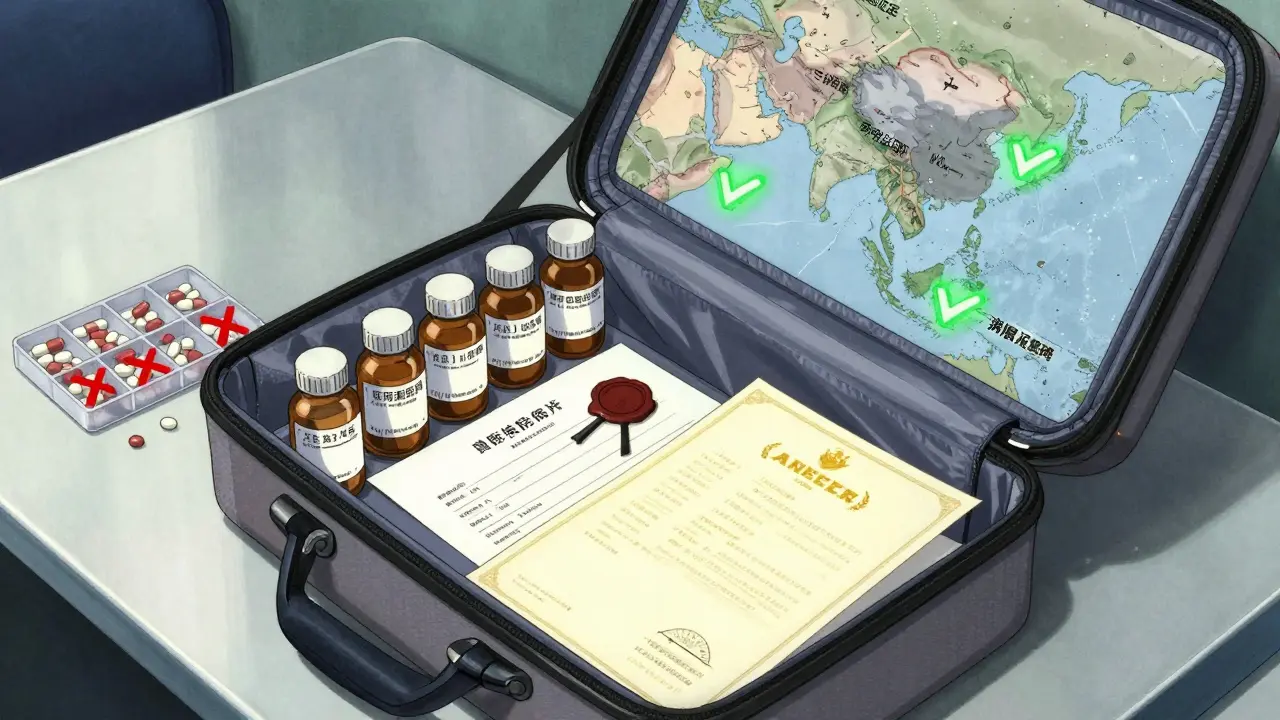
Packaging matters. The TSA says prescription labels are "recommended but not required," but that’s only true for U.S. domestic flights. Five states (California, New York, Texas, Florida, and Illinois) legally require controlled substances to stay in their original bottles-even if you’re just flying to another state before heading overseas. If you transfer pills to a pill organizer, you risk getting pulled aside at security.Here’s what you actually need:
- Original containers: Keep pills in bottles with your name, doctor’s name, and prescription label.
- Carry-on only: Never check medication. Airlines like Delta and United explicitly say medical supplies must be in carry-on luggage.
- Liquids: If you’re carrying liquid meds (insulin, syrups, injections), they’re exempt from the 3.4-ounce rule-but you must declare them at security. Bring a doctor’s note.
- Needles and syringes: Always carry them in original packaging with a prescription label. Bring a letter from your doctor explaining why you need them.
Pro tip: Don’t mix different medications in one container. If you’re carrying both Xanax and insulin, keep them separate. Security officers don’t know what’s what-and they’ll assume the worst.
What Documentation Do You Really Need?
A U.S. prescription alone isn’t enough. Many countries require:- A letter from your doctor: Written on letterhead, dated, and signed. It should list your name, medication names (both brand and generic), dosage, and reason for use.
- A notarized copy: Thailand, Japan, and several Middle Eastern countries demand this. A notary public can certify your doctor’s letter for around $15.
- An International Certificate for Medicinal Products (ICMP): Some U.S. pharmacies offer this-it’s a standardized form recognized in over 60 countries. It costs $25-$40 per medication.
And here’s the catch: embassies are your best friend. Don’t rely on Google. Go directly to the embassy website of every country you’ll visit-or even transit through. Many have downloadable forms or contact info for medical inquiries. The International Society of Travel Medicine says 78% of entry denials could’ve been avoided if travelers contacted embassies at least 60 days ahead.
What to Do If Your Meds Are Banned
Some medications are just not allowed-no matter how much paperwork you have. If your ADHD medication or painkiller is on the banned list (like in Japan or the UAE), you have three options:- Switch before you go: Talk to your doctor about an alternative that’s legal in your destination. For example, some countries allow methylphenidate instead of Adderall.
- Get a local prescription: In some countries, you can see a local doctor and get a new prescription. But this requires advance planning-you can’t just show up and walk into a clinic.
- Leave it behind: If you can’t get an alternative and can’t get a local script, you may need to manage without it. This is risky for chronic conditions. Talk to your doctor about a taper plan or temporary adjustment.
Never try to mail medication overseas. The U.S. Postal Service and private couriers like FedEx and DHL prohibit it for most controlled substances. Even if you think it’s "just a few pills," you’re breaking federal law-and risking your meds being seized or your package being investigated.

What’s New in 2026?
Regulations are tightening fast. In January 2025, Singapore raised penalties for unauthorized meds by 300%. South Korea and Malaysia banned all CBD products-even those legal in the U.S. The U.S. State Department is testing a new standardized form with Japan, Thailand, and the UAE, expected to launch in late 2026. But until then, you’re on your own.One big change: the INCB’s Country Regulations database (updated January 2025) now includes real-time embassy contacts and medication equivalency tools. You can now search for "Adderall" and see which countries allow it, what documentation is needed, and who to email for approval.
Checklist: Your 5-Step Medication Plan
Follow this before you book your flight:- Check legality: Visit the INCB Country Regulations Database and search for each medication you take.
- Contact embassies: Email the embassy of every country you’ll visit or transit through. Ask: "What documentation is required for [medication name]?"
- See your doctor: Get a signed, dated letter on letterhead. Ask if they can issue an ICMP. If not, get a notarized copy.
- Bring enough: Pack at least your full trip duration + 7 extra days. Don’t risk running out.
- Organize smart: Keep all meds in original bottles, in your carry-on. Bring extra copies of prescriptions and doctor’s letters.
Don’t wait until the airport to figure this out. One traveler in Bangkok was held for four hours because she had 28 Xanax tablets without a notarized letter. She had a U.S. prescription-but it wasn’t enough. She missed her connecting flight. She lost her hotel booking. And she spent $800 on emergency legal help.
Plan ahead. It’s not about being paranoid. It’s about being prepared.
Can I bring my medication in a pill organizer instead of the original bottle?
It’s risky. While the TSA doesn’t require original bottles for domestic flights, many international destinations and even some U.S. states (like California and Texas) legally require controlled substances to remain in their original packaging. If you’re flying internationally, always keep meds in their original bottles with prescription labels. Using a pill organizer might seem convenient, but it increases the chance of delays, confiscation, or even detention.
What if I’m traveling to multiple countries?
You need to check each country’s rules separately. The European Union has harmonized rules among Schengen countries, but if you’re flying from the EU to Thailand or the UAE, you’ll face completely different regulations. Always research every country on your itinerary-even if you’re just transiting. A stopover in Dubai or Singapore can trigger a search, and if your meds are banned there, you could be denied boarding or detained.
Are over-the-counter meds like ibuprofen or antihistamines a problem?
Most are fine, but not all. Pseudoephedrine (found in Sudafed) is banned in Japan, Singapore, and several Middle Eastern countries. Some antihistamines with sedative effects (like diphenhydramine) are restricted in the UAE. Always check the INCB database for any OTC medicine you plan to bring-even if it’s sold freely in the U.S.
Can I get my medication filled overseas if I run out?
Sometimes, but it’s not reliable. Many countries don’t recognize U.S. prescriptions. Even if they do, the brand or dosage might not match. For example, a 10mg tablet in the U.S. might be 5mg in Europe. You’d need to see a local doctor, get a new prescription, and possibly pay out-of-pocket. It’s better to bring enough for your entire trip plus a week’s buffer.
What should I do if my medication is banned in my destination?
Talk to your doctor at least 8-12 weeks before travel. Ask if there’s an alternative medication that’s legal in your destination. For example, if Adderall is banned, methylphenidate might be allowed. If no alternative exists, you may need to adjust your treatment plan or consider postponing travel. Never try to smuggle banned meds-it’s not worth the risk of arrest, fines, or deportation.




Nandini Wagh
February 21, 2026 AT 14:45Oh wow, another government-sponsored paranoia pamphlet. I love how we’ve turned ‘don’t get arrested abroad’ into a 3,000-word survival guide. Next up: ‘How Not to Get Kidnapped by a Foreign Pharmacist Who Thinks Your Xanax Is Cocaine.’
Holley T
February 22, 2026 AT 10:25Let’s be real-this whole thing is a bureaucratic nightmare designed by people who’ve never left a county fair. I’ve flown to 17 countries with my Adderall in a Ziploc, and not once has anyone asked me for a notarized letter. The TSA doesn’t care. Customs doesn’t care. The only people who care are the ones writing these articles. Meanwhile, my 78-year-old aunt takes her Valium in a pill organizer and still gets invited to every dinner party in Bali. This isn’t about safety-it’s about control.
Lou Suito
February 22, 2026 AT 14:46Wait-so you’re telling me I can’t bring my Sudafed into Japan? That’s insane. Pseudoephedrine is literally in every cold medicine in the U.S. And now you want me to get a notarized letter? For a decongestant? Who’s writing this? A lawyer who got fired from the DEA? Also, the INCB database? That’s not even a real thing. I Googled it. No results. This whole post is a scam. You’re selling notarization services. I’m calling the FTC.
Joseph Cantu
February 23, 2026 AT 14:16They’re watching you. Every pill. Every capsule. Every drop of insulin. They know you took it. They know you’re coming. They’ve been tracking your prescriptions since you filled that first script in 2018. You think your doctor’s letter protects you? Nah. That’s just the bait. The real trap? The QR code on the prescription bottle. It links to a global database. They’re building a pharmaceutical surveillance net. And you? You’re just another data point in their biometric ledger. Don’t you feel it? The chill? The silence? The way airport scanners linger on your carry-on? They’re not looking for bombs. They’re looking for your meds. And they’re coming for you next.
Lisandra Lautert
February 25, 2026 AT 00:22Just pack your meds in original bottles. Carry them on. Don’t overthink it. Done.
Cory L
February 26, 2026 AT 19:03Man, I just got back from Thailand and I had 30 days’ worth of Zolpidem. No letter. No notarization. Just my name on the bottle. Security gave me a thumbs-up. I think this whole thing is hype. The real danger? Running out of sleep meds mid-trip. That’s the nightmare. Not some bureaucrat in Dubai.
Southern Indiana Paleontology Institute
February 28, 2026 AT 13:21Why are we letting foreigners dictate what Americans can carry? We’re the United States of America. We don’t need permission from Thailand or Japan to take our own pills. This is socialism creeping in through pharmaceuticals. I’m gonna bring my Adderall in a shoe. Let ‘em search me. I’ve got rights. And I’ve got a 9mm in my bag. You think they’ll take my meds? Try it. I dare you.
Anil bhardwaj
March 1, 2026 AT 17:36I travel often from India to the US and always carry my blood pressure meds in original bottle. No issues. But I always check embassy websites. Simple. No drama. Just common sense. Your medicine is your business, but the law is not.
lela izzani
March 1, 2026 AT 18:06One thing this article doesn’t mention: always keep a digital copy of your doctor’s letter on your phone. I had my meds confiscated in Dubai once because I didn’t have a physical copy. But I had the PDF in my cloud. I emailed it to the officer on the spot. He let me go. Also, if you’re on insulin-bring twice as much. And a backup pen. Trust me. I’ve been there.
Joanna Reyes
March 2, 2026 AT 16:36I’ve been managing bipolar disorder for 12 years and have flown internationally 23 times. This guide is accurate, but it’s missing one crucial thing: the emotional toll. Every time I pack my meds, I feel like I’m smuggling contraband. I’m not a criminal. I’m not trying to sell pills. I just need to survive. And yet, I have to beg for permission from governments that don’t even understand mental health. This isn’t about rules-it’s about stigma. The real crisis isn’t the law-it’s the shame we’re forced to carry alongside our prescriptions.
Nerina Devi
March 3, 2026 AT 15:08As someone from India who travels to the US regularly, I want to say: this is why cultural awareness matters. In India, we don’t have the same stigma around mental health meds, but we also don’t have the same legal infrastructure. The solution isn’t fear-it’s education. Maybe if more countries had clear, accessible portals like the INCB database, fewer people would get caught. I’m glad someone is trying to bridge this gap. Thank you for the practical checklist. It’s rare to see advice that’s this clear.
Dinesh Dawn
March 5, 2026 AT 05:07I just got back from Vietnam and brought my ADHD meds in a pill organizer. No one said a word. But I did carry a copy of my prescription. Just in case. I think the key is to be calm, confident, and prepared. If you act like you’re hiding something, they’ll look harder. If you act like you’re just a regular person with regular meds, they’ll barely glance at you. Travel smart, not scared.
Vanessa Drummond
March 6, 2026 AT 07:52My therapist said I shouldn’t travel without my Xanax. My husband said I’m being dramatic. Then I got stopped in Singapore. Four hours. A strip search. A $2,000 fine. They said I was ‘attempting to import a controlled substance.’ I had 14 tablets. Fourteen. I cried in the airport bathroom. Now I carry a notarized letter. And a backup prescription. And a lawyer’s number. This isn’t a guide. It’s a warning. And you’re lucky you’re reading it before it’s too late.
Nick Hamby
March 7, 2026 AT 10:15There is a profound philosophical tension here: the individual’s right to bodily autonomy versus the state’s right to regulate substances under the guise of public order. We live in a world where a pill, a chemical compound, becomes a political symbol. The traveler, carrying their daily sustenance, is transformed into a suspect. The system, in its attempt to prevent harm, creates greater harm-through fear, humiliation, and bureaucratic violence. Perhaps the real solution is not more paperwork, but a global rethinking of medical sovereignty. Until then, we carry our pills, our letters, our dread-and hope that humanity, not regulation, will prevail.