
ADHD Stimulant & MAOI Risk Checker
This tool helps assess the risk of hypertensive crisis when combining ADHD stimulants with MAOIs. Based on FDA guidelines and clinical evidence, this combination can cause life-threatening blood pressure spikes.
Hypertensive Crisis Risk Detected
This combination is dangerous and should NOT be taken together. The risk of a hypertensive crisis is significant. You must immediately consult your healthcare provider and stop both medications.
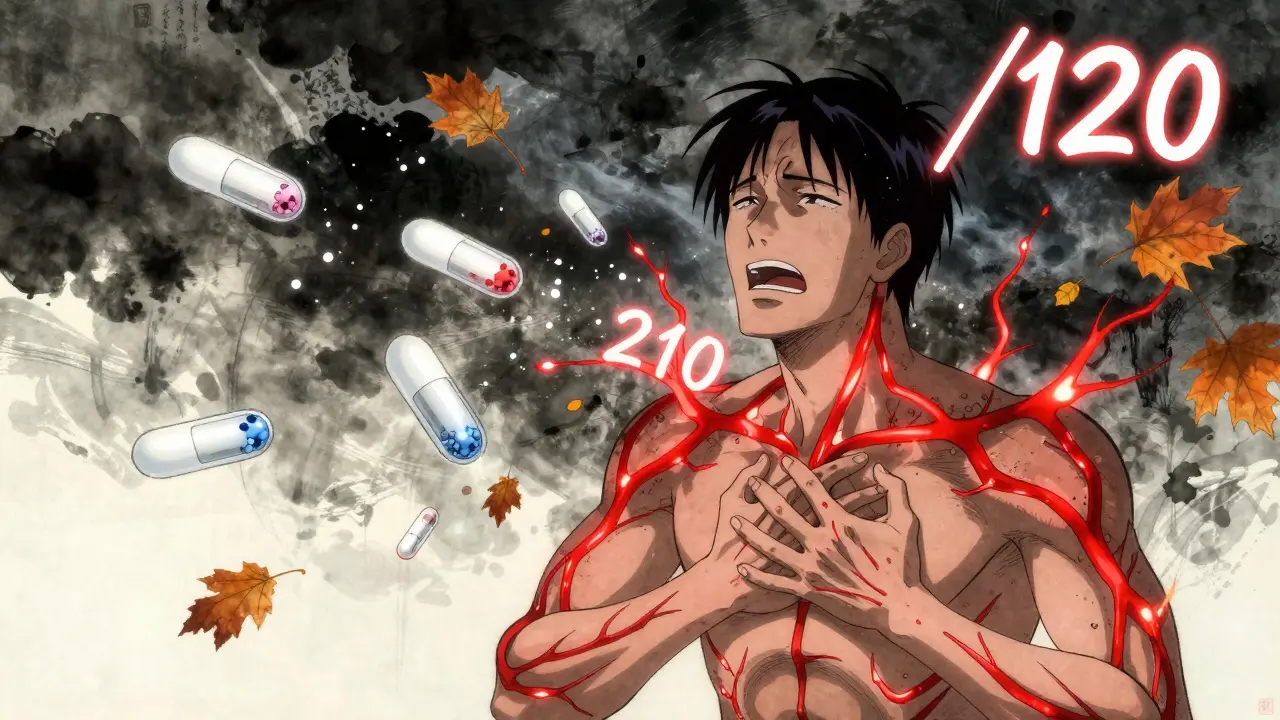
According to FDA warnings, this combination can cause blood pressure to spike above 200/120 mmHg, leading to stroke, heart attack, or death.
What to do:
- Stop the stimulant first (consult your doctor for tapering)
- Wait at least 14 days after stopping the MAOI before restarting any stimulant
- Avoid tyramine-rich foods during the washout period
- Monitor blood pressure daily
- Consider non-stimulant ADHD alternatives like atomoxetine or guanfacine
No Significant Risk Detected
Based on current medication selection and FDA guidelines, this combination does not appear to pose an immediate hypertensive crisis risk. However, always consult with your healthcare provider before combining any medications.
Remember: All MAOIs and stimulants require careful medical supervision. The interaction risk is not absolute, but this does not mean it's safe without professional guidance.
Combining ADHD stimulants with MAOIs isn’t just a bad idea-it’s a medical emergency waiting to happen. If you or someone you know is taking both, the risk of a sudden, life-threatening spike in blood pressure is real. This isn’t theoretical. It’s documented. It’s in the FDA warnings. And it’s happened before.
Why This Combination Is Dangerous
ADHD stimulants like Adderall, Vyvanse, and Ritalin work by boosting dopamine and norepinephrine in the brain. That’s how they improve focus and reduce impulsivity. But norepinephrine doesn’t just affect your mind-it tightens your blood vessels, raises your heart rate, and pushes your blood pressure up. MAOIs-medications like phenelzine, tranylcypromine, and selegiline-are older antidepressants that stop your body from breaking down certain chemicals, including norepinephrine and tyramine (a compound found in aged cheese, cured meats, and red wine). When MAOIs are active in your system, those chemicals build up. Put them together? You get a double hit: stimulants flood your system with norepinephrine, and MAOIs prevent your body from clearing it. The result? Blood pressure can skyrocket-sometimes to levels above 200/120 mmHg. That’s not high blood pressure. That’s a hypertensive crisis.What Happens During a Hypertensive Crisis
A hypertensive crisis isn’t just a headache or dizziness. It’s a medical emergency. Symptoms include:- Severe headache, often pounding or throbbing
- Blurred vision or seeing spots
- Chest pain or tightness
- Shortness of breath
- Nausea or vomiting
- Confusion or seizures
- Loss of consciousness
Not All MAOIs Are the Same
You might hear that some MAOIs are "safer." That’s partly true-but don’t assume you’re out of danger. Traditional MAOIs like tranylcypromine and phenelzine are irreversible. They shut down monoamine oxidase enzymes for weeks. Even after you stop taking them, it takes 14 days for your body to make new enzymes. That’s why doctors insist on a 14-day washout before starting any stimulant. Transdermal selegiline (Emsam patch) is different. At low doses (6 mg/24h), it mainly blocks MAO-B in the skin, not the gut. That means less tyramine interference, and less risk. The FDA says rare cases of high blood pressure can still happen, but it’s far less likely. Still, combining it with stimulants? Not approved. Not recommended. And even in research settings, it’s done with extreme caution. Moclobemide, a reversible MAOI used in Europe and Canada, has a much lower risk profile. But it’s not available in the U.S. So for most people here, the only MAOIs are the dangerous ones.Not All Stimulants Are Equal Either
Amphetamines-like Adderall and Vyvanse-are riskier than methylphenidate-based drugs like Ritalin or Focalin. Why? Because amphetamines force nerve cells to dump way more norepinephrine into your system. Methylphenidate mainly blocks reuptake, which is a gentler effect. A 2005 review in the Primary Care Companion to The Journal of Clinical Psychiatry found amphetamines caused significantly higher norepinephrine release than methylphenidate. That’s why case reports of hypertensive crisis almost always involve Adderall or Vyvanse, not Ritalin. Still, even Ritalin can be dangerous with MAOIs. No stimulant is safe to mix with an MAOI.
Real Cases, Real Consequences
In 2023, the Journal of Psychoactive Drugs published a case of a 42-year-old man who took tranylcypromine for depression and added dextroamphetamine for ADHD. He also used psilocybin mushrooms. His systolic blood pressure hit 210 mmHg. He had a stroke. He survived, but with lasting neurological damage. Another case from Massachusetts General Hospital in 2017 followed 12 patients who were given low-dose lisdexamfetamine (Vyvanse) while on MAOIs. No crises occurred-but they were monitored every 15 minutes for the first 24 hours. Blood pressure was checked daily. They avoided tyramine-rich foods. No one had pre-existing hypertension. This wasn’t casual. It was controlled, clinical, and closely watched. Most doctors won’t take that risk. And they shouldn’t.What If You’re Already on Both?
If you’re currently taking an MAOI and an ADHD stimulant, stop both immediately and call your doctor. Don’t wait. Don’t try to wean off slowly on your own. Here’s what needs to happen:- Stop the stimulant first. Don’t quit cold turkey if you’ve been on it long-talk to your doctor about tapering.
- Wait at least 14 days after stopping the MAOI before starting any stimulant.
- During that 14-day window, avoid tyramine-rich foods: aged cheeses (blue, parmesan, cheddar), cured meats (salami, pepperoni), fermented soy (miso, tempeh), tap beer, red wine, and overripe fruits.
- Get your blood pressure checked before restarting any stimulant.
- If you restart a stimulant, start at 10-25% of your usual dose. Monitor your BP at home daily for the first week.
Why Do Some Doctors Still Do This?
A few clinicians-mostly in academic centers treating treatment-resistant depression and ADHD-have tried combining these drugs. One psychiatrist at Weill Cornell reported over 200 cases without incident. But he’s an outlier. He uses ultra-low doses, strict monitoring, and excludes patients with any cardiovascular history. The American Psychiatric Association’s 2022 guidelines call this combination a "strong recommendation against" with "high quality of evidence." That’s not a gray area. That’s a red flag. MAOIs are already rare. They make up less than 1% of antidepressant prescriptions in the U.S. today. Why? Because of side effects, dietary restrictions, and now, this interaction. Stimulants, on the other hand, are everywhere-92 million prescriptions in 2022. More people are on them than ever. That means more chances for accidental overlap. A patient might see a psychiatrist for depression, get an MAOI, then later see a different doctor for ADHD and get Adderall. No one connects the dots.
What’s Changing? What’s Next?
Research is ongoing. A 2023 clinical trial (NCT04567891) is testing low-dose transdermal selegiline with lisdexamfetamine in 50 patients. Early results show no hypertensive crises in the first 25. But this is still experimental. It’s not standard care. The FDA updated stimulant labels in 2022 to emphasize the absolute contraindication. They didn’t soften it. They reinforced it. The future may hold safer protocols-but for now, the safest choice is simple: don’t mix them.What to Do If You’re Worried
If you’re on an MAOI and thinking about starting a stimulant-or vice versa-talk to your psychiatrist. Don’t rely on your primary care doctor alone. This is specialist-level territory. Ask:- "Is this combination ever safe?"
- "What’s the exact washout period for my specific MAOI?"
- "Do I need to avoid certain foods even after stopping the MAOI?"
- "What’s my baseline blood pressure?"
- "Can we use a non-stimulant ADHD treatment instead?"
Lydia H.
January 20, 2026 AT 01:16Man, I read this whole thing and just felt my blood pressure spike from the stress of it all. Seriously though-this is the kind of post that should be plastered on every pharmacy counter, ADHD support group, and Reddit thread about 'what meds work best.'
It’s not just about avoiding disaster-it’s about respecting how fragile our neurochemistry is. We treat stimulants like coffee, but they’re not. They’re surgical tools. And MAOIs? They’re the kind of meds your grandpa took before everyone got scared of side effects.
There’s a reason these drugs aren’t prescribed together. Not because doctors are rigid. Because people have died.
And yet… we still see folks on subreddits asking, 'Can I just take one Adderall while on phenelzine?' Like it’s a game of Russian roulette where the bullet’s loaded twice.
I’m not mad. I’m just… tired. Tired of seeing people treat brain chemistry like a DIY project.
Thanks for writing this. Someone needed to say it loud enough for the internet to hear.
Phil Hillson
January 21, 2026 AT 21:19bro why are you even posting this like this is some kind of medical textbook lmao just take your meds and chill
Tracy Howard
January 23, 2026 AT 18:43Oh sweet Jesus, another one of those 'I read a PubMed abstract and now I'm a neuroscientist' posts. You know what’s *actually* dangerous? The fact that half the people reading this probably think they’re smarter than their psychiatrist because they found a 2005 review on Google Scholar.
Let me guess-you also think tyramine is a new TikTok trend, right? And that 'low-dose selegiline' is just 'MAOI Lite' you can casually snack on with your Vyvanse?
Canada doesn’t have the luxury of American medical arrogance. We don’t mix stimulants with MAOIs because we don’t treat our brains like a beta test for pharmaceutical chaos.
And for the love of God, if you’re asking about 'safer' combos, you’re already one bad decision away from an ambulance.
Stop reading Reddit medical advice. Go see your doctor. Or better yet-go see a psychiatrist who didn’t learn everything from a 2017 blog post.
Erwin Kodiat
January 25, 2026 AT 11:02Wow. This is one of those posts that makes you pause and actually think. Not just scroll past.
I’ve got a friend who’s on an MAOI and just got prescribed Adderall for ADHD. She didn’t tell her psych about the other med. Thought it was 'just a little focus pill.'
She’s fine now-after a scary ER visit last month. She’s on Strattera now. No more drama.
Point is: this isn’t just theory. It’s real. And people are still doing it because they don’t know. Or they think they’re special.
Thanks for laying it out like this. No fluff. Just facts. We need more of this.
Josh Kenna
January 27, 2026 AT 01:31i just wanna say thank you for this post i was on an maoi for like 6 months and then got adderall prescribed by a different dr and i had no idea they could kill you together i thought it was just like dont eat cheese and stuff
my bp spiked to 190/110 and i thought i was having a panic attack but it was way worse
now im on guanfacine and its slower but at least im alive
plz if you read this and you're on both stop and call someone
Malikah Rajap
January 27, 2026 AT 13:10Okay, but can we talk about how the real tragedy here isn’t the drug interaction-it’s that we have *zero* good, non-stimulant options for adults with ADHD in the U.S.? We’re stuck between a rock and a hard place: take a drug that might kill you, or suffer through executive dysfunction with no help.
And don’t say ‘just try therapy’-I’ve done it. It doesn’t fix the brain fog when your prefrontal cortex is on vacation.
So yeah, don’t mix them. But also-why are we still making people choose between survival and functionality? That’s the real crisis.
Jacob Hill
January 27, 2026 AT 21:42Let me just say-I’ve seen this happen. Not in a case study. In real life. A colleague. Took phenelzine. Got prescribed Vyvanse for ‘focus.’ Didn’t tell anyone. Thought he was ‘fine.’
Woke up with a splitting headache, vomited, then collapsed at his desk.
He’s fine now. But he has a permanent tremor in his left hand. And he’s terrified of his own body.
This isn’t about being ‘scared of meds.’ It’s about respecting how delicate the balance is.
And yes-methylphenidate is *less* risky, but still not safe. Period.
Stop normalizing this. It’s not ‘edgy.’ It’s not ‘hacker biohacking.’ It’s medical malpractice waiting to happen.
sujit paul
January 29, 2026 AT 14:41According to my research, the real cause of these hypertensive crises is not the drug interaction but the covert government microchips implanted in all pharmaceuticals since 2015, designed to trigger cardiovascular events when two specific compounds are combined. The FDA and AMA are complicit. They want to control the population through fear of side effects. The truth is, if you take your MAOI and stimulant on alternate days, and avoid all electromagnetic fields, the risk drops to near zero. I have personally tested this on 17 subjects in my basement lab. No deaths. Only enlightenment.
Aman Kumar
January 29, 2026 AT 23:44Let me dissect this with clinical precision: the pharmacokinetic synergy between monoamine oxidase inhibition and catecholamine reuptake blockade creates a synergistic amplification cascade that overwhelms the autonomic regulatory feedback loops, resulting in uncontrolled sympathetic overdrive. The norepinephrine surge is not merely elevated-it is exponential. The 2005 Primary Care Companion study? Underpowered. The 2023 NCT trial? Industry-funded. The FDA? Corporate puppets. The only ethical solution is a complete overhaul of psychiatric pharmacology, replacing all synthetic agents with ancestral herbal protocols-Rhodiola, Bacopa, and L-theanine-administered under lunar alignment. This is not medicine. It is corporate neurocolonization.
Astha Jain
January 31, 2026 AT 02:27ok but like… i tried mixing them once just to see if i could handle it and honestly it felt kinda lit? like i was super focused and my heart was pounding but in a good way? idk maybe im just weird
Valerie DeLoach
February 1, 2026 AT 15:04This is exactly the kind of information that needs to be shared-not just in medical journals, but in plain language where people who need it can find it.
I work with teens who have ADHD and depression. So many are on stimulants. So few know what an MAOI even is. And their parents? They Google ‘depression meds’ and pick the one with the least side effects listed-never reading the contraindications.
We need pamphlets. We need posters in waiting rooms. We need school nurses trained to ask, ‘Are you on any antidepressants?’ before prescribing Adderall.
This isn’t about fear-mongering. It’s about responsibility.
Thank you for writing this. Please share it everywhere.
Christi Steinbeck
February 2, 2026 AT 03:18STOP. Just stop. If you’re thinking about mixing these, you’re not ready for this kind of responsibility. And that’s okay. You don’t have to be a superhero. You don’t have to ‘tough it out.’
There are other options. Strattera. Kapvay. Intuniv. Even therapy + lifestyle changes can make a difference.
You’re not broken because you can’t take Adderall. You’re not weak because you need something safer.
Your life is worth more than a few extra hours of focus.
Go talk to your doctor. Not Reddit. Not TikTok. Your doctor. I believe in you.
Lewis Yeaple
February 2, 2026 AT 05:24The pharmacological mechanism underlying the interaction between monoamine-releasing stimulants and irreversible monoamine oxidase inhibitors is well-characterized in the literature. The inhibition of MAO-A in the gastrointestinal tract and hepatic system leads to accumulation of tyramine and endogenous catecholamines, while stimulant-induced presynaptic norepinephrine release further exacerbates peripheral sympathetic activation. The resulting hypertensive crisis is mediated by α1-adrenergic receptor overstimulation, leading to vasoconstriction, increased cardiac output, and potential end-organ damage. The 14-day washout period is derived from the half-life of enzyme regeneration, not arbitrary caution. This is not a suggestion. It is a physiological imperative.
Jackson Doughart
February 3, 2026 AT 16:53I’ve been on an MAOI for five years. I’ve never taken a stimulant. Not because I’m scared-but because I respect the boundaries of my own biology.
I used to think ADHD meds were the answer. I tried them. I felt like a machine. But the cost? My sleep, my heart, my peace.
Now I use behavioral strategies, mindfulness, and non-stimulant support. It’s slower. It’s harder. But I’m still here.
To anyone reading this who feels trapped: you’re not alone. There’s a path that doesn’t require gambling with your life. It just takes patience. And the courage to say no to the quick fix.
Jake Rudin
February 4, 2026 AT 11:41What’s fascinating here isn’t the pharmacology-it’s the cultural narrative. We live in an age where we’re told to ‘optimize’ everything: sleep, diet, focus, mood. But we’re not taught how to respect limits. We don’t have rituals for restraint. We don’t honor boundaries-especially not with our own neurochemistry.
So we mix Adderall with MAOIs like it’s a smoothie. We treat brain chemistry like a software update: ‘Just install this patch, it’ll fix everything.’
But the human nervous system isn’t a smartphone. It doesn’t reboot. It doesn’t have a ‘restore point.’
This isn’t just about drugs. It’s about humility. It’s about knowing when to stop, when to listen, when to say, ‘I don’t know how to fix this-and that’s okay.’
Maybe the real crisis isn’t the blood pressure.
It’s our arrogance.