
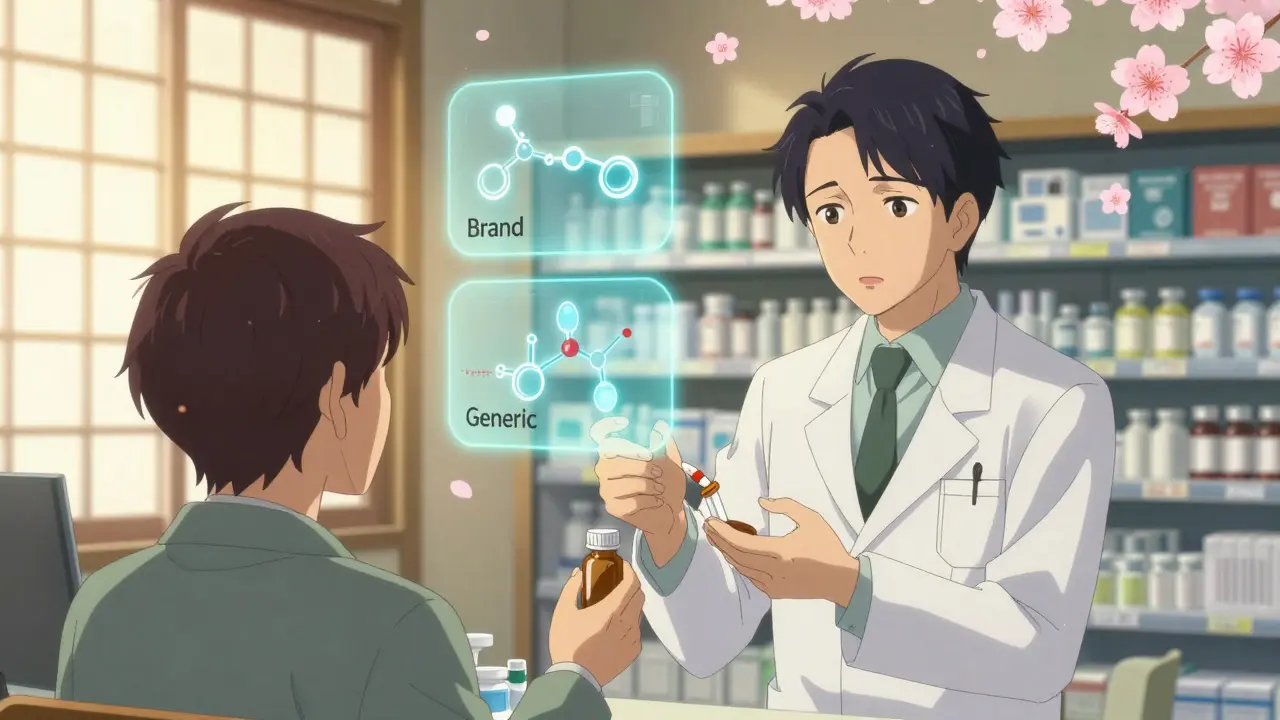
When you pick up a prescription and see a pill that looks completely different from what you’ve been taking, it’s natural to pause. Generic medications are just as effective as their brand-name versions-but many people don’t know that. Without clear counseling from your pharmacist, it’s easy to assume something’s wrong. Maybe you think the generic is weaker. Maybe you’re worried about side effects. Or maybe you just stopped taking it because it looked different. You’re not alone. Studies show nearly 31% of patients get confused when their medication changes appearance after switching to a generic. But here’s the truth: if your pharmacist does their job right, you shouldn’t feel any difference at all.
What Exactly Is a Generic Drug?
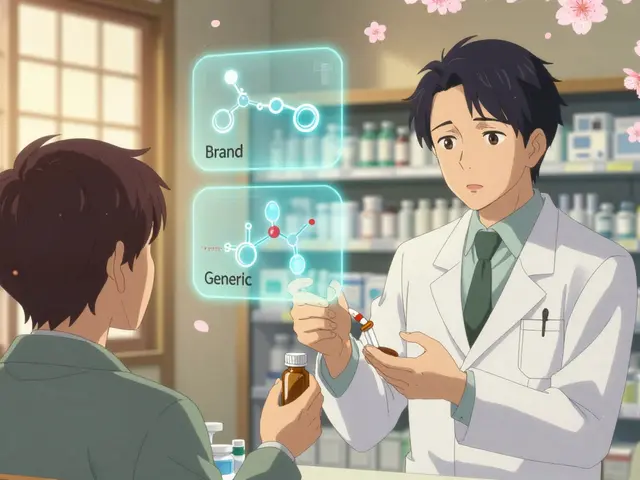
A generic drug isn’t a copycat. It’s the exact same medicine, just without the brand name. The FDA the U.S. Food and Drug Administration, the federal agency responsible for approving and regulating medications requires generics to meet strict standards. They must have the same active ingredient, same strength, same dosage form (pill, liquid, injection), and same route of administration (oral, topical, etc.) as the brand-name drug. The FDA calls this therapeutic equivalence the condition where two drugs produce the same clinical effect and safety profile in patients. In plain terms: if your brand-name drug works, the generic will too.
The FDA doesn’t just trust manufacturers. Every generic goes through a rigorous testing process called bioequivalence. This means scientists compare how fast and how much of the drug enters your bloodstream compared to the brand. The difference must be within 80% to 125%-a range so tight, it’s like matching two identical clocks to the second. Over 40 years of real-world data show that generics work just as well. In fact, a 2018 study tracking 12.7 million patients found that those on generics had an 8.2% higher rate of taking their meds as prescribed.
Why Do Generics Look Different?
If the medicine is the same, why does it look different? Because inactive ingredients change. These are things like dyes, fillers, and coatings-materials that help make the pill stable, easy to swallow, or easier to manufacture. The FDA doesn’t require generics to match the brand’s color or shape. That’s why your blue pill might now be white, or your capsule might be smaller. For most people, this doesn’t matter. But for some, it does.
If you have allergies-especially to lactose, gluten, or certain dyes-you need to know what’s in the pill. A 2022 report from the American Society of Health-System Pharmacists (ASHP) highlights that 14 classes of medications have higher risks for allergic reactions due to inactive ingredients. One patient on Drugs.com shared that they had a reaction to a generic blood pressure pill because it contained lactose, which wasn’t in the brand version. That’s why your pharmacist should always ask: “Do you have any allergies or sensitivities?”
What Should Your Pharmacist Tell You?
Under federal law (OBRA ’90), pharmacists are required to counsel patients when dispensing generics. But not all do it well. Here’s what they should cover:
- Therapeutic equivalence: “This is the same medicine as your old pill. The active ingredient is identical.”
- Why it looks different: “The color and shape changed because the manufacturer is different. That doesn’t affect how it works.”
- Dosage instructions: “Take one pill daily with water, same as before.”
- Potential side effects: “You might still feel the same side effects as before-dizziness, nausea, etc.”
- Inactive ingredients: “This version has [lactose/food coloring/etc.]. If you’re allergic to that, let us know.”
- Cost savings: “You’re saving $120 this month. That’s why generics exist.”
And here’s the most important part: they should use the “teach-back” method. That means they ask you to explain it back in your own words. “So, how will you take this pill?” If you can say it correctly, you understand. If you hesitate, they keep explaining. A 2020 study found that pharmacies using this method saw an 89% improvement in patient understanding.

When Generics Might Not Be Safe
Most of the time, generics are perfectly safe. But there’s one big exception: Narrow Therapeutic Index (NTI) drugs medications where small changes in dosage can lead to serious side effects or treatment failure. These include drugs like warfarin (blood thinner), levothyroxine (thyroid), and phenytoin (seizure control). For these, even tiny differences in how the body absorbs the drug can be dangerous.
Twenty-three states have lists of NTI drugs where automatic substitution is banned unless your doctor specifically approves it. Even then, many pharmacists will double-check with the prescriber. If you’re on one of these meds and your pharmacy switches you to a generic without asking, speak up. Ask: “Is this approved for my specific drug?”
What to Do If You Notice a Change
Let’s say you pick up your refill and the pill looks nothing like before. Here’s what to do:
- Don’t stop taking it. Just because it looks different doesn’t mean it’s wrong.
- Ask the pharmacist: “Is this the same as my last pill?”
- Ask: “What’s the generic name?” (It’s often printed on the bottle.)
- Ask: “Are there any new ingredients I should know about?”
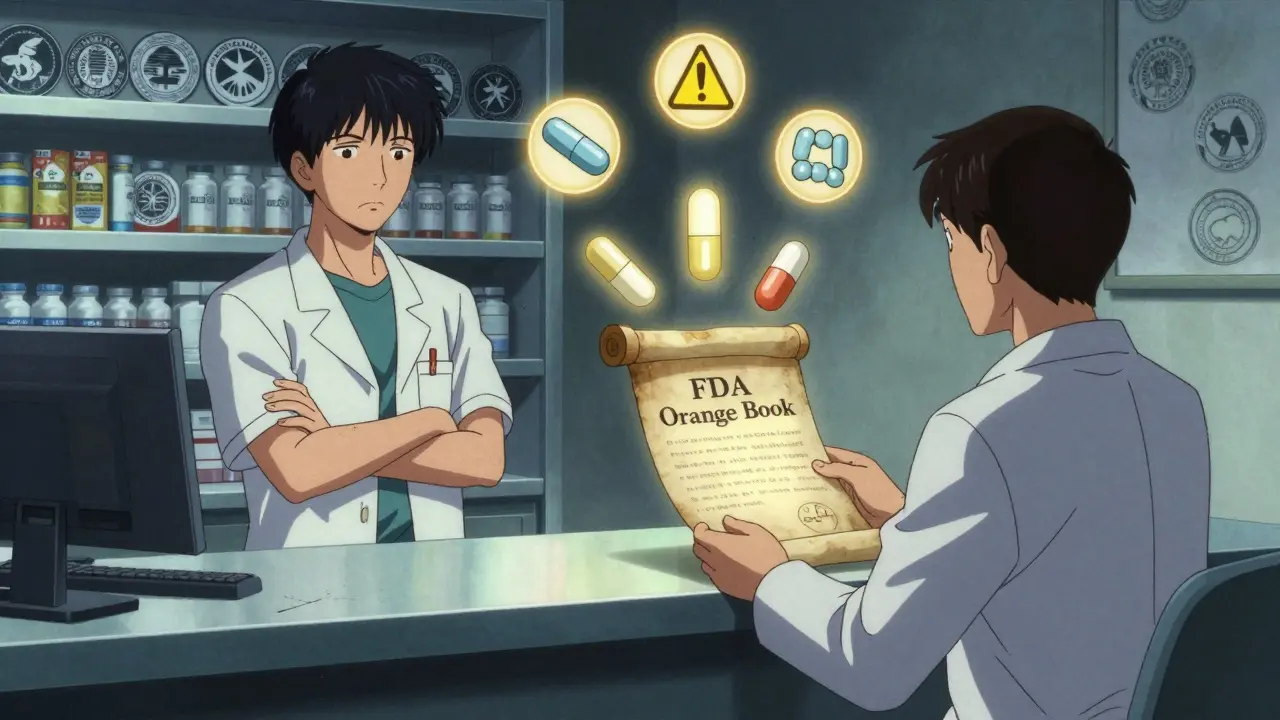
- If you’re unsure, ask for the FDA Orange Book the official government list of approved generic drugs and their therapeutic equivalence ratings entry. Pharmacists can pull it up on their computer.
If your pharmacist brushes you off or says, “It’s just a generic,” walk out and go elsewhere. Good counseling isn’t optional-it’s the law.
How Counseling Saves You Money-and Your Health
Generics aren’t just cheaper. They help you stay healthy. A 2019 IQVIA study found that states with strong counseling rules had 12.3% higher generic use. That’s not just about savings-it’s about adherence. When patients understand why a generic is safe, they take it consistently. That means fewer hospital visits, fewer complications, and lower overall costs.
One patient on PatientsLikeMe wrote: “My pharmacist spent 10 minutes showing me the FDA entry for my drug. I switched to the generic and saved $300 a month. No difference in how I felt.” That’s the power of clear, honest counseling.
On the flip side, patients who get no explanation are more likely to stop taking their meds. A Kaiser Family Foundation study found that 76% of patients who received full counseling were happy with the switch. Only 39% of those who got a quick “here’s your pill” were satisfied.
What If You’re Still Not Sure?
Trust your gut. If something feels off, ask again. You have the right to know what you’re taking. You can also check the FDA’s website for the Orange Book entries yourself. Or call your prescriber. But don’t assume the worst. Most generics are safe, effective, and approved by the same agency that approves brand-name drugs.
Remember: the goal isn’t just to give you a cheaper pill. It’s to make sure you stay healthy, take your medicine, and save money-all without compromise.
Are generic drugs really as effective as brand-name drugs?
Yes. The FDA requires generics to have the exact same active ingredient, strength, dosage form, and route of administration as the brand-name version. They must also pass strict bioequivalence tests, proving they work the same way in the body. Over 40 years of clinical data and 147 studies reviewed by the American College of Physicians confirm that generics are therapeutically equivalent in 99.5% of cases.
Why do generic pills look different?
The color, shape, or size of a generic pill can differ because manufacturers use different inactive ingredients-like dyes or fillers-to make the pill. The FDA doesn’t require generics to match the brand’s appearance. These differences don’t affect how the medicine works, but they can confuse patients. Always ask your pharmacist if the change is normal.
Can I be allergic to a generic drug?
Yes, but not because of the active ingredient. Allergic reactions to generics are caused by inactive ingredients like lactose, gluten, or food dyes-which may differ between brand and generic versions. If you have known allergies, always ask your pharmacist to check the inactive ingredients list before accepting a generic substitution.
Should I avoid generics for blood pressure or thyroid meds?
For most people, generics for blood pressure or thyroid meds are safe. But these drugs have a narrow therapeutic index, meaning small changes in dosage can cause problems. In 23 states, pharmacists can’t automatically substitute these without your doctor’s approval. If you’re on one of these, ask if substitution was approved and if the generic is listed as therapeutically equivalent in the FDA Orange Book.
What if my pharmacist won’t explain the generic to me?
You have a legal right to counseling when receiving a generic medication under OBRA ’90. If your pharmacist refuses or rushes you, ask to speak with the pharmacist in charge. If they still won’t help, you can file a complaint with your state board of pharmacy. Alternatively, go to another pharmacy-many offer free, detailed counseling with no pressure.
Generic medications are one of the most reliable tools we have to make healthcare affordable without sacrificing quality. But only if you understand them. Don’t let appearance fool you. Ask questions. Demand answers. Your health depends on it.



Ashley Johnson
February 24, 2026 AT 03:00They’re lying. Generics aren’t the same. I took one and my anxiety went through the roof. The FDA? Please. They’re in bed with Big Pharma and Big Generic. You think they really test these things? Nah. They just rubber-stamp them. I’ve seen the inside of a pill factory-trust me, it’s not clean. They’re just repackaging junk and calling it medicine. And don’t even get me started on the dyes. I swear, some of those pills have more chemicals than my laundry detergent.
Lillian Knezek
February 25, 2026 AT 14:10Same. I switched to generic lisinopril and felt like I was being slowly poisoned. 😭 Now I only take brand. Worth every penny. My body knows.
Maranda Najar
February 26, 2026 AT 00:00Oh. My. GOD. I just read this and I’m weeping. I’ve been through this nightmare. I was on a generic thyroid med-same active ingredient, they said. Same? SAME?! I felt like a ghost walking through life. My hair fell out. My heart raced. I couldn’t sleep. I begged my pharmacist. I called my doctor. I screamed into the void. And then-BAM-I switched back. The brand. The one with the little blue dot. I felt human again. This isn’t about money. This is about dignity. About trust. About the quiet, trembling hope that the system still cares. Please. Please. Ask. Demand. Fight.
Christopher Brown
February 26, 2026 AT 18:32Generics are for losers. If you can’t afford the real thing, you shouldn’t be taking pills at all. This country is falling apart because people are too lazy to pay for quality. The FDA? A joke. China makes 80% of these generics. Do you know what’s in those factories? I do. And I’m not sleeping tonight.
Sanjaykumar Rabari
February 27, 2026 AT 20:16My uncle died because of generic. Doctor said same. But my uncle got weak. Then coma. Then gone. No one told us about inactive ingredients. Now I only take brand. No more chances. India makes many generics. But not all are safe. You must check. Always.
Kenzie Goode
March 1, 2026 AT 12:19I’ve been on both. Brand. Generic. Honestly? I couldn’t tell the difference. But I do think pharmacists should explain it better. Not just hand you the pill and say ‘here you go.’ A little patience goes a long way. I appreciate when someone takes the time. It makes me feel seen.
Valerie Letourneau
March 3, 2026 AT 03:12As a Canadian pharmacist, I can confirm that our regulatory framework is equally rigorous. We require bioequivalence testing, and our guidelines mirror those of the FDA. The appearance of generics may vary, but the therapeutic outcome does not. What matters most is patient education. In our clinics, we use visual aids and printed handouts. We ask patients to repeat back the instructions. We do not rush. We do not assume. We listen. This is not just policy-it is professional ethics.
Khaya Street
March 3, 2026 AT 17:04Look, I get it. You want to save money. But don’t play games with your health. If you’re on warfarin or levothyroxine, stick with the brand. I’ve seen too many people get rehospitalized because someone tried to cut a corner. Pharmacists owe you more than a shrug. You’re not a number. You’re a person. And you deserve better.
Christina VanOsdol
March 4, 2026 AT 04:48Okay. So. I had a reaction. To a generic. Because of lactose. I didn’t know. The pharmacist didn’t tell me. I had a full-on allergic episode. Swelling. Hives. ER. Now? I check every. Single. Pill. I use the FDA Orange Book app. I screenshot the inactive ingredients. I send them to my doctor. I have a spreadsheet. Yes. I’m that person. And I’m not sorry. You think this is overkill? Try choking on your own tongue. Then come back.
Alfred Noble
March 4, 2026 AT 10:22Been a pharmacist for 18 years. I’ve seen the good, the bad, and the ugly. Most generics? Perfectly safe. But yeah, sometimes the filler changes. And yeah, some patients freak out. I always ask about allergies. I always explain the color change. I even draw little pictures. One guy thought his pill was a different drug because it was round instead of oval. I showed him the FDA page. He cried. Said he felt stupid. I told him: ‘No. You’re smart. You asked.’ That’s the job.
Matthew Brooker
March 4, 2026 AT 13:55You’re not alone. I used to think generics were shady too. Then I started reading the science. Then I talked to patients. Then I realized: this is how we make healthcare work for everyone. Not just the rich. Not just the lucky. The system isn’t perfect-but when pharmacists do their job? It’s beautiful. I’ve seen people cry because they saved $200 a month. I’ve seen them take their meds for the first time in years. That’s the real win. Don’t let fear steal your health. Ask. Learn. Trust the data.
Emily Wolff
March 4, 2026 AT 20:15If you’re taking generics, you’re already losing. Real medicine doesn’t come in unlabeled pills. You think the FDA cares? They’re bureaucrats. You’re a guinea pig. And you’re proud of it?
Lisandra Lautert
March 4, 2026 AT 22:57I took a generic for my anxiety. Felt like a zombie. I demanded the brand. Got it. Now I’m alive again. Don’t be a hero. Don’t be a martyr. Just ask. That’s it.
Cory L
March 5, 2026 AT 17:32Let me tell you about my grandma. She was on warfarin. Switched to generic. INR went haywire. Hospital. Three weeks. She’s fine now. But she won’t touch a generic again. I asked her why. She said: ‘Son, I’ve lived 82 years. I don’t need to test the system.’ Wise woman. Don’t be a statistic.
Bhaskar Anand
March 6, 2026 AT 17:18India makes the best generics. You Americans are paranoid. The FDA is weak. We have better testing. We have better quality. You should be proud we supply your medicine. But you don’t even know how lucky you are. You get cheap medicine. We get nothing. Just complaints. I have a cousin who works in a lab. He says your generics are fine. But you still scream. Why? Because you are weak. You don’t trust science. You trust fear.