

What IgA Nephropathy Really Does to Your Kidneys
IgA Nephropathy, sometimes called Berger’s disease, isn’t just a lab result. It’s an autoimmune attack on your kidneys. Your body makes too much of a faulty version of IgA, an antibody meant to fight infections. Instead of clearing out, this abnormal IgA clumps together with other proteins and gets stuck in the filtering units of your kidneys-the glomeruli. That’s when inflammation starts. Over time, these tiny filters scar, leak blood and protein into your urine, and slowly lose function. It’s not sudden. It creeps in. Many people don’t know they have it until they notice dark, tea-colored urine after a cold or sore throat-or until a routine blood test shows protein or blood in their urine.
It hits hardest in people between their teens and early 40s. In Asia, it’s the most common cause of kidney failure in young adults. In Western countries, it’s still the #1 form of primary glomerulonephritis. About 25% to 50% of all cases of this type of kidney disease are IgA Nephropathy. And here’s the hard truth: up to half of people with persistent proteinuria will lose kidney function within 10 to 20 years. That’s not a guess. That’s what registries show.
The New Rules: KDIGO 2025 Changed Everything
Before 2025, doctors treated IgA Nephropathy like a slow drip. Start with blood pressure meds-usually ACE inhibitors or ARBs-and wait three months to see if proteinuria drops. Only then, if it didn’t, would they consider steroids or other immune drugs. That waiting period? It was a mistake. While you waited, the IgA deposits kept damaging your kidneys. The KDIGO 2025 guidelines ended that. Now, if you’re at high risk, you start both types of treatment at the same time.
This isn’t just a tweak. It’s a full reset. The old approach assumed that lowering blood pressure and proteinuria alone would stop the disease. But IgA Nephropathy has its own engine-the abnormal IgA production. You need to shut that down and protect your kidneys from the damage it causes. That’s why the new guidelines say: treat the cause and the consequence, together.
What “High Risk” Really Means Now
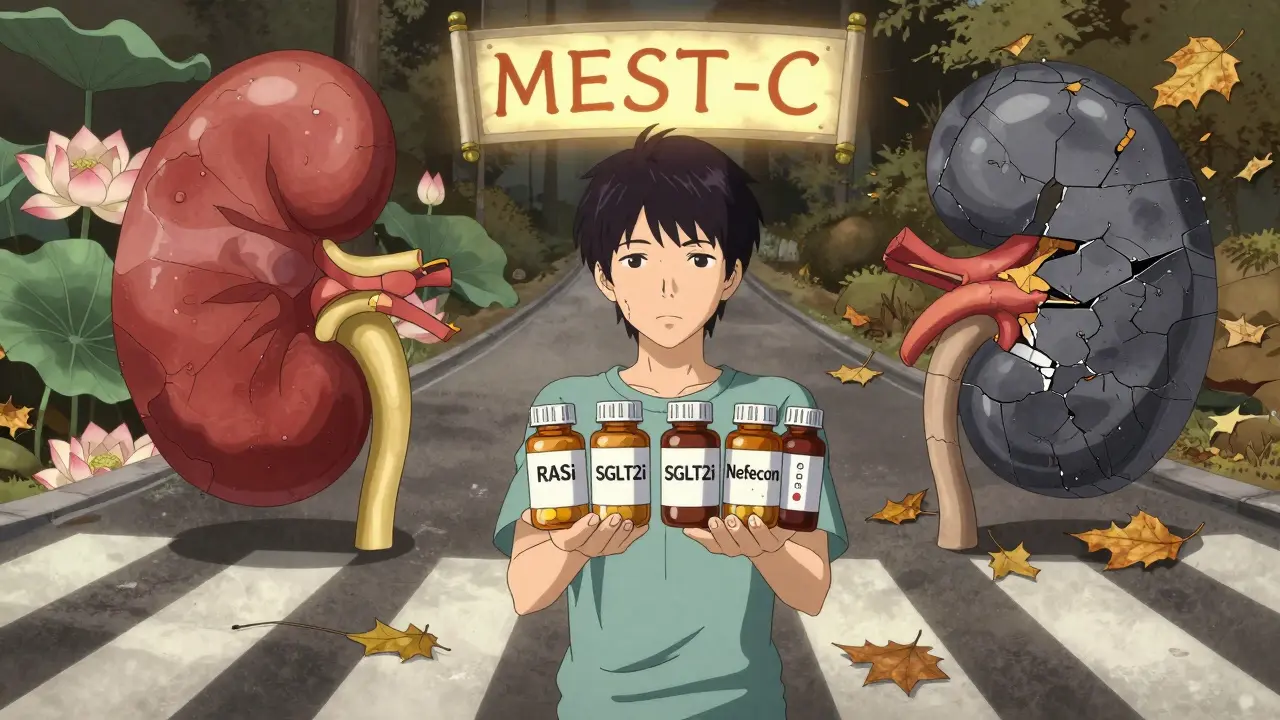
You can’t treat everyone the same. The 2025 guidelines use a risk calculator that looks at four things: how much protein you’re losing in your urine, your blood pressure, your kidney function (eGFR), and what your kidney biopsy shows (the MEST-C score). If you’re losing more than 0.75 grams of protein per day and have high blood pressure or low kidney function, you’re in the high-risk group. Even if your proteinuria is between 0.5 and 0.75 g/day, but your biopsy shows scarring (mesangial hypercellularity or endocapillary proliferation), you’re still considered high risk.
This shift matters because proteinuria used to be the only number that mattered. Now we know that even patients with proteinuria under 0.88 g/g creatinine can still reach kidney failure within 10 years. That’s why the new target isn’t just under 1 gram-it’s under 0.5 grams per day. It’s aggressive. It’s not easy. But data shows it’s necessary.
The Four Main Treatments You Need to Know
There are now four pillars of treatment, and which ones you get depends on your risk, your location, and your tolerance for side effects.
- RAS inhibitors (ACEi/ARBs) - These are the foundation. They lower blood pressure and reduce protein leakage. Most patients take these anyway. But now, they’re not optional-they’re mandatory from day one.
- SGLT2 inhibitors - Originally for diabetes, these drugs (like dapagliflozin) also protect kidneys in non-diabetic patients. They reduce filtration pressure and slow decline. Used with RASi, they’ve been shown to cut kidney failure risk by 30% in IgAN patients.
- Nefecon - This is the first drug approved specifically for IgA Nephropathy (FDA, December 2023). It’s a targeted-release steroid that releases budesonide in the gut, where abnormal IgA is made. It doesn’t flood your whole body with steroids. In trials, it cut proteinuria by 30-40% and slowed kidney decline by 40% over two years. Side effects? Mostly mild-sore throat, headache. But it costs $125,000 a year in the U.S. Insurance fights are common.
- Systemic glucocorticoids - Still used, especially where Nefecon isn’t available. But they’re a blunt tool. Weight gain, mood swings, bone loss, diabetes risk-these are real. The new guidelines recommend short, low-dose courses (like 0.6 mg/kg for 2 months, then taper) to reduce harm. They’re effective, but only if you can tolerate them.
Some regions have their own standards. In Japan, tonsillectomy is common-removing the tonsils reduces IgA triggers from throat infections. In China, mycophenolate mofetil and hydroxychloroquine are used more often than steroids. But outside those regions, the evidence isn’t strong enough to make them standard.
What’s on the Horizon? The Next Five Years
The future of IgA Nephropathy isn’t just about more drugs-it’s about smarter drugs. Right now, we guess who will respond. In five years, we might know. Several biomarkers are being tested: levels of galactose-deficient IgA1, antibodies against it, and complement proteins. If these pan out, we’ll be able to say: “Your IgA profile matches this pathway-so we’ll use this drug.”
Three new drugs are in phase 3 trials right now. One blocks APRIL, a protein that tells immune cells to make bad IgA. Another targets the complement system, which amplifies kidney damage. A third, sparsentan (approved in Europe in 2024), blocks both endothelin and angiotensin-two systems that raise pressure in the glomeruli. It’s already showing better proteinuria reduction than RASi alone.
And then there’s the big question: Can we stop the disease before it starts? Researchers are now looking at early signs in healthy people with family history or recurrent hematuria. Could we intervene before proteinuria even appears? That’s the next frontier.
The Real-World Struggle: Cost, Access, and Burnout
Here’s the gap between guidelines and reality. In the U.S., 68% of patients trying Nefecon get denied by insurance at first. Many need to file appeals, sometimes with letters from their nephrologist, lab results, and proof of failed alternatives. The process can take months. By then, some patients lose hope-or just give up.
Patients on combination therapy-RASi, SGLT2i, Nefecon, and maybe a steroid-are managing four pills a day, with different schedules. Some take them with food, others on empty stomach. Some need blood tests every month. It’s exhausting. A 16-year-old on Facebook told her group: “I hate taking so many pills. I feel like a lab rat.”
And it’s not just the U.S. In low- and middle-income countries, only 22% of patients get guideline-recommended care. Nefecon? Unavailable. SGLT2 inhibitors? Too expensive. Even ACE inhibitors aren’t always stocked. This isn’t just a medical problem-it’s a justice problem.
What You Can Do Right Now
If you have IgA Nephropathy, here’s what matters most:
- Track your numbers-proteinuria, blood pressure, eGFR. Write them down. Know your trend. If your proteinuria is still above 0.5 g/day after six months, ask your doctor why.
- Ask about Nefecon-even if you’re on steroids. It’s safer. Ask if your insurance covers it. If they say no, ask for the appeal process. Many patients win on second try.
- Don’t skip SGLT2 inhibitors-even if you’re not diabetic. They’re not just for blood sugar. They protect your kidneys.
- Know your biopsy-ask for a copy of your MEST-C score. If you have “C” (crescents) or “E” (endocapillary proliferation), you’re at higher risk. That changes your treatment plan.
- Join a patient group-the IgA Nephropathy Support Group on Facebook has over 8,500 people. They share insurance tips, side effect hacks, and emotional support.
The goal isn’t just to survive. It’s to live well. To work. To travel. To raise kids. To not be defined by your kidneys. The tools to do that exist now. The challenge is getting them to everyone who needs them.
Can IgA Nephropathy be cured?
No, there’s no cure yet. But with the right treatment, many people can stop the disease from progressing. Some achieve long-term remission-meaning their proteinuria stays below 0.5 g/day and their kidney function stays stable for decades. The goal isn’t to eliminate the disease completely, but to prevent kidney failure. That’s achievable for most people if treatment starts early and is aggressive enough.
Is Nefecon better than steroids?
For most patients, yes. Nefecon targets the gut, where the faulty IgA is made, so it doesn’t flood your whole body with steroids. That means fewer side effects-no major weight gain, less risk of diabetes or bone loss. Clinical trials show it’s just as effective at reducing proteinuria and protecting kidney function. The big downside is cost and access. If you can get Nefecon and tolerate it, it’s the preferred option. If you can’t, low-dose steroids are still a valid choice.
Why is proteinuria under 0.5 g/day the new target?
Because studies showed that even patients with proteinuria between 0.44 and 0.88 g/g creatinine still had a 30% chance of kidney failure within 10 years. That’s too high. The old target of under 1 g/day was based on older data. Newer, longer-term studies proved that lower is better. Getting proteinuria under 0.5 g/day significantly reduces the risk of needing dialysis or a transplant. It’s not just a number-it’s a life-saving threshold.
Do I need a kidney biopsy?
If your doctor suspects IgA Nephropathy and you’re at high risk for progression, yes. A biopsy confirms the diagnosis and gives you the MEST-C score, which tells you how much scarring or inflammation is already there. That score directly affects your treatment plan. If you have crescents or endocapillary proliferation, you need stronger therapy. If your proteinuria is low and your kidney function is normal, your doctor might wait. But for most adults with persistent proteinuria and hematuria, a biopsy is the standard next step.
Can I still drink alcohol or exercise?
Moderate alcohol is usually fine-no more than one drink a day. But avoid binge drinking. Alcohol can raise blood pressure and make proteinuria worse. Exercise is not just okay-it’s encouraged. Regular activity helps control blood pressure, reduces inflammation, and improves overall health. Avoid contact sports if your kidneys are very fragile, but walking, swimming, cycling, and yoga are all safe and beneficial. The key is consistency, not intensity.
How often should I see my nephrologist?
In the first 3 months of starting or changing treatment, check in monthly. You need frequent blood and urine tests to track proteinuria and kidney function. After that, if things are stable, every 3 months is standard. But if your proteinuria isn’t dropping, or if you’re on steroids or Nefecon, your doctor may want you back sooner. Don’t wait for symptoms-this disease doesn’t cause pain until it’s advanced. Regular monitoring is your best defense.





Nick Flake
February 2, 2026 AT 15:26Bro. This post is a MASTERCLASS. 🤯 I’ve been living with IgAN for 8 years and no one ever explained it like this. The way you broke down KDIGO 2025? Pure genius. I cried reading the part about ‘not being defined by your kidneys.’ That’s the quote I’m putting on my fridge. Thank you.
larry keenan
February 3, 2026 AT 20:00The shift from reactive to proactive management in KDIGO 2025 represents a paradigmatic evolution in nephrologic care. The concomitant targeting of pathogenic IgA production and downstream glomerular injury aligns with emerging immunopathological models of disease progression. Nefecon’s gut-targeted mechanism is particularly compelling from a pharmacokinetic standpoint.
Sandeep Kumar
February 4, 2026 AT 15:46USA thinks it owns medicine now? Nefecon costs 125k? In India we fix this with turmeric and tonsillectomy. No fancy pills needed. Your system is broken. We have better outcomes with half the cost. Stop acting like you invented kidneys.
Brittany Marioni
February 5, 2026 AT 12:49Thank you so much for writing this. I’m a nurse who works with renal patients, and I’ve seen so many give up because they didn’t understand the options. This is the kind of clarity we need. I’m sharing this with every patient I see. Please keep writing. 💪
Chinmoy Kumar
February 7, 2026 AT 11:20really cool post man… i had no idea about nefecon… i thought steroids were still the main thing… also the part about proteinuria under 0.5 g/day… that’s wild… i thought 1g was the goal… my doc never told me that… gonna ask him next week… thanks for the info… also the fb group link is gold
Dan Pearson
February 8, 2026 AT 00:05Oh wow, so now we’re supposed to believe that a drug that costs more than my car is ‘the future’? And you’re just gonna hand this to people who can afford it? Meanwhile, my cousin in Texas got denied 4 times and now she’s on dialysis. Great job, medicine. You’re so compassionate. 😂
Monica Slypig
February 10, 2026 AT 00:04As someone who’s been in the US healthcare system for 12 years… this is exactly what’s wrong. Nefecon? Sure. But only if you’re rich. Meanwhile, the VA won’t even prescribe SGLT2i unless you’re diabetic. This isn’t progress. It’s a luxury product wrapped in medical jargon. And don’t get me started on biopsy costs. I had to sell my laptop to pay for mine.
Vatsal Srivastava
February 10, 2026 AT 12:58Everyone’s talking about Nefecon like it’s magic. But the trial data is two years. What about 10-year outcomes? Also, why is tonsillectomy ignored in the West? We know it works. It’s not about money. It’s about bias. You all just love pills. Too lazy to cut stuff out
Bob Hynes
February 10, 2026 AT 17:10As a Canadian, I can confirm-Nefecon isn’t approved here yet. We’re stuck with steroids and hope. My brother’s on it. He’s gained 30 lbs, can’t sleep, and still has protein in his urine. This system is broken across borders. We need global access, not just US marketing.
Brett MacDonald
February 12, 2026 AT 09:13so like… if i dont have money for nefecon… am i just gonna die? because that’s what it sounds like. also why is everyone so calm about this? like… its not just a number. its my kidneys. my life. why is this so quiet?
Becky M.
February 12, 2026 AT 10:51My mom’s from India and she always said, ‘If your body’s sick, fix the inside, not just the outside.’ Tonsillectomy made sense to her. I never thought about it until now. Also, I didn’t know SGLT2i worked for non-diabetics. That’s a game-changer. Thank you for explaining this so gently. I’m printing this out.
Ellie Norris
February 13, 2026 AT 18:54Just wanted to say I’m in the UK and we’ve got access to SGLT2i and RASi, but Nefecon’s still under review. I’ve been tracking my proteinuria for 18 months-down from 1.8 to 0.42. It’s not easy, but it’s possible. Keep going. You’re not alone. 🤍
clarissa sulio
February 15, 2026 AT 11:04My nephrologist said I’m ‘low risk’ because my proteinuria is 0.6. But your post just made me realize I’m still in danger. I’m scheduling a biopsy tomorrow. Thanks for the wake-up call.