
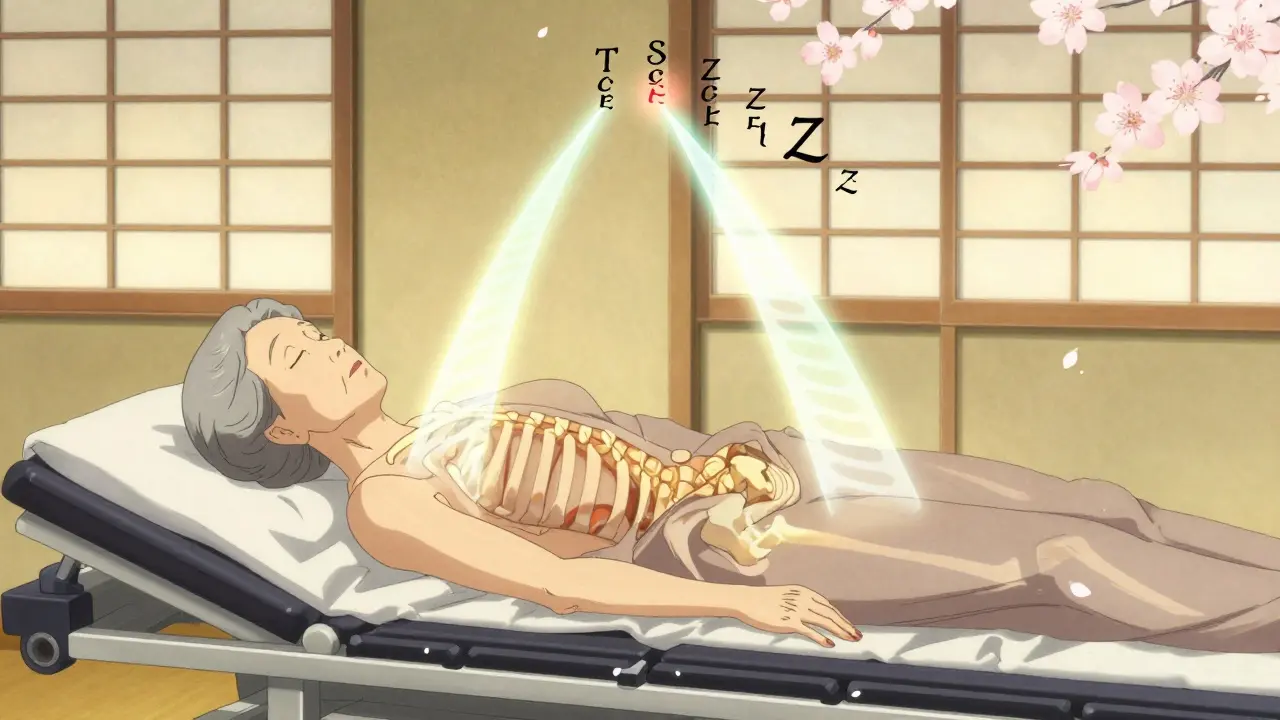
Most people don’t think about their bones until they break. But by then, it’s often too late. Osteoporosis doesn’t come with warning signs-no pain, no swelling, no redness. It’s silent. That’s why DEXA scan results matter more than you might realize. If you’re over 65, have had a fracture after age 50, or are on long-term steroid medication, getting a DEXA scan isn’t optional-it’s a preventive step that could change your future.
What a DEXA Scan Actually Measures
A DEXA scan (dual-energy X-ray absorptiometry) isn’t a regular X-ray. It’s a low-dose imaging test that measures how dense your bones are, specifically in the spine and hip. The machine sends two different X-ray beams through your body. One passes easily through soft tissue, the other gets absorbed by bone. By comparing how much of each beam makes it through, the computer calculates your bone mineral density in grams per square centimeter.
The radiation you get from a DEXA scan is tiny-less than what you’d absorb from a day of natural sunlight. In fact, it’s about the same as eating a banana or taking a short flight. You lie still on a table for about 10 minutes. No needles. No injections. No discomfort.
It’s not just about bone mass. DEXA also checks for vertebral fractures you might not even know you have. That’s called VFA-vertebral fracture assessment. It’s not always done, but if you’re over 70, have lost height, or have a history of back pain, it should be.
Understanding Your T-Score and Z-Score
Your DEXA report will show two numbers: T-score and Z-score. Most people focus on the T-score. That’s the one that tells you if you have osteoporosis.
- T-score of -1.0 or higher: Normal bone density. Your bones are strong.
- T-score between -1.0 and -2.5: Osteopenia. Your bone density is lower than average but not yet osteoporosis. This is your warning sign.
- T-score of -2.5 or lower: Osteoporosis. Your bones are fragile and at high risk of breaking.
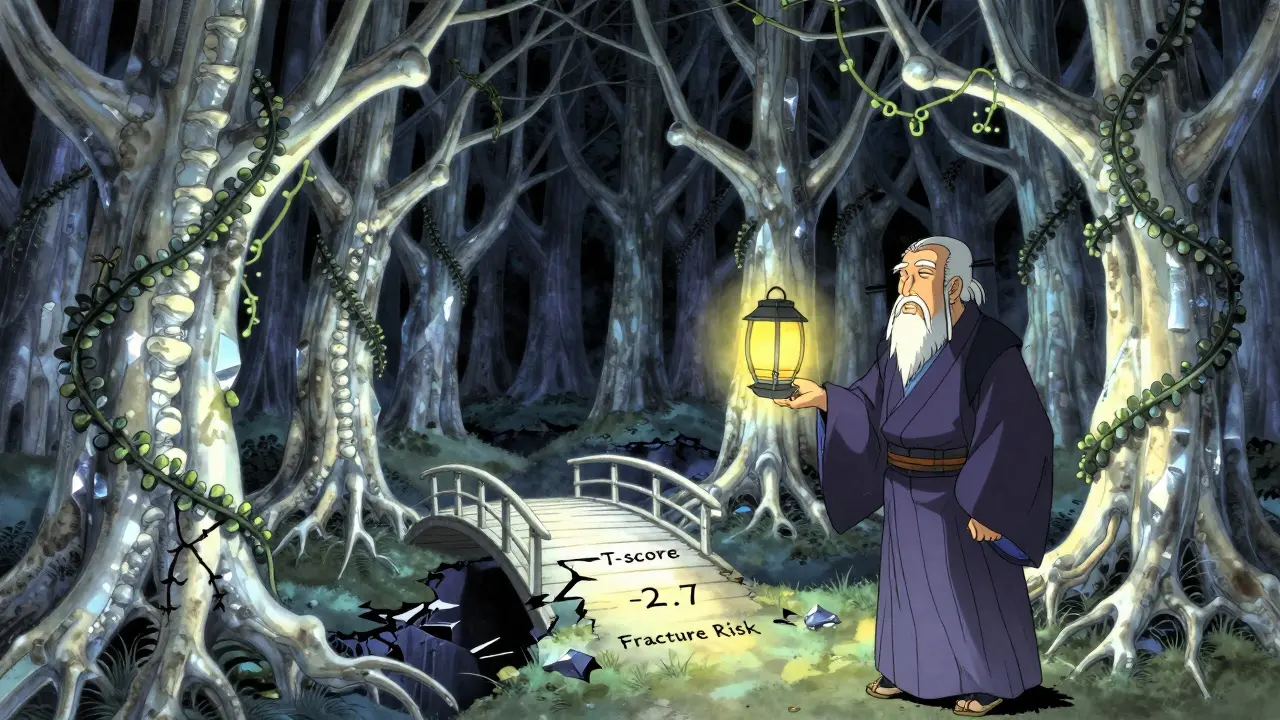
For example, a T-score of -2.7 means your bone density is 2.7 standard deviations below the average for a healthy 30-year-old adult of your sex and race. That’s not just a little low-it’s clinically significant.
The Z-score is different. It compares your bone density to people your own age. A low Z-score in a 45-year-old might point to an underlying condition-like celiac disease, rheumatoid arthritis, or long-term steroid use. But in a 75-year-old, a low Z-score is expected. That’s why doctors look at both scores together.
Why T-Score Alone Isn’t Enough
Here’s the catch: a T-score doesn’t tell the whole story. Two people with the same T-score can have very different fracture risks. Why? Because bone quality matters just as much as bone quantity.
Think of it like a wooden beam. Two beams can have the same thickness (bone density), but one might be warped, cracked, or rotten (poor microstructure). That’s where the FRAX tool comes in.
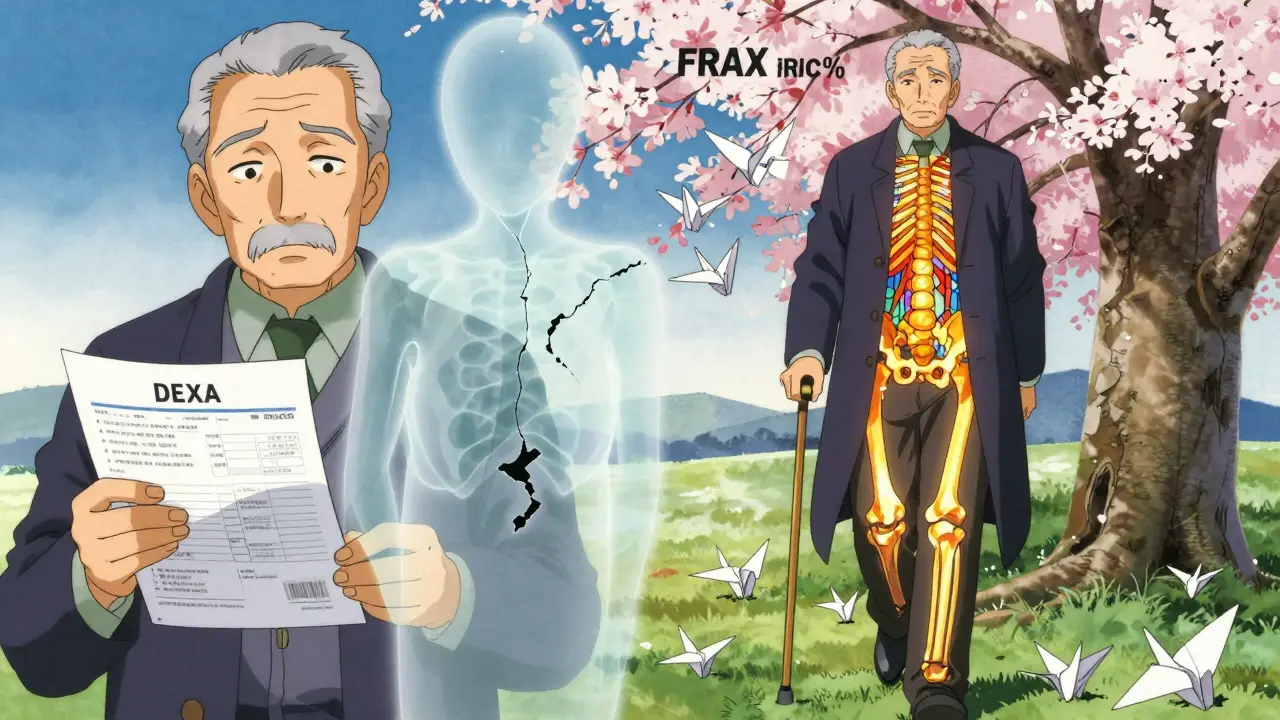
FRAX is a free online calculator developed by the World Health Organization. It takes your T-score and adds in other risk factors: age, sex, weight, smoking, alcohol use, family history of hip fracture, rheumatoid arthritis, and whether you’ve had a prior fracture. It then gives you a percentage chance of breaking a bone in the next 10 years.
For example, a 70-year-old woman with a T-score of -2.3 might have a 15% risk of major fracture. But if she smokes, drinks two glasses of wine daily, and her mother broke her hip at 78, that risk jumps to 32%. That changes everything. Treatment isn’t just about the number on the scan-it’s about your life.
What Happens After the Scan?
If your T-score is normal? Great. Keep doing what you’re doing: get enough calcium (1,200 mg/day), vitamin D (800-1,000 IU/day), and stay active. Walking, lifting weights, tai chi-all help keep bones strong.
If you have osteopenia? You’re not doomed. Many people with osteopenia never develop osteoporosis. But you should take action. Talk to your doctor about lifestyle changes. If you’re at high risk (based on FRAX), you might need medication. Bisphosphonates like alendronate or risedronate are common first-line treatments. They reduce fracture risk by 40-50% over three years.
If you have osteoporosis? Treatment is urgent. Studies show that without treatment, one in two women over 50 will break a bone due to osteoporosis. The most common? Hip, spine, wrist. A hip fracture can mean losing independence. Spinal fractures can lead to chronic pain and a hunched back.
Medications like denosumab or teriparatide are options if bisphosphonates don’t work or aren’t tolerated. Newer drugs like romosozumab can even rebuild bone. But they’re not for everyone. Your doctor will weigh your risks-like heart disease or kidney issues-before prescribing.
Common Misunderstandings About DEXA Scans
Many people think a DEXA scan is only for older women. It’s not. Men over 70 should get one too. And if you’re a man under 70 with risk factors-low testosterone, steroid use, Crohn’s disease-you should be screened as well.
Another myth: if you’ve had a fracture, you don’t need a scan. Wrong. The first fracture is often the first sign of osteoporosis. If you broke your wrist falling off a ladder at 62, that’s not just bad luck. It’s a red flag.
And don’t assume your DEXA results are permanent. Bone density can improve. With the right treatment and lifestyle, T-scores can go up by 0.1 to 0.3 over two years. That’s not a cure, but it’s progress.
What DEXA Can’t Do
DEXA doesn’t show bone quality in detail. It can’t tell if your bones are brittle, porous, or have weak internal structure. That’s why some clinics now add Trabecular Bone Score (TBS) to the DEXA report. TBS analyzes the texture of the bone on the scan image. A rougher texture means weaker structure. Studies show TBS improves fracture prediction by up to 18%.
DEXA also struggles with people who have severe arthritis, spinal fusion, or metal implants. In those cases, doctors might use QCT (quantitative CT), but it’s more expensive and exposes you to more radiation. DEXA is still the gold standard for a reason.
Who Should Get a DEXA Scan?
The guidelines are clear, but not everyone follows them. Here’s who should be screened:
- Women 65 and older
- Men 70 and older
- Postmenopausal women under 65 with risk factors (low body weight, smoking, family history)
- Men 50-69 with risk factors
- Anyone who’s had a fracture after age 50
- People on long-term steroid therapy (more than 3 months)
- Those with conditions linked to bone loss: rheumatoid arthritis, celiac disease, hyperthyroidism
In Australia, Medicare covers a DEXA scan every two years for eligible people. But only about 40% of eligible women get screened. The numbers are even lower for Indigenous and migrant women. That’s a gap we need to fix.
What Comes Next?
If you’ve had a DEXA scan and you’re confused by the numbers, ask for a copy. Don’t just take your doctor’s word for it. Understand what your T-score means. Ask about FRAX. Ask if TBS was calculated. Ask what your 10-year fracture risk is.
And if you haven’t had one yet? Don’t wait for a fall. If you’re in the risk group, schedule the scan now. It’s quick. It’s safe. It’s one of the few tests that can actually prevent a life-changing injury.
Bone health isn’t about supplements or trendy diets. It’s about knowing your numbers-and acting on them before it’s too late.
What does a T-score of -2.5 mean?
A T-score of -2.5 or lower means you have osteoporosis. This means your bone density is significantly below the average of a healthy young adult of your sex and race. At this level, your risk of breaking a bone-especially in the spine, hip, or wrist-increases dramatically. Treatment is usually recommended to reduce that risk.
Can you reverse osteoporosis with diet and exercise alone?
Diet and exercise can help slow bone loss and even improve bone density slightly, especially in early osteopenia. But once you reach osteoporosis (T-score ≤ -2.5), lifestyle changes alone are rarely enough to significantly reduce fracture risk. Medications like bisphosphonates or denosumab are often needed to lower fracture risk by 40-70%. Think of diet and exercise as the foundation-not the whole building.
How often should you get a DEXA scan?
If your bone density is normal or only mildly low and you’re not on medication, repeat the scan every 2-5 years. If you’re on treatment, your doctor may check every 1-2 years to see if your bone density is improving. If your T-score is very low or you have other risk factors, more frequent scans may be needed. Don’t assume you need one every year-unless your doctor says so.
Is the radiation from a DEXA scan dangerous?
No. A typical DEXA scan exposes you to about 0.001-0.03 mSv of radiation. That’s less than a day’s worth of natural background radiation from the sun and soil. For comparison, a chest X-ray is about 0.1 mSv, and a cross-country flight is about 0.03 mSv. The risk is negligible, especially compared to the benefit of preventing a fracture.
Why do some people get a Z-score instead of a T-score?
T-score compares you to a young adult peak bone mass-used for diagnosing osteoporosis in adults over 50. Z-score compares you to people your own age. It’s mainly used for younger adults (under 50), children, or people with conditions that cause early bone loss. A very low Z-score in someone under 50 might signal an underlying medical problem that needs investigation.
What to Do Next
If you’re unsure whether you need a DEXA scan, check your risk factors: age, gender, weight, medications, family history, past fractures. If you have two or more, talk to your doctor. Don’t wait for a fall. Bone loss happens slowly, but fractures happen fast.
If you’ve already had a scan and don’t understand your results, ask for a copy. Look up FRAX. Ask about TBS. Ask what your next steps are. Knowledge isn’t just power-it’s protection.

Kathy McDaniel
January 26, 2026 AT 22:50Desaundrea Morton-Pusey
January 28, 2026 AT 04:27Kirstin Santiago
January 29, 2026 AT 11:42Harry Henderson
January 29, 2026 AT 12:39suhail ahmed
January 31, 2026 AT 04:21astrid cook
February 1, 2026 AT 07:27Andrew Clausen
February 1, 2026 AT 20:50Anjula Jyala
February 3, 2026 AT 02:39Paul Taylor
February 4, 2026 AT 21:31Murphy Game
February 6, 2026 AT 10:03John O'Brien
February 6, 2026 AT 14:35Kegan Powell
February 6, 2026 AT 17:28April Williams
February 8, 2026 AT 08:42Candice Hartley
February 10, 2026 AT 02:07