

When a rheumatologist prescribes Humira instead of a biosimilar, or an oncologist chooses Ocrevus over a cheaper alternative, it’s not because they’re ignoring cost-it’s because they’ve seen what happens when patients switch.
Specialty drugs aren’t your typical prescriptions. They’re not pills you pick up at the corner pharmacy. These are high-cost, complex medications used to treat rare, chronic, or life-threatening conditions like multiple sclerosis, rheumatoid arthritis, and certain cancers. They often require injections, infusions, or special storage. And despite making up less than 7% of all prescriptions, they account for over 70% of total U.S. prescription drug spending. In 2021, the average annual cost per patient on a specialty drug was $38,000-75 times higher than for non-specialty drugs.
So why do specialists keep reaching for the brand-name version, even when generics or biosimilars are available? It’s not about loyalty to a company. It’s about fear-fear of relapse, fear of side effects, fear of losing hard-won control over a patient’s condition.
The Cost Isn’t Just Financial-It’s Clinical
One of the biggest myths is that biosimilars are just like generics. They’re not. Generics are exact copies of small-molecule drugs. Biosimilars are highly similar-but not identical-to complex biologic drugs made from living cells. That tiny difference can matter.
A 2023 Medscape survey of 1,200 specialists found that 68% reported frequent frustration with prior authorization for specialty drugs. Oncologists and rheumatologists were the most affected. But even when they get approval, many say switching patients to biosimilars feels risky. One rheumatologist in Chicago told a patient who asked why he wasn’t switching: “I’ve seen people go from stable to flaring in weeks after switching. I can’t guarantee it won’t happen to you.”
That’s not anecdotal. A 2022 study in Arthritis & Rheumatology tracked 1,100 patients with rheumatoid arthritis who switched from adalimumab (Humira) to a biosimilar. While most stayed stable, 12% experienced disease flare-ups within six months. For patients who had already lost multiple treatments, that’s not just a setback-it’s a crisis.
Patients aren’t passive in this. A Reddit thread from November 2023, titled “Specialty drug pricing nightmare,” had dozens of posts from people paying $1,200 a month out-of-pocket for Ocrevus. One user wrote: “My specialist says there are no alternatives that work as well for my specific mutation.” That’s not resistance-it’s lived experience.
When the System Works Against Patients
It’s easy to blame doctors for choosing expensive drugs. But the system makes it harder to choose cheaper options.
Pharmacy benefit managers (PBMs)-the middlemen between insurers, pharmacies, and drugmakers-control formularies. In 2023, the FTC found that the “Big 3” PBMs (Caremark, Express Scripts, OptumRx) generated over $7.3 billion in revenue from dispensing specialty drugs above their actual acquisition cost. And here’s the kicker: they mark up specialty generic drugs by thousands of percent. One drug, a generic version of a biologic, was sold for $1,800 a vial when the acquisition cost was $120. That’s a 1,400% markup.
Meanwhile, manufacturers of brand-name drugs often offer co-pay cards that reduce patient costs to $0 or $5 a month. That’s not charity-it’s strategy. These cards keep patients on expensive drugs by removing the financial pain of the price tag. But they’re not available for biosimilars. So even if a doctor wants to switch, the patient might not be able to afford it.
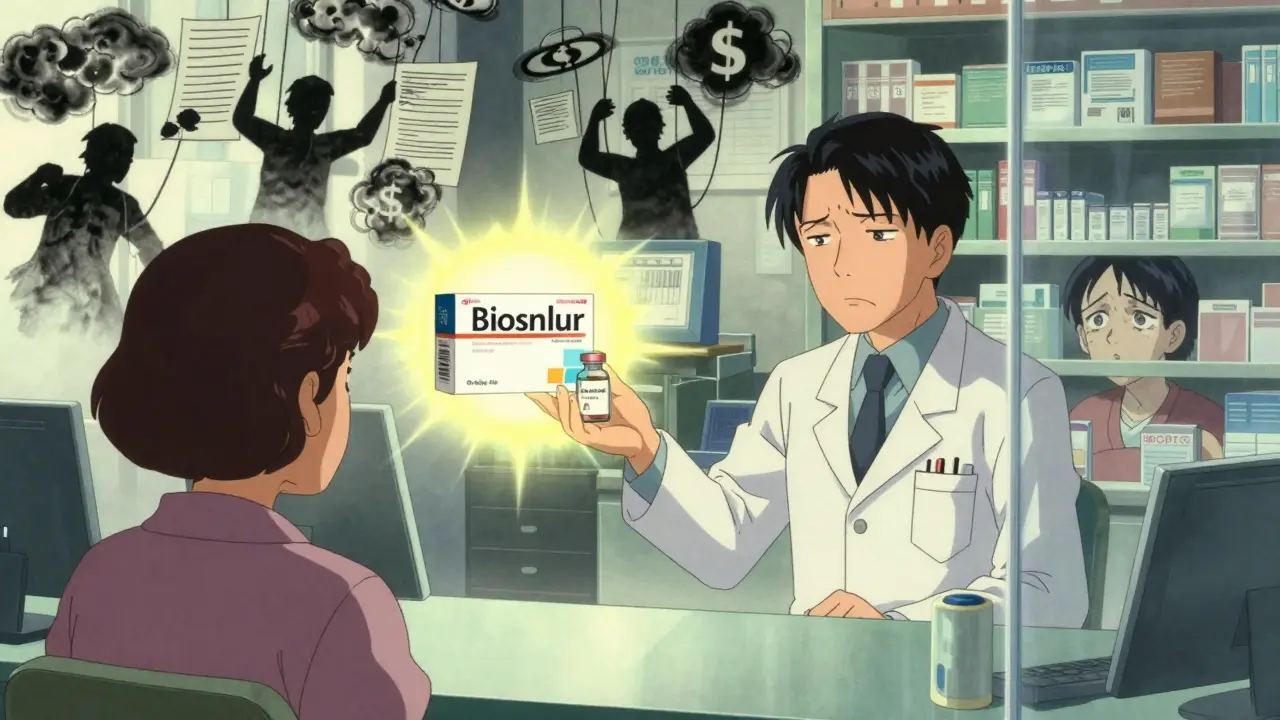
And then there’s the paperwork. Physicians spend an average of 13.4 hours a week on prior authorizations-78% of that time is on specialty drugs. One oncologist in Atlanta said: “I could write a prescription in 30 seconds. But getting approval takes three days, three phone calls, and three forms. If the brand-name version is already approved, why fight?”
Doctors Aren’t Paid to Push Brands-But They’re Influenced
There’s no direct payment system where drug companies pay doctors to prescribe their drugs. But influence runs deep.
ProPublica’s 2016 analysis found that doctors who received more than $5,000 from pharmaceutical companies in 2014 prescribed brand-name drugs at a rate 50% higher than those who received nothing. These weren’t just free dinners. They were speaker fees, consulting gigs, and educational grants tied to specific drugs.
It’s not about corruption-it’s about familiarity. When a rep shows up monthly with data, samples, and patient support materials, that drug becomes top of mind. When a biosimilar rep doesn’t show up at all, the brand stays dominant by default.
Plus, many specialists don’t have the time or training to evaluate biosimilar data. A 2024 study in JAMA Network Open found that only 31% of rheumatologists felt confident in their ability to assess biosimilar safety. That’s not ignorance-it’s a system that doesn’t equip them.
Patients Are Caught in the Middle
On the Medicare Rights Center forum, a user named SeniorCare2024 wrote: “My Humira copay went from $50 to $850 when my plan changed. My rheumatologist says biosimilars aren’t appropriate for me.”
That’s the reality. Patients rely on their doctors to protect them-not just from disease, but from financial ruin. When a doctor says, “This is the only one that works for you,” the patient believes them. And they’re right to.
For many, the difference between brand and biosimilar isn’t a cost issue-it’s a survival issue. A patient with multiple sclerosis might have tried three other drugs that failed. Ocrevus is the only one that kept them walking. Switching isn’t an option. It’s a gamble with their mobility.

What’s Changing? And What’s Not
The Inflation Reduction Act of 2022 gave Medicare the power to negotiate prices for some high-cost drugs. Starting in 2026, drugs like Jakafi, Ofev, and Xtandi will be on the list. That could lower prices-but only if the negotiated price is still profitable for manufacturers. And if it’s not, they’ll just raise the price of the next drug.
The FTC’s January 2025 report is a wake-up call. It found that PBM markups on specialty drugs grew at a compound annual rate of 42% from 2017 to 2021. Senator Bernie Sanders introduced the Specialty Drug Price Transparency Act in February 2025 to force PBMs to disclose their markups.
But none of this fixes the core issue: when a patient has no other option, the brand becomes the only option. And doctors, who’ve seen the consequences of switching, will keep prescribing it.
The Real Question Isn’t About Cost-It’s About Trust
Specialists aren’t ignoring value. They’re weighing risk. And for them, the risk of a relapse, a hospitalization, or a loss of function outweighs the cost savings of a biosimilar.
Until we fix the system-until PBMs stop gouging, until manufacturers offer equal support for generics, until doctors get better tools to evaluate biosimilars, and until patients aren’t forced to choose between their health and their bank account-brand-name drugs will stay the default.
It’s not about greed. It’s about fear. And until that fear is addressed, the prescriptions won’t change.





Oladeji Omobolaji
January 23, 2026 AT 10:18Man, I’ve seen this in Nigeria too-doctors stick to the brand because the generics? They don’t always work the same. Not because they’re shady, but because the supply chain is a mess. If your meds come from a warehouse that’s hot and humid for three weeks before reaching you, who knows what’s left in the bottle?
Janet King
January 25, 2026 AT 06:51The data shows biosimilars are clinically equivalent in most cases. The issue is not the science-it is the lack of standardized protocols for switching and inadequate physician education on biosimilar monitoring.
dana torgersen
January 25, 2026 AT 16:27Okay, so… let me get this straight… the PBMs are making, like, 1400% profit on generics?? And doctors are stuck doing paperwork for hours?? And patients are paying hundreds… and no one’s talking about how the entire system is just… broken?? Like, is this a dystopian novel or is this real life?? I mean, come on…
Laura Rice
January 26, 2026 AT 04:06I just want to say-this isn’t about doctors being greedy. It’s about trust. Trust that the drug won’t fail. Trust that the patient won’t lose their mobility. Trust that the system won’t abandon them after they switch. These aren’t just prescriptions-they’re lifelines. And when you’ve seen someone go from walking to wheelchair in six weeks after a switch? You don’t gamble with that. Ever.
Stacy Thomes
January 27, 2026 AT 01:04STOP blaming doctors. The real villains are the PBMs and the drug companies playing games with co-pay cards. If biosimilars had the same support, same cards, same reps showing up with samples-this wouldn’t be an issue. We need to level the playing field-not punish the people trying to save lives.
Dawson Taylor
January 27, 2026 AT 05:16Trust is the currency of clinical decision-making. When risk is high and data is ambiguous, the default is the known quantity. This is not irrational-it is rational conservatism.
Andrew Smirnykh
January 28, 2026 AT 16:10In my country, we don’t have this problem because the government negotiates drug prices directly. No PBMs. No co-pay cards. Just fair pricing and clear guidelines. Maybe the U.S. needs to stop treating healthcare like a marketplace and start treating it like a public good.
Kerry Evans
January 30, 2026 AT 08:32Doctors are just lazy. If they studied the data instead of listening to pharma reps, they’d realize biosimilars are safe. This isn’t about fear-it’s about ignorance and complacency. Patients deserve better than outdated thinking.
Sue Stone
January 30, 2026 AT 10:31My cousin switched to a biosimilar and had a flare-up so bad she ended up in the hospital. Now she’s on Humira again. No one’s talking about that. The system wants to save money-but not at the cost of people’s lives.
Anna Pryde-Smith
January 31, 2026 AT 23:20THIS IS WHY WE NEED TO DESTROY THE PBMs. THEY’RE THE REAL MONSTERS. THEY’RE MAKING BILLIONS WHILE PEOPLE GO BANKRUPT. DOCTORS ARE JUST TRYING TO SURVIVE THIS BROKEN SYSTEM TOO. STOP BLAMING THEM!
charley lopez
February 1, 2026 AT 13:52The pharmacoeconomic model fails to account for indirect costs associated with disease flare-ups: hospitalizations, lost productivity, and long-term disability. From a societal perspective, the marginal cost of brand-name therapy is often lower than the marginal cost of switching.
Kerry Moore
February 3, 2026 AT 11:35I appreciate how this post acknowledges the human side of this issue. It’s easy to reduce this to numbers, but behind every prescription is someone who’s afraid of losing what little stability they’ve gained. Compassion matters as much as data.
Sallie Jane Barnes
February 4, 2026 AT 16:17Let’s be real: if biosimilars had the same patient support programs-nurse hotlines, financial aid, infusion training-doctors would feel safer switching. It’s not about the drug. It’s about the safety net.
Susannah Green
February 5, 2026 AT 09:38Wait-so the brand-name companies give $0 co-pays, but biosimilars don’t? That’s not fair. That’s manipulation. It’s like giving someone a free car and then telling them they can’t get gas for the one they’re trying to switch to. That’s not competition-that’s sabotage.
Vanessa Barber
February 5, 2026 AT 20:57Actually, most biosimilars are just as effective. The 12% flare rate? That’s within normal variation. This fear is being exaggerated to protect profits. Let’s stop pretending this is about patient safety-it’s about market control.