
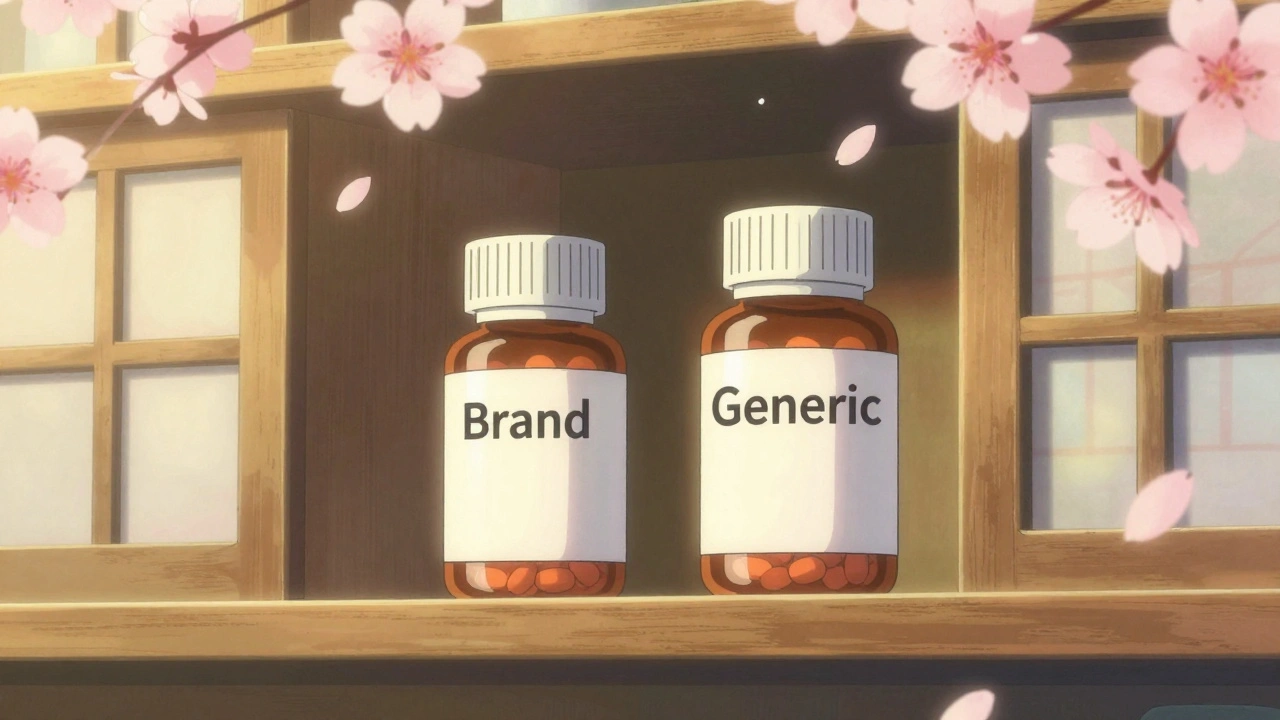
When you pick up a prescription, you might see two options: the familiar brand name or a cheaper generic version. Many assume they’re the same. But are they? Over time, do generics perform just as safely? This isn’t just about cost-it’s about whether your health is truly protected when you switch.
What Does ‘Therapeutic Equivalence’ Really Mean?
The FDA says generics are equivalent to brand-name drugs. That’s based on bioequivalence testing: the amount of active ingredient absorbed into your bloodstream must fall within 80-125% of the brand’s levels. On paper, that sounds tight. But here’s the catch: that range allows for up to a 20% difference in absorption. For most drugs, that’s harmless. For others, it’s not. Take levothyroxine, a drug used for thyroid conditions. A 2017 study found patients switching from Synthroid (brand) to generic versions had 12.3% more fluctuations in their thyroid-stimulating hormone (TSH) levels. That might not sound like much, but for someone with heart disease or an older adult, even small shifts can trigger palpitations, weight gain, or worse. The FDA’s standard was never designed for drugs where tiny changes matter.Big Studies Show Generics Can Be Safer
In 2020, researchers in Austria looked at over 1 million patients on long-term medications for high blood pressure, diabetes, and cholesterol. They tracked outcomes over five years. The results stunned many: patients on generic versions had fewer deaths and fewer heart attacks and strokes than those on brand-name drugs. For antihypertensive meds specifically:- Branded: 53.8 deaths per 1,000 patient-years
- Generics: 30.2 deaths per 1,000 patient-years
But Sometimes, Switching Causes Problems
Real people tell different stories. There are documented cases where switching from brand to generic led to clear worsening of symptoms. One patient on Ciproxin (brand ciprofloxacin) for a stubborn infection kept getting sick after switching to Mylan’s generic version. Symptoms didn’t improve until they went back to the brand. Another patient on generic levofloxacin developed a persistent fever that vanished only after switching to Tavanic. These aren’t rare flukes-they’re patterns. A 2013 analysis found that when patients switched from brand to generic:- 30% got better
- 30% saw no change
- 30% had side effects or worse symptoms
- 10% stopped the drug entirely
Who’s Making Your Generic Drug?
Here’s something most people don’t know: not all generics are created equal. A 2018 study from Ohio State University found that generic drugs made in India had 54% higher rates of severe adverse events-including hospitalizations and deaths-than those made in the U.S. For ciprofloxacin specifically, Indian-made versions caused 62% more hospitalizations due to serious side effects. That’s not a small gap. It’s a red flag. Why? Manufacturing standards vary. The FDA inspects foreign plants, but not as often as U.S. ones. And when problems arise, recalls are slow. The FDA’s own database (FAERS) shows more reports of problems tied to certain generic manufacturers-especially those producing older, off-patent drugs.Authorized Generics: The Hidden Middle Ground
There’s a version of generics most people never hear about: authorized generics. These are made by the original brand company, sold under a generic label. Same formula. Same factory. Same packaging-just cheaper. When researchers compared adverse event reports for amlodipine (a blood pressure drug), they found:- Brand: 29.54% of reports
- Authorized generic: 14.26%
- Generic (other manufacturers): 56.20%
What About the Most Critical Drugs?
Some drugs have a narrow therapeutic index. That means the difference between a helpful dose and a dangerous one is razor-thin. These include:- Warfarin (blood thinner)
- Levothyroxine (thyroid hormone)
- Phenytoin and carbamazepine (anti-seizure meds)
- Lithium (mood stabilizer)
What Do Real Patients Say?
On PatientsLikeMe, over 3,800 people reported on hypertension meds. Here’s what they found:- 78.4% said generics worked just as well
- 12.6% said generics were less effective
- 9.0% said generics worked better




Anthony Breakspear
December 1, 2025 AT 23:46Man, I’ve been on generic levothyroxine for years and never noticed a thing-until my pharmacist switched me to a new batch from some Indian plant. Suddenly I’m tired all day, heart racing like I drank three espressos. Went back to the brand? Back to normal in 48 hours. Not saying generics are trash, but don’t treat your thyroid like a lottery ticket.
Also, authorized generics? Why the hell isn’t that the default? Same pill, half the price. Pharmacies act like it’s some secret handshake.
Zoe Bray
December 2, 2025 AT 18:00While the bioequivalence threshold of 80–125% is statistically permissible under FDA guidelines, it is not clinically inert across pharmacokinetic domains, particularly for medications with a narrow therapeutic index (NTI). The variance in Cmax and AUC0–t parameters may not be statistically significant in population cohorts, yet individual pharmacodynamic responses are heterogenous and clinically consequential.
Furthermore, the differential bioavailability of excipients-such as lactose monohydrate versus microcrystalline cellulose-may induce subclinical inflammatory cascades in susceptible populations, thereby confounding therapeutic outcomes. The data from the Austrian cohort, while robust, fails to account for medication adherence as a confounder of mortality endpoints, not a causal agent of improved outcomes.
Girish Padia
December 4, 2025 AT 10:27India makes good drugs. People just don’t want to admit it. You think American pills are pure? Look at the opioid crisis. You think your brand-name pills are made in some clean lab? Nah. They’re made in the same factories, just with fancier packaging. Stop being scared of generics just because you’re used to paying more.
My cousin in Delhi takes generic warfarin. He’s fine. You’re just scared of saving money.
Saket Modi
December 5, 2025 AT 11:40Ugh. Another 10-page essay on pills. Can we just agree generics are fine and move on? I’m already late for my Zoom meeting. 😴
Chris Wallace
December 5, 2025 AT 22:51I’ve been on generic amlodipine for five years now. My blood pressure’s stable. My doctor says it’s fine. But I still remember when I switched from the brand to the cheapest generic and got this weird metallic taste in my mouth for three days. Didn’t tell anyone. Thought I was imagining it. Then I read this post and realized… maybe I wasn’t.
It’s weird, right? How something so small-like a filler or coating-can make your whole body feel off. I don’t blame people for being nervous. I just wish we talked about it more before we switched.
Also, I asked my pharmacist once if they had the authorized generic. They looked at me like I asked for a unicorn. I had to order it online. Took two weeks. Worth it.
william tao
December 7, 2025 AT 20:14Let me get this straight: you’re telling me that after 40 years of pharmaceutical science, we’re still letting companies manufacture life-altering drugs in factories with fewer inspections than a roadside taco stand? And we call this progress?
The FDA’s entire regulatory framework for generics was designed in 1984. The world has changed. People are living longer. Drugs are more complex. And yet we’re still using the same rules as when cassette tapes were cool.
Someone’s making billions off this. And you? You’re the one swallowing the consequences.
Shubham Pandey
December 9, 2025 AT 00:03Generics work. Stop overthinking. My dad takes 7 pills a day. Half are generic. He’s 82. Still walks his dog. No hospital trips. Case closed.
Elizabeth Farrell
December 9, 2025 AT 05:30Thank you for writing this. Seriously. I’ve been terrified to switch my mom’s lamotrigine since she had that seizure spike last year. I didn’t know if it was the generic or just stress. Reading this made me feel less alone.
I’ve started keeping a little journal: date switched, how I felt, sleep quality, mood. It’s not fancy, but it helps me talk to her doctor. And honestly? Just knowing there’s data out there-real stories, real numbers-makes me feel like I’m not just guessing.
To anyone scared to speak up: you’re not being dramatic. You’re being careful. And that’s not weakness. It’s wisdom.
Sheryl Lynn
December 9, 2025 AT 07:27Oh, darling, the *authorized* generic? How quaint. Like ordering a ‘designer’ knockoff that’s actually made by the original atelier. The real luxury is knowing your pharmacist has access to the *real* version-the one the brand uses, just without the logo. It’s not about saving money. It’s about *aesthetic* safety.
And let’s be honest, if your generic comes from a factory that doesn’t even have air filtration, you’re not taking medicine. You’re participating in a global pharmaceutical performance art piece. I’d rather pay $15 extra and sleep at night.
Paul Santos
December 9, 2025 AT 16:39It’s fascinating how we’ve reduced human physiology to a pharmacokinetic model, as if we’re all just identical bio-reactors. The FDA’s 80–125% range is a statistical abstraction. But bodies? Bodies are messy. They remember. They adapt. They rebel.
And yet, we treat drug switches like changing your socks. ‘Oh, it’s the same molecule.’ No. It’s not. It’s the *context*. The coating. The filler. The manufacturing environment. The cultural weight of a brand name that says ‘I trust this.’
Maybe the real problem isn’t the generic. It’s our belief that medicine can be standardized like a McDonald’s burger.
🫠
Eddy Kimani
December 10, 2025 AT 11:57Wait-so if authorized generics have fewer adverse events, why aren’t they promoted more? Is it because the brand company doesn’t want to cannibalize their own branded sales? Or is it because pharmacies get bigger margins on regular generics?
And why does the FDA still treat all generics as equal? If a pill’s made by a company with a history of violations, shouldn’t that be flagged on the label? Like ‘Made in Plant X: 3 FDA warnings since 2019’?
This feels like a transparency issue, not a science one.
Chelsea Moore
December 11, 2025 AT 21:06HOW DARE YOU SAY GENERICS ARE SAFE?! MY COUSIN HAD A STROKE BECAUSE OF A GENERIC BLOOD THINNER!!! AND NOW SHE CAN’T WALK!!! AND YOU’RE JUST SITTING THERE TALKING ABOUT ‘STATISTICS’ LIKE IT’S A BOARD GAME?!?!?!?!?!
THE FDA IS A CORRUPT CORPORATE TOY!!! THEY DON’T CARE ABOUT US!!! THEY CARE ABOUT PROFITS!!!
I’M TELLING EVERYONE!!!
John Biesecker
December 11, 2025 AT 23:00Man, I just read this whole thing and my brain feels full. Like, I didn’t even know generics could have different fillers. I thought it was just the same powder in a different bottle.
Also, I didn’t know authorized generics were a thing. I’m gonna ask my pharmacist tomorrow. I’ve been on the cheapest generic for my blood pressure and I’ve had this weird dizziness since last winter. Maybe it’s the coating. Maybe it’s nothing. But now I’m curious.
Also, if you’re gonna switch, write it down. Like, ‘switched to Mylan levo on 3/12-felt foggy for 2 weeks.’ Just so you don’t forget. 🤓
Genesis Rubi
December 12, 2025 AT 03:23India makes bad drugs. That’s why they’re cheap. We shouldn’t be importing pills from countries that can’t even clean their streets. This isn’t about money, it’s about American health. Stick to the brand. It’s not that expensive. And if you can’t afford it, get a job. America still has opportunity.
Doug Hawk
December 13, 2025 AT 12:05I’ve been on generic warfarin for six years. My INR’s always been in range. But last year my pharmacist switched me without telling me. I didn’t notice until I started bruising like a toddler who fell down the stairs. I went back to the original generic. Done.
What’s wild is that my doctor never asked me if I’d switched. He just saw the script and assumed it was fine. I think the system is broken. Not because generics are bad. But because no one’s checking in. We’re just handed a pill and told to trust it.
Maybe we need a ‘medication diary’ built into the EHR. Just a checkbox: ‘Did you switch? How do you feel?’
And yeah, authorized generics are the quiet MVPs.