

Combining kava with sedative medications can be dangerous-seriously dangerous. If you’re taking anything that makes you drowsy-like Xanax, Valium, lorazepam, or even sleep aids-you need to understand what happens when kava enters the picture. This isn’t just a theoretical risk. Real people have ended up in the hospital with liver failure after mixing the two.
What Is Kava, Really?
Kava (Piper methysticum) is a plant from the Pacific Islands, traditionally brewed as a drink for calming nerves and easing social anxiety. In the West, it’s sold as capsules, powders, and tinctures, often marketed as a natural alternative to anti-anxiety drugs. Its active compounds, called kavalactones, work on the brain to produce relaxation, muscle relief, and mild sedation. A typical dose ranges from 70 to 250 mg of kavalactones per day. But here’s the catch: not all kava products are made the same.
Traditional Pacific Island preparations use cold water to extract kavalactones from the root. This method keeps the concentration moderate and avoids harmful solvents. But many commercial supplements use alcohol or acetone to pull out more kavalactones faster. These extracts can pack in up to 300 mg per dose-way higher than what’s used traditionally. And that’s where things start to go wrong.
Why Kava Can Hurt Your Liver
The FDA issued a warning about kava and liver damage back in 2002. Since then, over 25 international cases have been reported where people developed hepatitis, cirrhosis, or even needed liver transplants after using kava. Some of these cases happened after just a few months of use.
Doctors still debate whether kava alone causes liver injury or if other factors-like genetics, alcohol use, or other supplements-are involved. But the pattern is clear: people who take kava and develop liver problems often show elevated liver enzymes like ALT. In one Sacramento County case, a 42-year-old taking 300 mg of kava daily with alprazolam had ALT levels spike to 2,840 U/L (normal is under 40). That’s not a fluke. That’s liver stress.
Studies suggest kava may interfere with liver enzymes (CYP2D6, CYP2C9, CYP3A4) that break down drugs. When those enzymes get blocked, medications build up in your system. That’s bad enough on its own. But when you add kava’s own potential liver toxicity into the mix, you’re stacking risks.
The Sedation Danger: When Kava Makes You Too Drowsy
Kava doesn’t just affect your liver-it affects your brain. It crosses the blood-brain barrier in under 15 minutes. Within 30 minutes, you start feeling calm. By 90 minutes, you’re sleepy. That effect lasts 2 to 6 hours.
Now imagine taking that same kava pill and then popping your prescribed benzodiazepine or sleep medication. You’re doubling down on CNS depression. The result? Excessive drowsiness, confusion, slowed breathing, even loss of coordination.
Reddit users have shared stories of being unable to stand for hours after combining kava with lorazepam. One person described confused speech and total mental fog. The FDA’s adverse event database has 37 reports of sedation-related incidents involving kava since 2019-12 of them required emergency care. These aren’t outliers. They’re warning signs.
Studies show kava can increase the blood levels of midazolam (a common sedative) by 27%. That’s a major interaction. It’s not like taking valerian root, which rarely causes problems. Kava is powerful-and unpredictable.

Who’s at the Highest Risk?
Not everyone who takes kava gets hurt. Many people use it without issues. But certain groups are at much higher risk:
- People taking sedatives: Benzodiazepines, barbiturates, sleep aids, even some antidepressants. Kava doesn’t just add to the effect-it can amplify it dangerously.
- People with existing liver conditions: If you have fatty liver, hepatitis, or elevated liver enzymes, kava is a hard no. The CDC says avoid it entirely.
- People drinking alcohol: Alcohol and kava together? That’s a one-way ticket to liver damage. Both are processed by the same enzymes. Together, they overwhelm your system.
- People taking high doses: Anything over 250 mg of kavalactones daily increases risk. The European Food Safety Authority says there’s no safe level for people on medications.
And here’s the scary part: most people don’t tell their doctors they’re taking kava. Sacramento County researchers found only 22% of patients with liver problems mentioned kava use when asked. They assume it’s “just a herb,” so it doesn’t count. But it does.
What Doctors and Pharmacists Say
Most medical professionals agree: kava is risky, especially when combined with other drugs. The American Association for the Study of Liver Diseases recommends stopping kava immediately if liver enzymes rise more than three times the normal level. In 92% of mild cases, the liver recovers within two months after quitting.
Pharmacists are trained to screen for 14 major drug interactions with kava. That includes not just sedatives, but also antipsychotics like haloperidol (risk of irregular heartbeat) and Parkinson’s meds like ropinirole (risk of low blood pressure). If you’re on any prescription medication, ask your pharmacist before taking kava.
But here’s the problem: not everyone is trained to ask. Naturopathic doctors still recommend kava to 41% of patients, according to a 2023 survey. Board-certified psychiatrists? Only 3% do. That gap is dangerous.
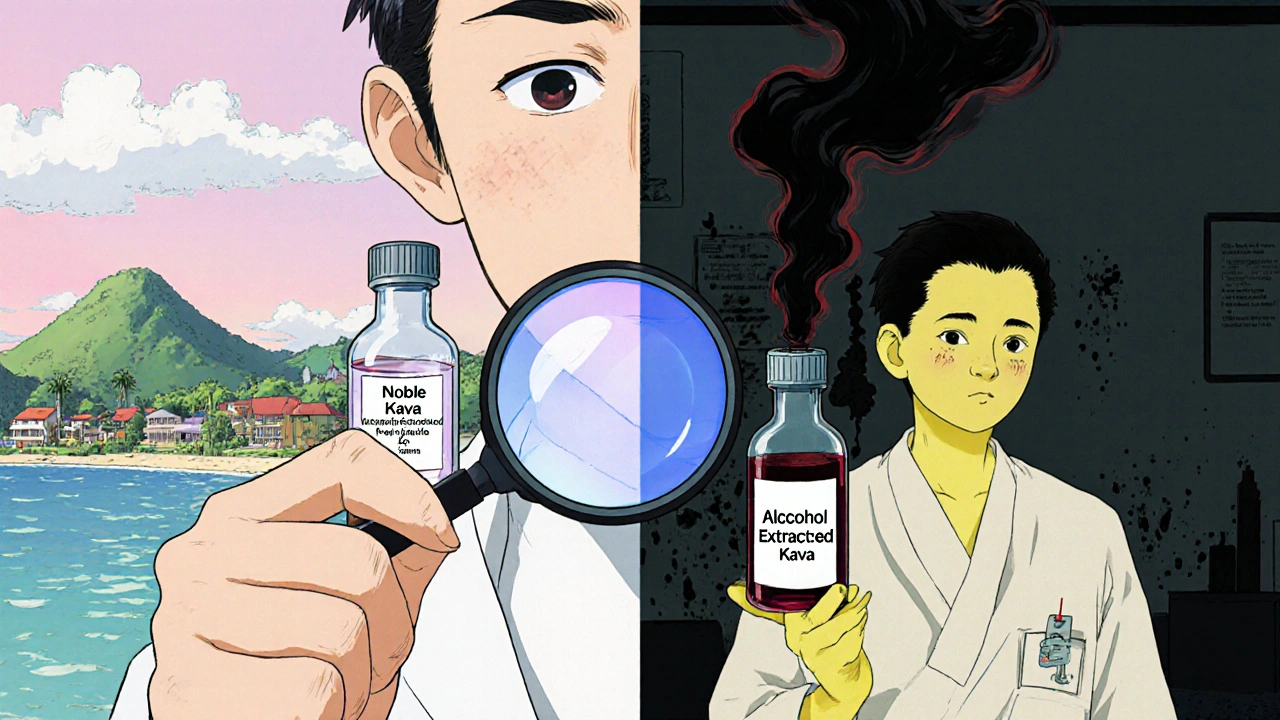
What About “Noble Kava”? Is It Safer?
There’s some hope. Traditional Pacific Island cultures use only certain strains of kava, called “noble” varieties. These are carefully selected for low toxicity. Modern commercial products often use “two-day” or “tudei” varieties-cheaper, stronger, and far more likely to cause liver issues.
A 2023 NIH-funded study at Oregon State University is testing whether noble kava is truly safer. Early data suggests water-based, noble kava preparations have 10 times fewer adverse events than alcohol-extracted supplements. The WHO’s 2023 monograph backs this up: traditional kava drinks show 0.8 adverse events per 100,000 servings. Commercial extracts? 7.3 per 100,000.
If you’re going to use kava, stick to water-extracted, noble root powder from reputable sources. Avoid pills, tinctures, or anything made with alcohol. And even then-don’t mix it with sedatives.
What Should You Do?
If you’re on sedative medication:
- Stop taking kava. Seriously. Don’t wait for symptoms.
- Talk to your doctor. Tell them everything you’re taking-even “natural” stuff.
- Get a liver test. If you’ve taken kava in the last 6 months, ask for ALT, AST, and bilirubin tests.
- Don’t assume it’s safe. Just because it’s sold in a store doesn’t mean it’s safe with your meds.
If you’re not on sedatives but still want to use kava:
- Use only water-extracted, noble kava root powder.
- Stick to 70-150 mg of kavalactones per day.
- Avoid alcohol completely while using it.
- Take breaks-don’t use it daily for months on end.
- Monitor for fatigue, nausea, or yellowing of the skin or eyes. Stop immediately if they appear.
Is Kava Worth the Risk?
Kava works for anxiety. Some people swear by it. But so do SSRIs, therapy, and mindfulness practices-all without the risk of liver failure.
Prescription anxiolytics like alprazolam have a severe liver injury rate of about 1 in 100,000 prescriptions. Kava’s estimated rate is lower-but it’s not tracked well. There’s no standardization. No quality control. No warning labels on most bottles.
Meanwhile, countries like Canada, the UK, and Switzerland banned kava as a medicine in 2002. The EU still says it’s unacceptable. Only the U.S. lets it fly under the radar as a dietary supplement.
If you want calm, there are safer paths. Kava might seem like a gentle solution. But for people on sedatives, it’s a hidden hazard.
Can I take kava with my anxiety medication?
No. Combining kava with benzodiazepines, SSRIs, or other sedatives can cause dangerous increases in drowsiness and liver toxicity. Even low doses of kava can interfere with how your body breaks down these drugs. The risk of liver damage and excessive sedation is real and documented. Stop using kava if you’re on any prescription sedative.
What are the first signs of kava-related liver damage?
Fatigue is the most common early sign-reported in 89% of cases. Nausea (76%) and loss of appetite follow. Jaundice (yellowing of the skin or eyes) appears later, in about 63% of cases. These symptoms usually show up 1 to 4 months after starting kava. If you notice any of these and have been using kava, stop immediately and get a liver function test.
Is organic or natural kava safer than regular kava?
Not necessarily. “Organic” or “natural” doesn’t mean safer. The real issue is how it’s extracted and what part of the plant is used. Alcohol-based extracts and non-noble kava varieties carry the highest risk. Even organic kava made with acetone can damage your liver. Stick to water-extracted noble kava root powder if you choose to use it at all.
How long does kava stay in your system?
The sedative effects wear off in 2 to 6 hours, but kavalactones can linger in your liver for days. If you’ve taken kava regularly, traces may still be affecting your liver enzymes for weeks after stopping. This is why doctors recommend waiting at least 2 weeks after quitting kava before starting a new medication that’s processed by the liver.
Are there any safe herbal alternatives to kava for anxiety?
Yes. Lemon balm, passionflower, and ashwagandha have shown mild anxiolytic effects in studies with far fewer drug interactions. Valerian root is also an option, though it can cause drowsiness on its own. None of these have the same documented risk of liver failure as kava. Always check with your doctor before starting any new supplement, even if it’s “natural.”





Ifeoma Ezeokoli
November 30, 2025 AT 19:03Okay but like… I’ve been taking kava for anxiety for two years and I’m fine? My liver enzymes? Normal. My sleep? Better. My panic attacks? Gone. I get the warnings, but not everyone’s gonna react the same way. Maybe it’s about the source, not the plant itself.
My kava’s from Fiji, water-extracted, noble root, no alcohol, no shortcuts. I don’t mix it with anything. I take it once a week, not daily. It’s not a drug-it’s a ceremony.
Stop treating natural like it’s dangerous just because it’s not FDA-approved. We’re not all lab rats.
Daniel Rod
December 2, 2025 AT 14:05Man, this post hit different. I used to take kava with my Xanax because I thought ‘natural’ meant ‘safe’.
Then I woke up one morning unable to stand, my vision blurry, and my liver enzymes through the roof. Took me 3 months to recover.
I don’t blame kava. I blame myself for not asking my pharmacist. I blame the marketing that makes herbal supplements look like harmless tea.
Don’t be like me. Talk to someone who knows pharmacology. Not a YouTube influencer with 5k followers and a ‘herbalist’ badge.
gina rodriguez
December 2, 2025 AT 17:43I really appreciate how thorough this is. As a nurse, I see so many people come in thinking ‘natural = no side effects.’
It breaks my heart when someone says, ‘But it’s just kava!’ and then their ALT is 2,500.
Just please, if you’re on meds-especially benzos or sleep aids-don’t risk it. There are safer herbs. Talk to your provider. You deserve to feel calm without endangering your body.
Sue Barnes
December 4, 2025 AT 05:21Stop giving kava a pass. It’s a liver toxin. Period. People who say ‘I’m fine’ are just lucky. Or they’re already damaged and don’t know it yet.
There’s no ‘safe dose’ when you’re on meds. The science is clear. The FDA warned you. The WHO warned you. The EU banned it. You’re not special. You’re just a statistic waiting to happen.
Stop romanticizing it. It’s not ‘ancient wisdom.’ It’s a chemical that interferes with your liver’s ability to survive.
jobin joshua
December 5, 2025 AT 08:01Bro I took kava with my Zoloft for 8 months and nothing happened 😎
My liver is fine, my mood is stable, I even got promoted at work.
Why are you all scared? 🤔 Maybe you just don’t know how to use it properly. Chill out. 🙃
Sachin Agnihotri
December 7, 2025 AT 07:00Wait, wait, wait-so you’re saying that if I take kava from a reputable source, water-extracted, noble variety, and I’m not on any meds, it’s low risk? But if I take it with even one pill, it’s a death sentence?
That’s… actually kind of reasonable. I’ve seen people get mad at kava for being ‘toxic’ without realizing that even water can kill you if you drink 10 liters in an hour.
Context matters. The dose. The source. The combo. Not the herb itself.
But yeah, if you’re on benzodiazepines? Don’t. Just… don’t.
Diana Askew
December 7, 2025 AT 22:07THEY KNOW. THEY ALL KNOW. The FDA, the WHO, the pharmaceutical companies-they’re hiding the truth. Kava is a miracle herb. They banned it because it’s too cheap, too natural, too effective. They want you addicted to pills that cost $200 a month.
They’re poisoning your liver with prescriptions and then blaming the herb. Wake up. It’s not kava. It’s the system.
Don’t trust your doctor. They’re paid by Big Pharma. 🕵️♀️💊
King Property
December 9, 2025 AT 10:54You people are ridiculous. Kava’s not the problem-your ignorance is.
Did you even read the paper? The 2023 Oregon State study? Noble kava + water extraction = 10x safer. The problem is 90% of the market sells toxic extracts made with acetone and tudei root.
It’s like blaming whiskey for liver failure while drinking cheap methanol from a gas station.
Stop blaming the plant. Start blaming the scam artists selling ‘kava’ in 500mg capsules with ‘natural flavor’ and no extract info.
And if you’re on meds? You’re an idiot if you combine anything. Not just kava. Anything. Period.
Yash Hemrajani
December 9, 2025 AT 20:04Oh wow. So the ‘natural’ herb that’s been used for centuries is suddenly dangerous because someone made a bad extract with alcohol? And now we’re all supposed to panic?
Meanwhile, your prescription Xanax has a 1 in 100,000 liver injury rate. Kava? 1 in 10,000 for bad extracts. But if you use it right? Less than 1 in 100,000.
So the real issue isn’t kava. It’s that you’re buying it from a Walmart shelf next to gummy vitamins.
Do your homework. Or don’t. But don’t pretend you’re being ‘responsible’ by avoiding it entirely while still taking benzos like candy.
Pawittar Singh
December 11, 2025 AT 06:47Hey, I know it’s scary to hear ‘liver failure’-I’ve been there. But don’t throw the baby out with the bathwater.
I switched from kava pills to water-based noble root powder after reading this post. No more dizziness. No more anxiety. And my liver? Clean as a whistle.
It’s not about fear. It’s about doing it right. You can still feel calm. You just need to be smart.
And yes, talk to your doctor. But also, talk to someone who’s been using kava for 15 years in Bali. They know more than any supplement label.
You got this. 💪🌱
Josh Evans
December 11, 2025 AT 07:12I took kava with my sleep med once. Felt like I was underwater. Couldn’t speak. Had to call my roommate to help me sit up.
Didn’t go to the hospital. Didn’t even tell my doctor. Just stopped.
Now I use chamomile tea and a weighted blanket. Not as fast, but I sleep without fear.
Just… don’t be lazy. Your liver doesn’t care if it’s ‘natural’.
Allison Reed
December 11, 2025 AT 15:24This is one of the most well-researched, balanced, and urgently needed posts I’ve seen on this topic. Thank you for including the specific enzyme interactions, the noble vs. tudei distinction, and the pharmacist screening protocols. Too many discussions devolve into fearmongering or blind advocacy. This is science-based, practical, and human. Please share this everywhere. People need to know the difference between tradition and commercial exploitation-and the real risks of polypharmacy with unregulated supplements.