
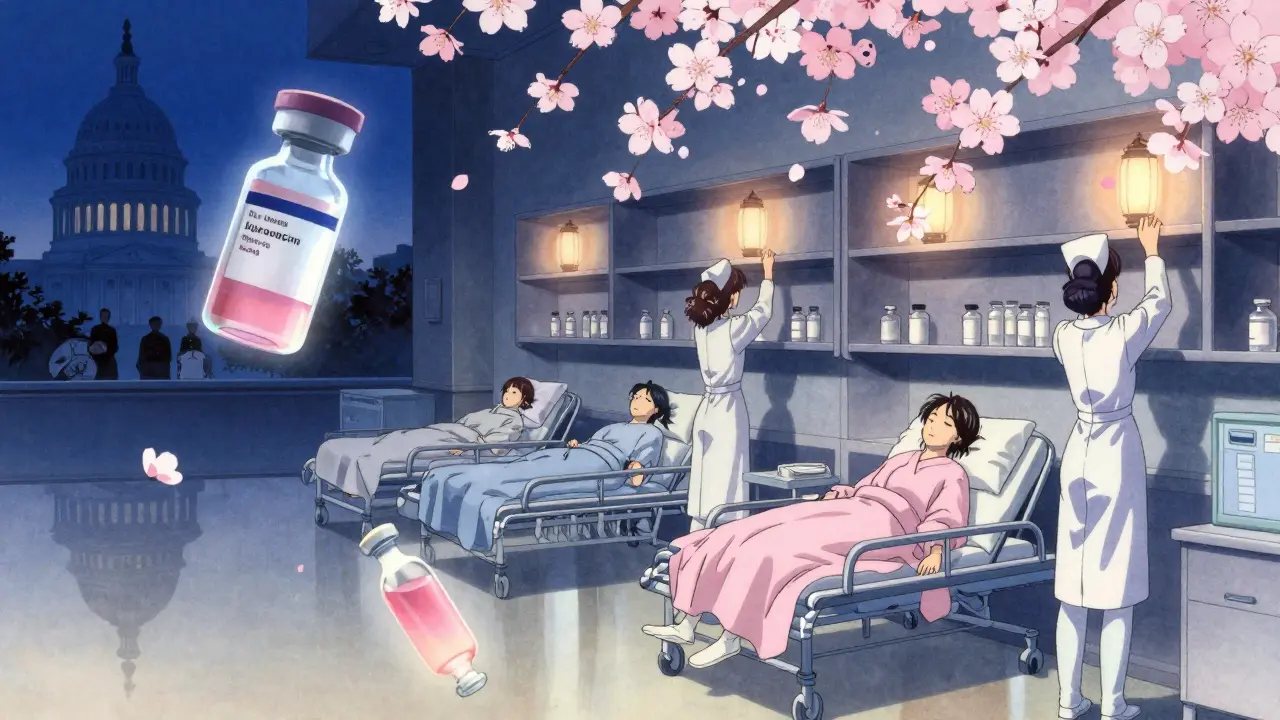
Drug shortages are hitting hospitals harder than ever
In the third quarter of 2025, 98% of U.S. hospitals reported at least one critical drug shortage. Insulin, antibiotics like vancomycin, and cancer drugs like doxorubicin vanished from shelves without warning. Patients waited days for treatments. Emergency rooms rationed doses. Nurses scrambled to find alternatives that weren’t as effective-or worse, unavailable altogether. This isn’t a glitch. It’s a system failure.
The Food and Drug Administration tracked 287 drug shortages by September 30, 2025. Nearly half-47%-were for life-saving medications. And the problem isn’t getting better. Manufacturing delays caused 63% of these shortages, according to the Association for Accessible Medicines. Many of these drugs are generic, made overseas, and produced by just one or two factories. When one shuts down, the whole supply chain collapses.
Two bills were introduced to fix this-but they’re stuck
In August 2025, Senator Amy Klobuchar introduced the Drug Shortage Prevention Act of 2025 (S.2665). Its goal? Force drug manufacturers to tell the FDA the moment they see demand spiking. Right now, companies don’t have to report anything until it’s too late. By then, hospitals are already out of stock. This bill would require early warnings, giving regulators time to find backup suppliers, reroute shipments, or even fast-track approvals for new makers.
It sounds simple. But the bill hasn’t moved since it was sent to the Senate Health, Education, Labor, and Pensions Committee. No hearings. No votes. No public debate. Why? Because the federal government shut down on October 1, 2025-and it’s still shut down as of January 11, 2026. The longest shutdown in U.S. history. Over 800,000 federal workers are furloughed. The FDA can’t even maintain its own Drug Shortage Portal. Monitoring systems are down. Staff are gone. How can a law that depends on the FDA to work, get passed when the FDA can’t open its emails?
Meanwhile, in the House, H.R.1160-the Health Care Provider Shortage Minimization Act of 2025-was introduced with even less detail. Public records show only the title. No sponsors listed. No committee assigned. No text available. All we know is it’s meant to tackle the shortage of doctors, nurses, and pharmacists. The Health Resources and Services Administration says 122 million Americans live in areas with too few primary care providers. That’s not just a staffing issue. It’s a drug access issue. If there’s no pharmacist on duty, it doesn’t matter if the medicine is in the warehouse.
Why these bills matter-and why they’re being ignored
The Drug Shortage Prevention Act isn’t asking for billions. The Congressional Budget Office estimates it would cost $45 million a year to train staff and upgrade systems. That’s less than the cost of one F-35 fighter jet. But in a $1.74 trillion deficit year, lawmakers are cutting foreign aid and public media budgets instead. The Rescissions Act of 2025 slashed $7.9 billion from overseas programs. No one’s talking about saving lives at home.
And here’s the cruel irony: doctors know this is happening. A September 2025 survey by the American Medical Association found that 87% of physicians have had to change or delay patient treatments because of drug shortages. Yet only 12% even knew H.R.1160 existed. Most haven’t heard of S.2665 either. The public doesn’t know because Congress isn’t telling them.
Even the proposed continuing resolution to end the shutdown-set to extend funding through January 30, 2026-doesn’t mention drug shortages or provider staffing. Congressman Don Beyer called it out: “This isn’t a budget fix. It’s a delay tactic.” And while Congress debates whether senators can sue over phone records, real people are dying because their cancer drug is out of stock.
What’s really behind the shortages?
It’s not just about factories closing. It’s about incentives. Generic drug makers operate on razor-thin margins. If a drug sells for $5 a pill and costs $4.80 to make, there’s no profit. No incentive to invest in backup production. No reason to stockpile raw materials. No motivation to build redundancy.
The FDA knows this. That’s why they’ve tried to fix it before-with voluntary reporting, advisory panels, and warnings. But without teeth, it’s just noise. S.2665 tries to add enforcement. If a company fails to report a spike in demand, they could face fines. But without a functioning FDA, who enforces it?
And then there’s the workforce. The American Association of Medical Colleges predicts a shortage of 124,000 physicians by 2034. Pharmacies are closing in rural towns. Nurses are leaving for higher-paying jobs in tech or travel nursing. If you can’t staff a hospital, you can’t give out medicine-even if it’s sitting in a warehouse.
What happens if nothing changes?
If S.2665 and H.R.1160 die in committee-which they will if the shutdown continues past January 30, 2026-then the next chance won’t come until January 2027, when the 120th Congress starts. That’s 18 more months of unpredictable shortages. More canceled surgeries. More patients turned away. More deaths.
Right now, the system is built to react, not prevent. We wait until the drug is gone. Then we panic. Then we beg. Then we pray.
What we need is a system that sees the problem coming. That calls ahead. That moves medicine before it’s gone. That’s what S.2665 tries to do. And H.R.1160 tries to fix the people who deliver it.
But laws don’t fix problems. People do. And right now, the people who could fix this are sitting idle, waiting for a budget vote that may never come.
What you can do
Don’t wait for Congress to act. Call your representative. Ask them: “Will you support S.2665 and H.R.1160? Will you push for a vote before the shutdown ends?”
Write to your hospital. Ask them: “Do you have a drug shortage plan? Are you tracking critical meds? Are you informing patients?”
Share this. Talk about it. Drug shortages aren’t abstract. They’re your mother’s insulin. Your child’s antibiotic. Your neighbor’s chemotherapy. This isn’t politics. It’s survival.
What is the Drug Shortage Prevention Act of 2025?
The Drug Shortage Prevention Act of 2025 (S.2665) is a Senate bill that would require pharmaceutical manufacturers to notify the FDA as soon as they foresee increased demand for critical drugs. The goal is to give regulators time to find alternative suppliers or approve new manufacturers before a shortage occurs. It amends the Federal Food, Drug, and Cosmetic Act and is currently stalled in committee due to the federal government shutdown.
Why haven’t these bills passed yet?
Both bills are stuck because the federal government has been shut down since October 1, 2025. With over 800,000 federal workers furloughed-including FDA staff-legislative activity has ground to a halt. Committees aren’t meeting, hearings aren’t happening, and votes aren’t being scheduled. Even if lawmakers wanted to act, the system to implement these bills is offline.
How many drugs are currently in short supply?
As of September 30, 2025, the FDA recorded 287 active drug shortages, with 47% classified as critical-meaning they’re used to treat life-threatening conditions like cancer, heart failure, or severe infections. Generic drugs account for the majority of these shortages, primarily due to manufacturing delays and lack of backup suppliers.
What’s the difference between S.2665 and H.R.1160?
S.2665 focuses on preventing drug shortages by requiring manufacturers to report rising demand to the FDA. H.R.1160 aims to reduce healthcare provider shortages-like doctors, nurses, and pharmacists-by improving workforce training and placement. While S.2665 addresses medicine availability, H.R.1160 addresses who can deliver it. But unlike S.2665, H.R.1160’s full text hasn’t been made public, so its exact provisions are unknown.
Can the FDA handle these new requirements right now?
No. The FDA’s Drug Shortage Portal is already malfunctioning due to the shutdown. Staff responsible for monitoring and responding to shortages are furloughed. Even if S.2665 passed tomorrow, the agency lacks the people and systems to enforce it. The bill would need $45 million in annual funding to scale up operations-money that’s not being allocated in current budget talks.
What’s the biggest obstacle to solving drug shortages?
The biggest obstacle is a broken incentive system. Generic drug makers make so little profit that they don’t invest in backup production, spare inventory, or quality control improvements. Without financial rewards for reliability, companies have no reason to prevent shortages. Laws like S.2665 can help, but they won’t work unless manufacturers are financially motivated to comply.



Monica Puglia
January 12, 2026 AT 14:13Cecelia Alta
January 13, 2026 AT 12:50steve ker
January 14, 2026 AT 13:45George Bridges
January 16, 2026 AT 12:35Faith Wright
January 17, 2026 AT 19:10Audu ikhlas
January 19, 2026 AT 03:36Sonal Guha
January 19, 2026 AT 05:49TiM Vince
January 19, 2026 AT 06:47gary ysturiz
January 19, 2026 AT 13:20Jessica Bnouzalim
January 20, 2026 AT 11:01