

Millions of people take Ginkgo Biloba a standardized herbal extract derived from the leaves of the Ginkgo biloba tree, one of the oldest living tree species on Earth every year for memory support, circulation, and brain health. But if you’re also on a blood thinner-like warfarin, aspirin, or clopidogrel-you need to stop and think before you take it. The question isn’t whether it’s dangerous. It’s whether the risk is real, and what you should actually do.
The truth is messy. Some studies say Ginkgo Biloba doesn’t increase bleeding risk. Others say it might. Case reports show people bleeding out after surgery because they kept taking it. But those same case reports often involve cheap, unregulated supplements-not the kind used in clinical trials. So what’s going on? And more importantly, what should you do?
How Ginkgo Biloba Might Affect Blood Clotting
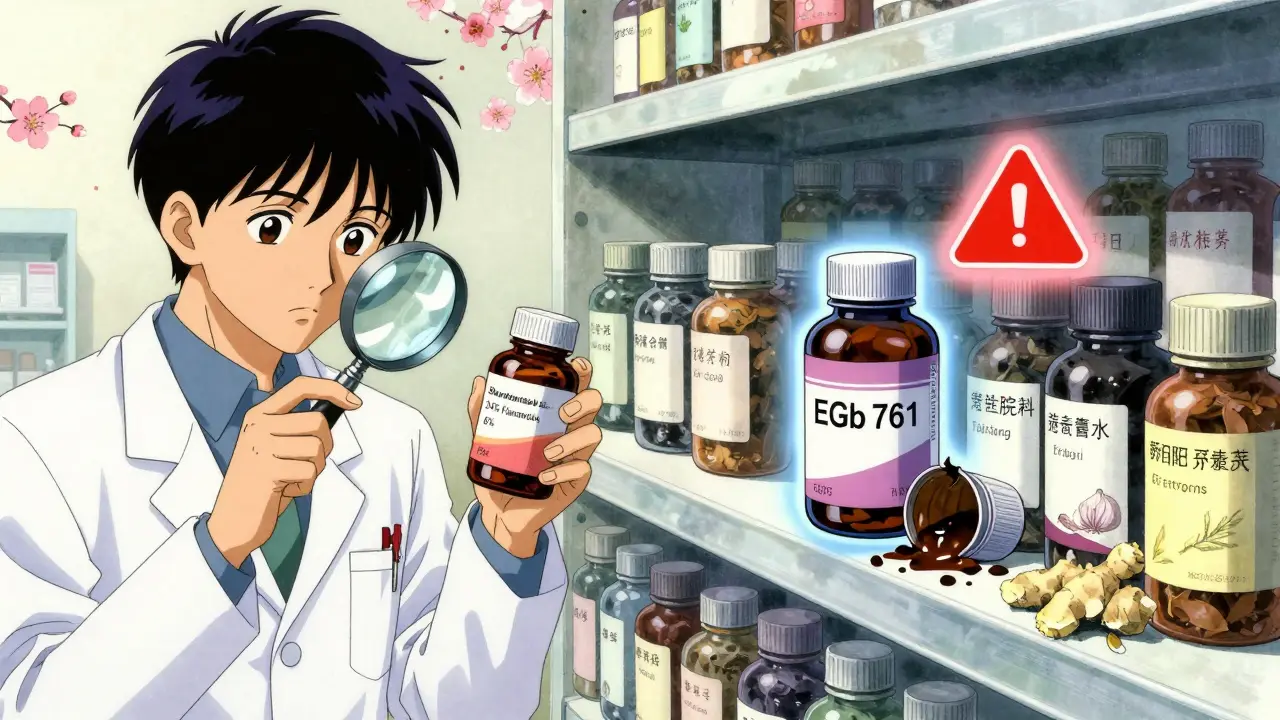
Ginkgo Biloba extract, especially the standardized form called EGb 761 a specific 50:1 leaf extract containing 24% flavonol glycosides and 6% terpene lactones, the most widely studied and commercially dominant formulation, works in a few ways that could interfere with blood clotting.
First, it may reduce platelet aggregation. Platelets are the tiny cells in your blood that stick together to form clots. If they’re too slow to respond, bleeding can last longer. Ginkgo appears to block certain signals that trigger platelet activation-specifically by inhibiting tyrosine kinase, a protein involved in clotting pathways.
Second, it might affect how your liver processes some blood thinners. Ginkgo can influence the CYP2C9 enzyme, which breaks down warfarin. If this enzyme slows down, warfarin builds up in your system. That means your INR levels-what doctors measure to check how thin your blood is-could rise unexpectedly. One study found that patients on warfarin who took Ginkgo had INR spikes that led to bruising and nosebleeds.
But here’s the catch: most of the evidence for this comes from lab studies or small case reports. In controlled trials, where people took standardized Ginkgo for weeks or months while on blood thinners, no major increase in bleeding was seen. The PLOS ONE study from 2020 looked at over 3,000 prescriptions and found Ginkgo interacted with anticoagulants in only 1.8% of cases. That’s low-but not zero.
The Real Risk: What the Data Says
Let’s cut through the noise. The biggest concern isn’t that Ginkgo causes bleeding. It’s that it might make bleeding worse when combined with other drugs.
Here’s what the evidence shows:
- Warfarin (Coumadin): The most documented interaction. Some patients experienced elevated INR levels, leading to bruising, nosebleeds, and even intracranial hemorrhage in rare cases. But controlled trials didn’t find consistent changes. The difference? The bad cases usually involved non-standardized Ginkgo products.
- Aspirin: A 2012 study found no significant increase in bleeding when Ginkgo was taken with low-dose aspirin. Yet, the Mayo Clinic still lists it as a possible interaction. Why? Because aspirin itself thins blood, and adding another agent-even if weak-could tip the balance in vulnerable people.
- Clopidogrel (Plavix): A 2020 study found 2.61% of clopidogrel prescriptions were taken with Ginkgo. In a few of those cases, patients had unexplained bleeding. The risk is low, but not absent.
- DOACs (Apixaban, Rivaroxaban): Data is limited, but one study found 18% of DOAC users who took herbal supplements used Ginkgo. No major bleeding events were confirmed, but monitoring is still advised.
The FDA received 18 reports of possible bleeding linked to Ginkgo between 2008 and 2020. But in every case, other factors were involved-surgery, other medications, underlying conditions. No one report proved Ginkgo alone caused the bleed.
Still, if you’re on blood thinners, you’re already at risk. Adding anything that might nudge that risk higher? It’s not worth gambling on.
What the Experts Say-And Why They Disagree
Why do different sources give conflicting advice?
Mayo Clinic, GoodRx, and Cleveland Clinic all warn against combining Ginkgo with blood thinners. They err on the side of caution. Their reasoning? Case reports exist. People have bled. Even if it’s rare, the consequences can be deadly.
On the other side, the American Society of Health-System Pharmacists (AHFS) calls the risk "theoretical." The 2008 PubMed review by Izzo et al. found no consistent evidence that Ginkgo worsens bleeding in controlled settings. Dr. Michael Murray, a respected integrative medicine expert, says the risk is minimal-but still advises stopping it 36 hours before surgery.
The disconnect? It’s about product quality.
Most clinical trials used EGb 761, a precise, standardized extract. But 60% of Ginkgo supplements sold in the U.S. don’t meet labeling standards. Some contain too little active ingredient. Others have contaminants, fillers, or even undisclosed blood-thinning herbs like danshen or garlic.
If you’re taking a random brand from a gas station or Amazon, you have no idea what you’re actually getting. That’s the real danger-not the herb itself, but the lack of control over what’s in it.
What You Should Do Right Now
Here’s what actually matters:
- If you’re on warfarin: Talk to your doctor before taking Ginkgo. Get your INR checked before and after starting it. Don’t assume it’s safe just because you’ve seen others take it.
- If you’re on aspirin, clopidogrel, or a DOAC: The risk is lower, but not zero. If you’re considering Ginkgo, tell your pharmacist. Ask them to check your full medication list. Many pharmacies now flag these combinations automatically.
- If you’re scheduled for surgery: Stop Ginkgo at least two weeks before. The American Society of Anesthesiologists recommends this. Even if the risk is low, surgeons don’t want surprises. Bleeding during surgery can be life-threatening.
- If you’re buying Ginkgo: Only choose products labeled "EGb 761" or "standardized to 24% flavonoids and 6% terpenes." Avoid anything without a clear label. Look for third-party testing seals like USP or NSF.
- Don’t mix it with other blood-thinning herbs: Garlic, ginger, danshen, and fish oil all have similar effects. Taking them with Ginkgo multiplies the risk.

What the Numbers Don’t Tell You
Here’s the uncomfortable truth: 21% of patients on blood thinners also take herbal supplements. Nearly half of them are at risk for a dangerous interaction. And most don’t tell their doctors.
Why? Because they think herbs are "natural" and therefore safe. Or because their doctor never asked. Or because they read an article online saying Ginkgo is harmless.
But "natural" doesn’t mean "risk-free." Willow bark is natural-it’s aspirin’s ancestor. Foxglove is natural-it’s the source of digoxin, a heart drug with a narrow safety window.
Herbs are powerful. They’re not candy. And when you’re on a blood thinner, your body is already on a tightrope. Adding another variable? That’s not a smart gamble.
Bottom Line: Play It Safe
Ginkgo Biloba might be fine. It might not be. The science doesn’t give you a clear yes or no.
But here’s what it does tell you: if you’re on a blood thinner, don’t take Ginkgo without talking to your doctor first.
Don’t rely on internet forums. Don’t assume your pharmacist knows your full history. Don’t think "I’ve taken it for years and nothing happened" means it’s safe. Things change. Your liver changes. Your dose changes. Your health changes.
Ask your doctor. Get your blood tested. Check your supplement label. If you’re unsure, skip it. There are other ways to support brain health-exercise, sleep, omega-3s, cognitive training. You don’t need Ginkgo to do that.
When it comes to blood thinners and herbs, the safest choice isn’t always the most popular one. It’s the one that keeps you out of the ER.
Can I take Ginkgo Biloba with aspirin?
Some studies show no significant interaction between Ginkgo Biloba and low-dose aspirin, but others suggest a possible increase in bleeding risk, especially in older adults or those with clotting disorders. The Mayo Clinic and GoodRx classify this as a moderate-risk interaction. If you take aspirin daily, talk to your doctor before starting Ginkgo. Avoid combining them if you’ve had recent bleeding, ulcers, or surgery.
Is Ginkgo Biloba safe if I’m on warfarin?
Warfarin and Ginkgo Biloba have the most documented risk. While controlled trials haven’t consistently shown increased bleeding, case reports include serious events like brain bleeds. The FDA has received reports linking the two. Most experts recommend avoiding this combination entirely. If you’re on warfarin, do not take Ginkgo without explicit approval from your prescriber and regular INR monitoring.
How long before surgery should I stop Ginkgo Biloba?
The American Society of Anesthesiologists recommends stopping Ginkgo Biloba at least two weeks before any surgical procedure. This gives your body time to clear the compound and reduce bleeding risk during surgery. Even if you’ve taken it safely for years, surgery changes your body’s response. Don’t risk it-stop early.
Are all Ginkgo supplements the same?
No. Only standardized extracts like EGb 761 have been studied in clinical trials. Many over-the-counter products vary widely in potency and purity. Some contain contaminants, fillers, or undisclosed herbs that also thin blood. Always choose supplements with third-party verification (USP, NSF, or ConsumerLab) and clear labeling of active ingredients. Avoid unbranded or cheap products.
What are safer alternatives to Ginkgo for memory support?
If you’re on blood thinners and want to support brain health, focus on lifestyle changes: regular aerobic exercise, quality sleep, stress management, and a diet rich in omega-3s (from fish or algae oil), leafy greens, and berries. Omega-3 supplements (especially purified EPA/DHA) have strong evidence for cognitive support and minimal bleeding risk at standard doses. Always check with your doctor before starting any new supplement.
If you're currently taking Ginkgo Biloba and a blood thinner, don’t stop abruptly without medical advice. But do schedule a conversation with your doctor or pharmacist this week. Bring your supplement bottles. Ask: "Is this safe with what I’m on?" That simple step could prevent a hospital visit-or worse.



Alex Ogle
February 10, 2026 AT 17:34Look, I’ve been taking ginkgo for years-mostly for focus during long workdays. Never had an issue. But then I got my INR checked last month after my doc asked, and it spiked from 2.4 to 3.8. No symptoms, no bleeding, just a weird lab result. I stopped it. Didn’t even think to mention it. Turns out, I’m not alone. I’ve seen at least three people in my support group have similar stories. It’s not dramatic. It’s not a catastrophe. But it’s a silent variable you didn’t know was in the equation. And when you’re on warfarin, you don’t need silent variables.
Standardized extract? Maybe. But if you’re not buying EGb 761, you’re gambling with a loaded die. And the house always wins.
My advice? If you’re not sure, don’t take it. There’s no prize for being the guy who ‘got away with it.’
Brandon Osborne
February 12, 2026 AT 15:44THIS IS WHY PEOPLE DIE. You think ‘natural’ means safe? Willow bark is natural. Foxglove is natural. Poison ivy is natural. And yet you wouldn’t lick it. But you’ll swallow some random powder from a bottle labeled ‘Ginkgo Biloba’ because some guy on YouTube said it ‘boosts memory’? You’re not smart. You’re just lucky.
I work in ER. I’ve seen the aftermath. Brain bleeds. Unexplained bruising. People who thought ‘I’ve been taking this for 10 years’-until the day they didn’t wake up. And guess what? Their doctor didn’t even know they were taking it. Because they’re too proud to ask. Too stubborn. Too ‘natural’ to care.
Stop. Talking. To. Your. Doctor. Not ‘maybe.’ Not ‘if you feel like it.’ STOP. NOW.
And if you’re one of those people who says ‘but my cousin took it and nothing happened’-your cousin is an idiot. And so are you for believing them.
Marie Fontaine
February 14, 2026 AT 02:50Ken Cooper
February 15, 2026 AT 03:39so i just wanna say-i get it. people are scared of herbs. and i’m not saying ginkgo is harmless. but let’s be real. the real problem isn’t the herb. it’s the fact that 70% of supplements are just… garbage. like, i bought a bottle last year labeled ‘pure ginkgo’-turned out it had 3% ginkgo and 17% starch. the rest? mystery fillers. i sent it to a lab. yeah. that happened.
so if you’re gonna take it, get the standardized stuff. egb 761. usp verified. or don’t take it at all. but don’t blame the herb. blame the system. the system is broken. the supplement industry is a wild west. and we’re all just trying to survive it.
also-doctors don’t ask because they’re overworked. not because they don’t care. so ask them. bring the bottle. show them the label. make them look. it’s your life. not theirs.
MANI V
February 17, 2026 AT 00:48How can you even consider taking this? You are playing Russian roulette with your life. Ginkgo is not medicine. It is a placebo wrapped in green leaves and sold for profit. The fact that people still believe in these ‘natural’ remedies shows how deeply ignorant society has become. You think your ‘brain health’ matters more than your liver? Your INR? Your survival?
Stop wasting money. Stop wasting time. Stop pretending herbs are safe because they come from trees. Trees don’t care if you live or die. Only you do. And you’re not doing enough to protect yourself.
Go to the gym. Sleep. Drink water. That’s what ‘brain health’ really is. Not magic leaf powder.
Random Guy
February 17, 2026 AT 19:26so like… ginkgo is the herbal version of ‘i’ll just take one more’? 😂
‘oh it’s natural’ → ‘oh i’m bleeding from my nose’ → ‘wait, was that in the fine print?’
yo doc, can we get a warning label that says ‘this might make you a human popsicle’? 🧊🩸
Ryan Vargas
February 19, 2026 AT 18:00The real issue here is epistemological. We live in a post-truth pharmacopeia where anecdote replaces evidence, and branding replaces biochemistry. The FDA’s 18 reports? That’s the tip of the iceberg. The vast majority of adverse events go unreported because patients don’t connect the dots. They don’t understand pharmacokinetics. They don’t know what CYP2C9 even is.
And yet, we’ve built an entire industry around selling hope disguised as science. Ginkgo is not the villain. It’s the symptom. The real villain is the commodification of health. The erosion of scientific literacy. The normalization of self-experimentation without oversight.
Standardized extracts? EGb 761? These are not solutions. They’re band-aids on a hemorrhaging system. Until we regulate supplements like pharmaceuticals, we’re all just gambling with our biology. And the house? The house is always the supplement manufacturer.
So yes. Don’t take it. But also-demand change. Because this isn’t about one herb. It’s about how we’ve abandoned reason in favor of marketing.
Tasha Lake
February 20, 2026 AT 14:45As a clinical pharmacist, I see this every week. The real risk isn’t EGb 761-it’s the unstandardized, untested, unlabeled stuff that makes up 60% of the market. We’ve had patients come in with INR >8 because they took ‘ginkgo’ from a roadside vendor that contained danshen (which is a potent CYP2C9 inhibitor) and no ginkgo at all.
Bottom line: if your supplement doesn’t have a USP or NSF stamp, it’s not a supplement-it’s a lottery ticket. And you’re not playing for a prize. You’re playing for your life.
Also: DOACs aren’t risk-free with ginkgo either. The data is sparse, but the pharmacodynamic overlap is real. Just because there’s no RCT doesn’t mean there’s no risk. We’re talking about anticoagulation here. One point of INR change can mean the difference between a bruise and a hemorrhage.
Sam Dickison
February 21, 2026 AT 23:45I’ve been on Plavix for 5 years. Took ginkgo for 8 months. Never had an issue. But I did two things: 1) I bought the EGb 761 version. 2) I told my pharmacist. They flagged it in the system. I got a call a week later asking if I was okay. That’s the kind of care we need.
It’s not about fear. It’s about awareness. If you’re gonna do this, do it right. Don’t just grab the cheapest bottle. Don’t assume ‘it’s fine.’ Talk to someone who knows. Your pharmacist is your ally. Not your enemy.
Also-yes, exercise and sleep matter more. But sometimes, we need a little help. And if that help is clean, documented, and monitored? Fine. But only if you’re responsible.
John McDonald
February 22, 2026 AT 13:57Just want to say-this post saved me. I was about to start ginkgo for ‘focus.’ My dad had a brain bleed last year. He was on warfarin. He took ginkgo. He didn’t tell anyone. We almost lost him.
I stopped. Called my doc. Got my INR checked. It was fine. But I didn’t take the risk. I didn’t need to.
There’s no glory in being the one who ‘got away with it.’ There’s only peace in knowing you did the right thing.
Thanks for writing this. I’m sharing it with my whole family.