

For years, doctors hesitated to prescribe statins to patients with liver disease. The fear? That these cholesterol-lowering drugs might damage an already fragile liver. But today’s evidence tells a very different story. Statins are not just safe in liver disease-they may actually protect it. And for people with chronic liver conditions like NAFLD, cirrhosis, or hepatitis, the cardiovascular benefits can be life-saving.
Why Statins Are Now a Game-Changer for Liver Patients
Statins work by blocking HMG-CoA reductase, the enzyme your liver uses to make cholesterol. That simple action lowers LDL (bad) cholesterol by 25% to 60%, depending on the dose and type. But that’s only part of the story. Statins also reduce inflammation, improve blood vessel function, and even lower pressure in the liver’s blood vessels. For someone with cirrhosis, this isn’t just about heart health-it’s about preventing deadly complications like variceal bleeding and liver failure. A 2023 study in Gastroenterology Research followed over 5,000 patients with compensated cirrhosis. Those taking statins had a 38% lower risk of hepatic decompensation and a 38% lower risk of dying from liver-related causes. These aren’t small numbers. They’re the kind of results that change clinical practice.Myths About Statins and Liver Damage
The biggest myth? That statins cause liver injury. In reality, severe liver damage from statins happens in about 1 in 100,000 patients per year. That’s rarer than being struck by lightning. The American Heart Association and the European Association for the Study of the Liver both state that routine liver function monitoring isn’t needed for statin users-even those with liver disease. Historical concerns came from older studies in the 1990s, like the EXCEL trial with 8,000 patients, which found zero cases of symptomatic hepatitis in the statin group. More recent data from the JUPITER trial with 18,000 people showed identical rates of liver issues between those on rosuvastatin and those on placebo. Meanwhile, older drugs like fibrates actually carry a higher risk of liver toxicity. Even patients with mildly elevated liver enzymes-up to three times the normal limit-can safely take statins. Dr. Neil Kaplowitz from USC Keck School of Medicine says, “Statins do not cause progressive liver injury.” In fact, some patients see their liver enzymes improve on statins. One patient on HealthUnlocked reported, “My liver numbers actually improved on atorvastatin.”How Statins Help the Liver Directly
It’s not just about lowering cholesterol. Statins improve blood flow in the liver. In a 2013 study on rats with cirrhosis, simvastatin increased levels of KLF2 and nitric oxide, two molecules that relax blood vessels in the liver. The result? A 14% drop in hepatic vascular resistance and a 20% increase in blood flow. That same effect was seen in humans. In a small clinical trial with 30 cirrhotic patients, a single 40 mg dose of simvastatin lowered liver pressure within 30 minutes. This matters because high pressure in the liver’s blood vessels leads to varices-swollen veins that can rupture and cause fatal bleeding. Statins reduce that risk by nearly 40%, according to a 2023 meta-analysis.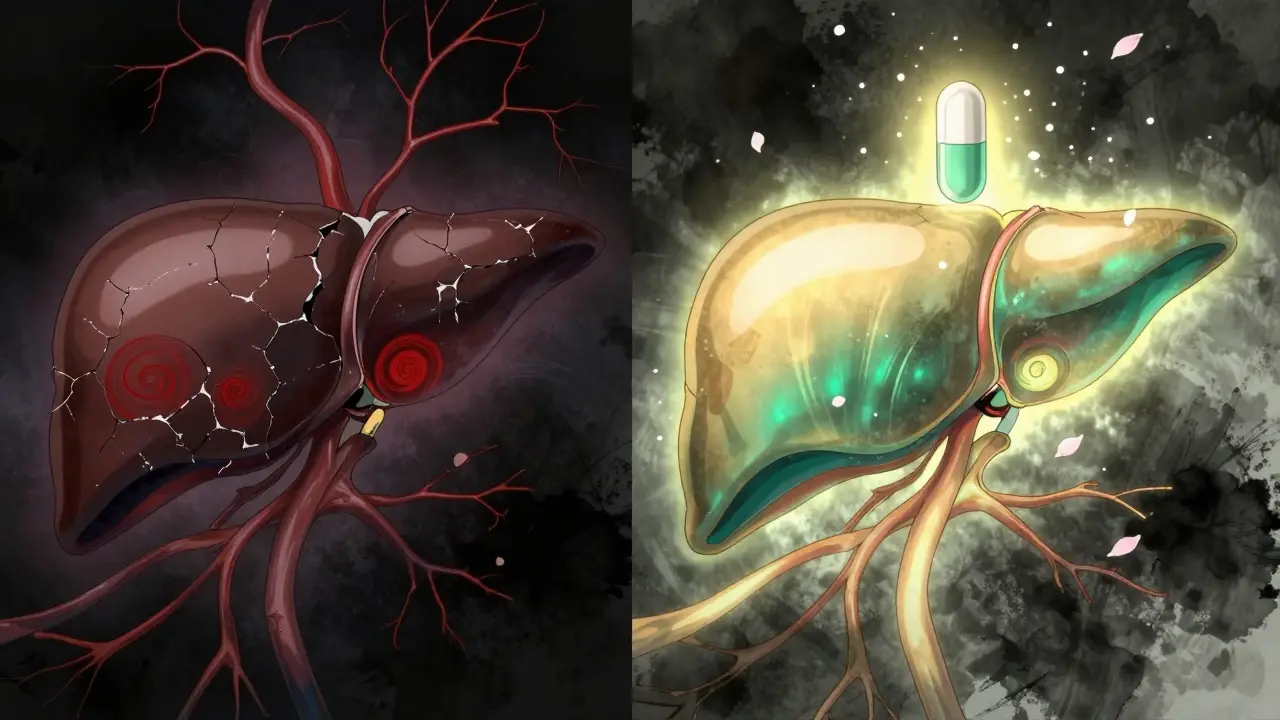
Who Benefits Most?
The strongest evidence supports statin use in patients with compensated cirrhosis-those whose livers are scarred but still functioning. For them, statins cut:- Overall mortality by 26%
- Liver-related death by 28%
- Variceal bleeding by 38%
- Hepatic decompensation by 22%
What About Advanced Liver Disease?
For patients with Child-Pugh Class C cirrhosis-the most severe stage-statins aren’t automatically off-limits. They just need to be started low and slow. Doctors typically begin with pravastatin 20 mg or rosuvastatin 5 mg, avoiding drugs that rely heavily on liver metabolism like simvastatin or lovastatin. The AASLD 2022 guidelines recommend statins even in advanced cases if there’s a clear cardiovascular indication. A 2023 review of 1,200 patients with Child-Pugh C cirrhosis showed that those on statins had 31% lower mortality over two years than those who weren’t. The key? Avoiding grapefruit juice (which interferes with statin metabolism) and watching for muscle pain, not liver spikes.
Real Patient Experiences
On Reddit’s r/liverdisease forum, 84% of 58 cirrhotic patients using statins reported no liver side effects. One wrote: “After starting rosuvastatin, my portal hypertension symptoms decreased significantly.” On HealthUnlocked, 63% of users said they felt more energetic-likely because their heart and circulation improved. The biggest complaint? Not side effects. It’s doctors refusing to prescribe. One patient shared: “I had to argue with three hepatologists before one finally agreed.” That’s the real barrier-not safety, but outdated thinking.Choosing the Right Statin
Not all statins are the same when it comes to liver disease:| Statins | Metabolism Pathway | Best For | Dose Range |
|---|---|---|---|
| Rosuvastatin | Minimal CYP metabolism | Most patients, including advanced cirrhosis | 5-20 mg |
| Pravastatin | Non-CYP, renal excretion | Patients on multiple meds, elderly | 20-40 mg |
| Atorvastatin | CYP3A4 (moderate) | High-intensity LDL lowering | 10-80 mg |
| Simvastatin | CYP3A4 (high) | Only in mild-moderate disease | 10-20 mg |
For patients on multiple medications (common in liver disease), rosuvastatin and pravastatin are safest because they don’t interfere with other drugs metabolized by CYP enzymes. Avoid grapefruit juice with any statin-it can spike blood levels and increase side effects.
What’s Next? The Future of Statins in Liver Care
The STATIN-CIRRHOSIS trial (NCT04567891), expected to finish in late 2025, will be the first major randomized study to test statins in decompensated cirrhosis. Early data suggests even these patients may benefit. Meanwhile, the market is shifting. In 2015, only 12% of statin prescriptions went to patients with liver disease. By 2023, that jumped to 25%. The American Gastroenterological Association now recommends statins for nearly all CLD patients with a 10-year cardiovascular risk over 7.5%. The bottom line? Statins are no longer a risky add-on. They’re a proven tool for extending life and preventing complications in liver disease. The science is clear. The question isn’t whether to use them-it’s why so many patients still don’t get them.Are statins safe if I have cirrhosis?
Yes, statins are safe in compensated cirrhosis and even in some cases of advanced cirrhosis. Severe liver injury from statins is extremely rare-about 1 in 100,000 patients per year. Studies show statins reduce liver-related death and complications like variceal bleeding. Start with low doses of rosuvastatin or pravastatin and avoid grapefruit juice.
Do statins raise liver enzymes?
Statins rarely raise liver enzymes. In fact, some patients with NAFLD see their ALT and AST levels drop after starting statins. Mild, temporary increases (less than 3x the upper limit of normal) are not a reason to stop the drug. Routine liver testing is not needed unless symptoms like jaundice or fatigue appear.
Which statin is best for someone with liver disease?
Rosuvastatin and pravastatin are the safest choices. They don’t rely heavily on liver enzymes for metabolism, making them ideal for patients on multiple medications or with advanced liver disease. Atorvastatin is also safe for most, but avoid simvastatin and lovastatin in moderate-to-severe cirrhosis due to higher interaction risks.
Can statins help with fatty liver disease?
Yes. Statins reduce inflammation and fat buildup in the liver in patients with NAFLD. They also lower cardiovascular risk, which is the leading cause of death in this group. A 2024 study found high-intensity statins reduced all-cause death by 17% in NAFLD patients compared to low-intensity options.
Why do some doctors still refuse to prescribe statins for liver patients?
Outdated guidelines and lingering myths about hepatotoxicity are the main reasons. Many doctors were trained to avoid statins in liver disease based on data from the 1980s and 1990s. New evidence since 2018 has overturned those fears, but it takes time for practice to catch up. Patients often need to advocate for themselves with current guidelines from the AHA or AASLD.



Allison Priole
March 22, 2026 AT 15:00So i just read this whole thing and honestly? I’m blown away. I’ve been on rosuvastatin for like 3 years now since my NAFLD diagnosis, and yeah my liver enzymes went down not up. My doc was skeptical at first but i brought him the studies and he finally caved. No more ‘statins hurt your liver’ nonsense. I feel better, my energy’s up, and my last echo showed improved flow. Why are we still arguing about this in 2025?
Casey Tenney
March 23, 2026 AT 02:31Statins save lives. End of story. If your doctor won’t prescribe them, find a new one.
Bryan Woody
March 24, 2026 AT 12:09Let me break this down for the folks still stuck in 1998. Statins don’t wreck livers. They heal them. The liver doesn’t hate statins-it *uses* them. Think about it: statins lower LDL, reduce inflammation, improve endothelial function, and drop portal pressure. That’s not a side effect-that’s a triple play. And yeah, the 1 in 100k liver injury stat? That’s less likely than your phone exploding from a firmware update. We’re talking about a drug that’s safer than ibuprofen for your liver. Yet doctors still act like it’s radioactive. 🤦♂️
Timothy Olcott
March 26, 2026 AT 00:21AMERICA IS THE ONLY COUNTRY THAT GETS THIS 😎
EUROPEAN DOCTORS STILL AFRAID OF STATINS LOL
WE’RE LEADING THE FUTURE 🇺🇸💪
trudale hampton
March 27, 2026 AT 00:23I’ve been following this topic for years and honestly, the data is just so clear now. I work in a clinic and we’ve started prescribing statins to almost every compensated cirrhosis patient with CVD risk. The drop in hospitalizations for variceal bleeding? Crazy. And the best part? Patients report feeling less fatigued. Not just because their heart’s working better-but because their liver’s actually doing less work fighting inflammation. It’s beautiful science.
Shaun Wakashige
March 27, 2026 AT 06:04meh
Paul Cuccurullo
March 27, 2026 AT 13:31It is truly remarkable how the medical community has evolved on this issue. The transition from fear-based practice to evidence-based prescribing represents a profound shift in clinical wisdom. I commend the researchers and clinicians who have persisted in advocating for statin use in liver disease, despite entrenched skepticism. This is a textbook example of how science corrects itself over time.
Johny Prayogi
March 28, 2026 AT 03:29My mom’s on pravastatin for NAFLD and cirrhosis. She’s 72. Used to be dizzy, tired, always in bed. Now she walks 3 miles a day. Her AST went from 88 to 39. Doc said ‘I didn’t expect this.’ Yeah, well neither did I. So if you’re hesitating? Just start low. Rosuvastatin 5mg. Watch. You’ll be shocked. 🙌
Nicole James
March 28, 2026 AT 07:03Wait… so you’re telling me… the pharmaceutical industry… didn’t just… manipulate decades of medical dogma… to sell more statins… while quietly suppressing the ‘real’ hepatotoxicity data… because they knew… the liver benefits… would make them look like heroes… while the real danger… was cardiovascular mortality… which they’ve been profiting from… since 1994…? 🤔
Who controls the guidelines? Who funds the trials? Who decides what’s ‘rare’? Are we being… guided… or… sold?
Chris Dwyer
March 29, 2026 AT 09:34Hey, if you’re on statins and your liver feels better-you’re not crazy. You’re just one of the lucky ones who got the right info. Don’t let anyone tell you otherwise. I’ve seen patients go from barely getting out of bed to hiking, gardening, even traveling. It’s not magic. It’s biology. And it’s working. Keep pushing. Keep asking. You’ve got science on your side.
Desiree LaPointe
March 29, 2026 AT 15:25Oh honey. Let me grab my monocle. You’re telling me that a class of drugs that cost $2.50 a month… can reduce portal hypertension… reverse endothelial dysfunction… and cut mortality by 28%… while simultaneously lowering LDL… and improving NAFLD… without a single RCT in decompensated cirrhosis until 2025? Darling. That’s not medicine. That’s a fairy tale wrapped in a meta-analysis and sold with a ‘trust me bro’ vibe. I mean… really? We’re just… believing this? No placebo-controlled trial? No long-term histology? No liver biopsy data? No wonder we’re all confused. The real scandal isn’t the refusal to prescribe-it’s the lack of rigor in the ‘evidence.’