
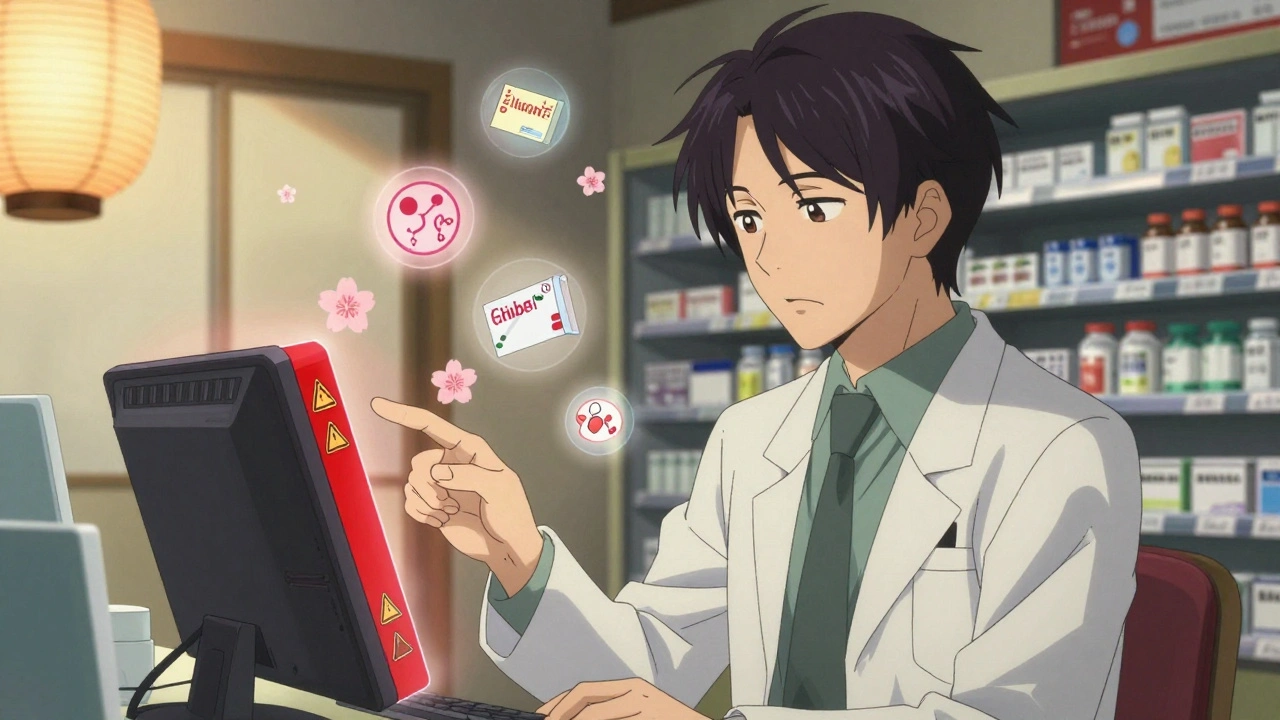
Every time a prescription leaves the doctor’s office, it enters a system full of potential mistakes. Illegible handwriting, similar-sounding drug names, wrong dosages, allergic reactions, dangerous drug combinations - these aren’t rare accidents. They happen every day. And the person standing between that error and a patient’s harm? The pharmacist.
Pharmacists aren’t just the people who hand out pills. They’re the final, critical checkpoint in the entire medication process. In the U.S. alone, pharmacists catch about 215,000 potentially harmful medication errors each year, according to the Agency for Healthcare Research and Quality. That’s more than 580 errors a day. Most patients never know these mistakes were almost made. That’s the point.
How Pharmacists Spot Errors Before They Happen
Pharmacists don’t rely on luck. They use a mix of training, technology, and strict protocols to catch mistakes. The process starts the moment a prescription hits the pharmacy system - whether it’s sent electronically from a doctor’s office or faxed in.
First, they run a drug utilization review (DUR). This isn’t just a quick glance. It’s a deep dive into the patient’s full medication history. The system checks for:
- Drug-drug interactions (like mixing blood thinners with certain antibiotics)
- Drug-allergy conflicts
- Dosage errors (too high, too low, wrong frequency)
- Red flags like duplicate therapy (two drugs doing the same job)
- Unnecessary prescriptions (like long-term opioids without clear benefit)
These checks are powered by software that flags 85-90% of potential issues. But here’s the key: the software doesn’t decide. The pharmacist does. That’s where expertise matters. A system might flag a common interaction between two drugs - but if the patient has been taking them together for years with no problem, the pharmacist knows to override it. Or if the alert is for a rare interaction that’s not clinically significant, they dismiss it. That judgment? That’s what machines can’t replicate.
The Power of Double Checks and Technology
In hospitals and large pharmacies, high-risk medications like insulin, heparin, or warfarin go through a double-check system. One pharmacy technician prepares the dose. A second pharmacist verifies it. This simple step cuts dispensing errors by 42%, according to ASHP guidelines.
Technology plays a huge role too. Barcode scanning at the dispensing counter reduces errors by 51%. Automated dispensing cabinets in hospitals prevent the wrong drug from being pulled. Electronic prescribing - which replaced handwritten orders - slashed errors from bad handwriting by 95%. But none of these tools work alone. They’re only as good as the person using them.
Take the case of a 72-year-old woman prescribed warfarin. The doctor meant 2.5 mg daily, but the system accidentally entered 25 mg. The software flagged it as a potential overdose - but only because the pharmacist noticed the discrepancy. Without that human review, the patient would have taken a dose ten times too high. That could have led to internal bleeding, hospitalization, or worse. She later left a review saying, “My pharmacist saved my life.”
Medication Reconciliation: Catching Errors During Transitions
One of the most dangerous moments for medication errors is when patients move between care settings - from hospital to home, or from ER to nursing home. At these handoffs, medications get lost, forgotten, or changed without proper review.
That’s where medication reconciliation comes in. Clinical pharmacists sit down with patients and their records to build a complete, accurate list of everything they’re taking - including over-the-counter drugs, supplements, and herbal products. They compare it to what’s being ordered in the new setting.
In one hospital study, pharmacists found an average of 2.3 medication discrepancies per patient during admission. That means nearly every patient had at least one error: a drug they were told to stop but still took, a dose that was wrong, or a missing medication. Pharmacists caught these before the patient got home - or worse, before they were discharged.
Why Pharmacists Outperform Technology Alone
Many hospitals and clinics think buying fancy software is enough to prevent errors. But data shows otherwise. Computerized order entry (CPOE) systems alone reduce errors by 17-25%. Add a pharmacist into the mix, and that jumps to 45-65%.
Why? Because software can’t understand context. It doesn’t know that a patient is frail, has kidney problems, or is taking a supplement that interacts with their blood pressure med. It doesn’t know if the patient just got out of the hospital last week and is confused about their new pills. Pharmacists do.
A 2021 meta-analysis in the Journal of the American Medical Informatics Association showed that pharmacist-led interventions reduce medication errors by 37% across all healthcare settings. That’s not a small number. That’s life-saving.
The Hidden Work: Communication and Documentation
Most of a pharmacist’s error-prevention work happens off the counter. They spend an average of 2.7 hours per week calling doctors to clarify prescriptions, correcting dosing errors, or explaining why a drug shouldn’t be used. They don’t just say, “This looks wrong.” They say, “Dr. Lee, I noticed you prescribed metformin 1000 mg twice daily, but the patient’s creatinine clearance is 38 mL/min. That’s above the recommended max. Can we reduce it to 500 mg twice daily?”
They also document everything. In hospitals, error reporting systems score 4.2 out of 5 for completeness. In community pharmacies? Only 2.8. That’s a problem. If an error isn’t documented, it can’t be tracked. And if it can’t be tracked, it won’t be fixed.
Where the System Still Fails
Pharmacists aren’t superheroes. They’re overworked. In some community pharmacies, a single pharmacist might handle 300-400 prescriptions in a single shift. That’s one prescription every 90 seconds - including time for counseling, answering calls, and filling insurance issues.
That pressure leads to alert fatigue. Clinical decision support systems throw up so many warnings - many of them low-risk - that pharmacists start ignoring them. One study found pharmacists override nearly half of all drug interaction alerts because they feel overwhelmed. The fix? Tiered alerts. High-risk interactions (like warfarin and certain antibiotics) get loud, urgent flags. Low-risk ones fade into the background.
And in low-income areas or rural clinics, the problem is worse. Some places have one pharmacist for every 500 patients. That’s not enough. Studies show error reduction drops to just 15% in those settings.
Real Impact: Numbers That Matter
Every error a pharmacist catches saves money - and lives.
- Each prevented error saves an average of $13,847 in healthcare costs (American Journal of Health-System Pharmacy, 2021).
- Pharmacist interventions prevent $2.7 billion in annual U.S. healthcare costs from medication errors (American Pharmacists Association, 2023).
- Patients who get pharmacist-led medication reviews are 28% more likely to be on the right drug at the right dose (NIH, 2023).
One study in Tehran’s infectious disease ward found pharmacists caught 112 errors among 861 patients. Nearly half came from doctors. Nearly half from nurses. Only 2.7% from patients. The system failed at multiple points - but the pharmacist caught them all.
What’s Next for Pharmacists in Safety?
Pharmacists are no longer just dispensers. They’re becoming active members of care teams. In 27 U.S. states, pharmacists can now adjust medications under collaborative practice agreements - meaning they can change doses, add or stop drugs, and order labs without waiting for a doctor’s approval.
New AI tools are emerging too. These systems analyze prescriptions and flag the highest-risk ones for pharmacist review, cutting down their workload by 35% while keeping error detection at 98% accuracy.
By 2026, the number of dedicated medication safety pharmacists is expected to grow by 22%. The goal? Prevent 4.3 million medication errors annually by 2027.
But that growth depends on one thing: hiring more pharmacists. The U.S. could face a shortage of 15,000 pharmacists by 2025. Without enough people, even the best systems will fail.
What Patients Can Do
You don’t have to wait for your pharmacist to catch an error. You can help:
- Keep a written list of every medication you take - including vitamins and herbs.
- Ask: “What is this for? What side effects should I watch for?”
- Bring that list to every doctor’s visit and hospital admission.
- If your pharmacist asks you a question about your meds - answer it. They’re not being nosy. They’re protecting you.
Pharmacists are the last line of defense. But they’re not alone. They’re part of a team - and so are you.
How often do pharmacists catch prescription errors?
In the U.S., pharmacists prevent an estimated 215,000 medication errors each year. That’s about 580 errors a day. Most of these are caught before the patient even leaves the pharmacy. In hospitals, pharmacists identify an average of 2.3 medication discrepancies per patient during transitions of care.
Can technology replace pharmacists in catching errors?
No. While electronic systems and AI can flag potential issues, they can’t understand patient context. A computer might not know that a patient has kidney disease, takes herbal supplements, or is confused about their meds. Pharmacists use clinical judgment to decide which alerts matter and which don’t. Studies show that adding a pharmacist to automated systems increases error detection from 17-25% to 45-65%.
What types of errors do pharmacists catch most often?
The most common errors include wrong dosage (especially with high-risk drugs like insulin or warfarin), drug-drug interactions (like mixing blood thinners with NSAIDs), allergic reactions, duplicate therapy (two drugs with the same effect), and prescriptions for patients who no longer need them. Pharmacists also catch errors from poor handwriting, confusing drug names (like hydralazine vs. hydroxyzine), and transcription mistakes.
Do community pharmacists catch as many errors as hospital pharmacists?
Yes - but with different challenges. Hospital pharmacists often have more time and access to full medical records, so they catch complex issues like medication reconciliation errors. Community pharmacists catch more dispensing errors - like the wrong pill, wrong dose, or wrong label. They also prevent errors from patients picking up the wrong prescription. In community settings, pharmacist-led interventions reduce dispensing errors by up to 63% when paired with pharmacy technician double-checks.
What can I do to help my pharmacist catch errors?
Keep a written list of all your medications - including over-the-counter drugs, vitamins, and supplements. Bring it to every appointment. Ask your pharmacist: “What is this for?” and “Are there any interactions with my other meds?” If they ask you questions, answer them honestly. Your input helps them make better decisions. Never assume your pharmacist knows everything about your health - they need your help too.


Emily Haworth
December 13, 2025 AT 21:57Tom Zerkoff
December 14, 2025 AT 01:50Yatendra S
December 15, 2025 AT 14:31Himmat Singh
December 16, 2025 AT 04:14kevin moranga
December 16, 2025 AT 15:24Alvin Montanez
December 17, 2025 AT 01:16